Matematika Ekonomi - Derivatif (Turunan)
Summary
TLDRThis video provides a comprehensive introduction to derivatives in the context of economics, explaining how changes in one variable affect another. It covers the concept of gradients, the formal definition of a derivative, and practical methods for calculating derivatives using the power rule, as well as rules for constants, linear functions, sums, products, quotients, and chain functions. The video also explores higher-order derivatives, illustrating their application through step-by-step examples. With clear explanations and multiple worked examples, viewers gain a solid understanding of how derivatives measure change and how they can be applied to analyze costs, demand, and profit in economic models.
Takeaways
- 📈 Derivatives measure how one variable changes in response to changes in another variable, which is crucial in economics.
- 🟢 The slope or gradient of a straight line is constant, while the slope of a curve varies at different points.
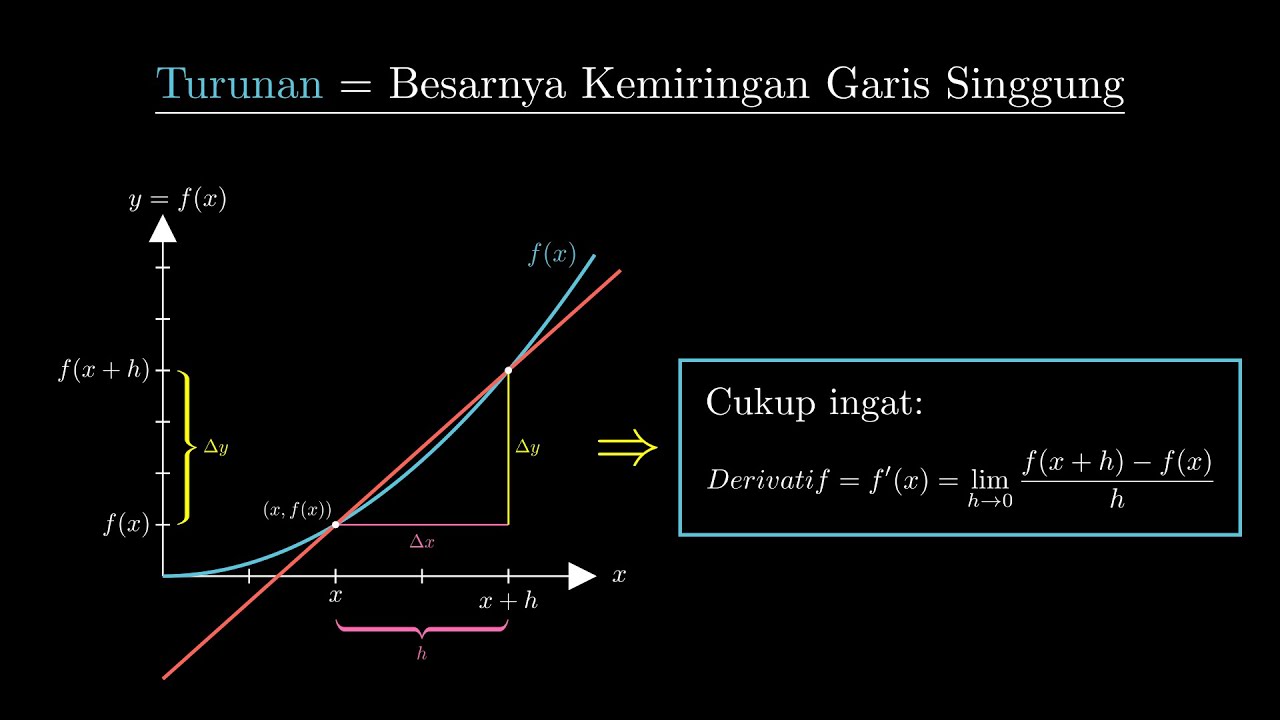
- 🔍 The derivative of a function at a point is defined as the limit of the slope of a secant line as the interval approaches zero.
- ✏️ Basic derivative notation includes f'(x), dy/dx, or D[f(x)].
- 🧮 The derivative of a power function x^n is n * x^(n-1), while the derivative of a constant is 0.
- ➕ The derivative of a sum or difference of functions is the sum or difference of their individual derivatives.
- ✖️ The derivative of a product of two functions follows the product rule: (u*v)' = u*v' + u'*v.
- ➗ The derivative of a quotient of two functions follows the quotient rule: (u/v)' = (v*u' - u*v') / v^2.
- 🔗 The chain rule is used to differentiate composite functions: dy/dx = (dy/du) * (du/dx).
- 📊 Higher-order derivatives represent the rate of change of previous derivatives, with second, third, fourth derivatives, and so on.
- ⚡ Derivatives provide a mathematical tool to analyze and predict changes in cost, demand, profit, and other economic variables.
- 📝 Practical examples in the video illustrate how to apply derivative rules to polynomial, fractional, and composite functions.
Q & A
What is the main purpose of derivatives in economics as explained in the video?
-Derivatives help determine how much one variable changes in response to a change in another variable, such as changes in cost due to production, demand due to price, or profit due to output.
How is the slope of a straight line different from the slope of a curve?
-The slope of a straight line is constant along its entire length, while the slope of a curve varies at different points, requiring the use of derivatives to measure it accurately.
What is the formal definition of a derivative according to the video?
-The derivative of a function f(x) at a point x is defined as the limit of the difference quotient as h approaches 0: f'(x) = lim(h→0) [(f(x+h) - f(x)) / h].
Using the example f(x) = 5x² + 3, what is the derivative and how is it calculated?
-The derivative is f'(x) = 10x. It is calculated by applying the definition of the derivative: expand (x+h)², subtract f(x), divide by h, and take the limit as h approaches 0.
What is the general formula for the derivative of x^n?
-The derivative of x^n is n * x^(n-1). This comes from expanding (x+h)^n, subtracting x^n, dividing by h, and taking the limit as h approaches 0.
What are the rules for the derivative of a constant, linear function, and a power function?
-Constant: derivative is 0; Linear function y = a + bx: derivative is b; Power function y = ax^n: derivative is n * a * x^(n-1).
How are the derivatives of sums, differences, products, and quotients of functions calculated?
-Sum/Difference: derivative is the sum/difference of the derivatives; Product: (uv)' = u*v' + u'*v; Quotient: (u/v)' = (v*u' - u*v') / v^2.
What is the chain rule and how is it applied in the example y = 4u^3 where u = 3x² + 5?
-The chain rule states that the derivative of a composite function is the derivative of the outer function with respect to the inner function multiplied by the derivative of the inner function. For y = 4u^3, dy/dx = 12u^2 * 6x = 72x*(3x²+5)^2.
What are higher-order derivatives and how are they represented?
-Higher-order derivatives are derivatives of derivatives. The first derivative shows the rate of change of the function, the second shows the rate of change of the first derivative, the third of the second, etc. Notations include y', y'', y''', y'''' and so on.
In the example y = x^4 + 3x^3 - 5x^2 + 7x - 9, what are the first four derivatives?
-First derivative: y' = 4x^3 + 9x^2 - 10x + 7; Second derivative: y'' = 12x^2 + 18x - 10; Third derivative: y''' = 24x + 18; Fourth derivative: y'''' = 24.
Why is using the limit approach (h → 0) important for finding the derivative of a curve?
-Using h → 0 ensures that the derivative accurately represents the slope at a single point on a curve rather than an average slope over a finite interval, minimizing errors caused by the curvature.
Outlines

このセクションは有料ユーザー限定です。 アクセスするには、アップグレードをお願いします。
今すぐアップグレードMindmap

このセクションは有料ユーザー限定です。 アクセスするには、アップグレードをお願いします。
今すぐアップグレードKeywords

このセクションは有料ユーザー限定です。 アクセスするには、アップグレードをお願いします。
今すぐアップグレードHighlights

このセクションは有料ユーザー限定です。 アクセスするには、アップグレードをお願いします。
今すぐアップグレードTranscripts

このセクションは有料ユーザー限定です。 アクセスするには、アップグレードをお願いします。
今すぐアップグレード関連動画をさらに表示



5.0 / 5 (0 votes)

