Metode Seleksi Pedigree, Bulk, SDD, dan Back Cross - Pemuliaan Tanaman | Ratna Zulfarosda Channel
Summary
TLDRThis video explains advanced plant breeding methods for self-pollinating crops, focusing on pedigree, bulk, single seed descent (SSD), and backcross techniques. It details how pedigree selection tracks individual plant traits across generations, bulk selection delays evaluation for efficiency, SSD minimizes land use by advancing single seeds per plant, and backcrossing improves specific traits from a parent. Each method is described step-by-step, highlighting their advantages, limitations, and optimal applications based on heritability and breeding goals. The video emphasizes meticulous record-keeping, strategic selection across generations, and proper testing to develop superior, high-yielding, and adaptable crop varieties.
Takeaways
- 😀 Pedigree selection is a method used for self-pollinating plants resulting from hybridization, aiming to combine traits from two or more parents.
- 😀 This method involves detailed record-keeping of each population, such as the generation (F1, F2, etc.) and characteristics like pod shape, color, and plant identification.
- 😀 High heritability is essential for pedigree selection, meaning the traits should be stable and passed down consistently across generations.
- 😀 Selection occurs in multiple steps: selecting the best family, the best row within that family, and the best individual plant within that row.
- 😀 Pedigree selection can start as early as F2 generation, whereas other methods like pure line selection typically require later generations (F5, F6, or beyond).
- 😀 During pedigree selection, plant populations are grown in rows and evaluated for uniformity, choosing the most uniform families for further propagation.
- 😀 In F4 and F5 generations, plant populations are selected for higher homogeneity, with further testing of yield potential in F6 and F7.
- 😀 Once F8 and F10 generations are reached, multi-location trials are conducted to evaluate the new varieties' performance in different environments.
- 😀 The backcross method is used for improving traits controlled by a single gene, often by crossing a hybrid offspring back with one of its original parents to increase the desirable traits.
- 😀 While the pedigree method requires detailed records and careful tracking of each generation, methods like bulk and single-seed descent are simpler and more cost-effective, though with potential risks of losing superior plants early on.
- 😀 The backcross method can involve several cycles of crossing (up to 4 or more) to bring the offspring closer to the desired parent traits, especially in traits like disease resistance.
Q & A
What is the main focus of the video transcript?
-The main focus is on various methods of plant selection for self-pollinating crops, including pedigree, book, single seed descent (SSD), and backcross methods.
Why is the pedigree selection method named as such?
-It is called pedigree selection because it involves detailed recording of the lineage and characteristics of each plant in segregating populations through generations.
At which generation can pedigree selection begin, and why is this significant?
-Pedigree selection can begin at the F2 generation. This is significant because it allows early identification and selection of superior plants with high heritability traits, speeding up the breeding process.
What are the advantages and disadvantages of the pedigree selection method?
-Advantages include precise tracking of superior plants and efficient use of land by continuing only with selected individuals. Disadvantages include complex record-keeping and the potential loss of promising lines during early selection.
How does the book method differ from the pedigree method in terms of selection timing?
-In the book method, early generations (F1–F4) are planted in bulk without selection. Selection is delayed until later generations (F5–F6), unlike pedigree selection, where selection occurs from F2 onward.
What is the primary benefit of the Single Seed Descent (SSD) method?
-The primary benefit of SSD is efficiency in land and labor usage, as only one seed per plant is taken for subsequent generations, allowing multiple generations to be grown within a year with minimal space and effort.
What is a major limitation of the SSD method?
-A major limitation is that traits with low heritability may not be efficiently selected, and superior plants in early generations may be lost if selection is not precise.
Describe the backcross method and its primary purpose.
-The backcross method involves crossing a hybrid with one of its parent lines repeatedly to incorporate or enhance a specific trait from the donor parent while maintaining most of the recipient parent's genetic background. Its primary purpose is to improve a single trait controlled by a major gene.
What challenges are associated with the backcross method?
-Challenges include the need for multiple backcross generations to recover the recipient parent's characteristics and issues with linked genes, which may complicate trait transfer.
Why is heritability an important factor in plant selection methods?
-Heritability determines the likelihood that a trait will be passed from parent to offspring. High heritability traits can be effectively selected in early generations, while low heritability traits require delayed or bulk selection strategies.
How are families (groups of plants from a single selected parent) used in pedigree selection?
-Families are used to identify and compare uniformity and superior performance within segregating populations. Selection is made among families and within families to advance the best plants to the next generation.
What role does multi-location testing play in these selection methods?
-Multi-location testing, usually performed from F8 onward, evaluates the performance and stability of selected lines across different environments and seasons before releasing a new variety.
Outlines

このセクションは有料ユーザー限定です。 アクセスするには、アップグレードをお願いします。
今すぐアップグレードMindmap

このセクションは有料ユーザー限定です。 アクセスするには、アップグレードをお願いします。
今すぐアップグレードKeywords

このセクションは有料ユーザー限定です。 アクセスするには、アップグレードをお願いします。
今すぐアップグレードHighlights

このセクションは有料ユーザー限定です。 アクセスするには、アップグレードをお願いします。
今すぐアップグレードTranscripts

このセクションは有料ユーザー限定です。 アクセスするには、アップグレードをお願いします。
今すぐアップグレード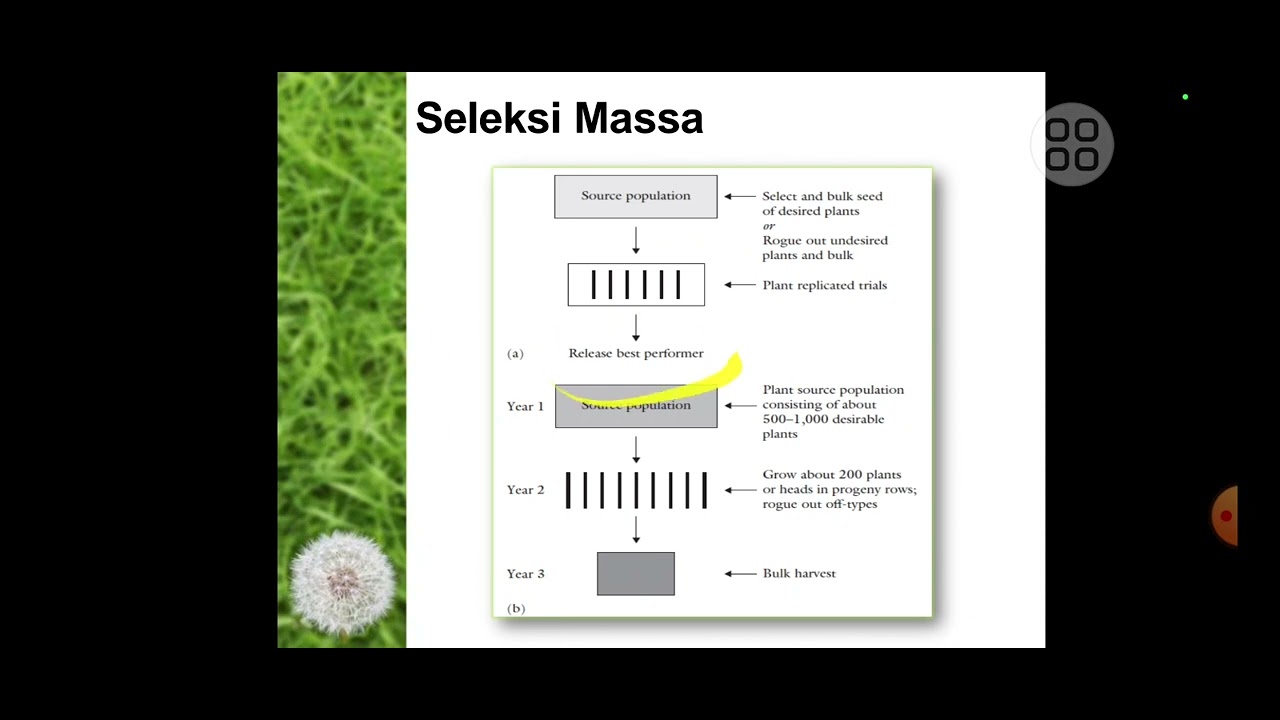




5.0 / 5 (0 votes)

