MATERI UTBK SNBT PENGETAHUAN KUANTITATIF - TEOREMA PHYTAGORAS
Summary
TLDRIn this engaging tutorial, Kak Yuni walks students through the fundamentals of the Pythagoras theorem, focusing on right-angled triangles. The video explains the basic formulas for calculating the hypotenuse and other sides, introduces common Pythagorean triples, and demonstrates step-by-step problem solving. Viewers are guided through examples involving missing sides, verification of triples, calculating perimeters of composite shapes, and determining areas of complex figures like hexagons using triangles and squares. The explanations are visual and methodical, ensuring that students grasp both the theory and practical applications, making it a comprehensive review for UTBK preparation.
Takeaways
- 😀 The video focuses on explaining the Pythagorean theorem, which applies to right-angled triangles.
- 😀 The main formula of the Pythagorean theorem is c² = a² + b², where c is the hypotenuse and a and b are the other sides.
- 😀 To find a missing side, you can rearrange the formula: a² = c² - b² or b² = c² - a².
- 😀 Common Pythagorean triples include 3-4-5, 5-12-13, 6-8-10, and 7-24-25, which are helpful for quick calculations.
- 😀 When only one side of a triangle is known, it is insufficient to determine other unknown sides; additional information is required.
- 😀 Checking if a set of numbers forms a Pythagorean triple involves verifying if the square of the largest side equals the sum of the squares of the other two sides.
- 😀 For complex shapes made of multiple right triangles, break the figure into simpler shapes to calculate lengths or areas.
- 😀 To calculate the perimeter of a composite shape, sum the lengths of all its sides, including calculated or derived lengths.
- 😀 When finding the area of a polygon like a hexagon, divide it into triangles and squares, calculate each area, and sum them for the total area.
- 😀 Using the Pythagorean theorem in practical problems often involves substituting known values, simplifying squares and square roots, and sometimes applying multiples of Pythagorean triples for easier computation.
- 😀 The video emphasizes step-by-step problem-solving, careful checking of available information, and methodical application of the theorem to different geometric problems.
Q & A
What is the Pythagorean theorem and when is it applied?
-The Pythagorean theorem states that in a right-angled triangle, the square of the hypotenuse (c) is equal to the sum of the squares of the other two sides (a and b): c² = a² + b². It is applied specifically to right-angled triangles.
How can you find one side of a right-angled triangle if the hypotenuse and the other side are known?
-If the hypotenuse (c) and one side (b) are known, the other side (a) can be found using the formula: a² = c² - b², then take the square root of the result to get a.
What are Pythagorean triples and why are they useful?
-Pythagorean triples are sets of three positive integers (a, b, c) that satisfy the Pythagorean theorem. Common examples are (3, 4, 5), (5, 12, 13), (6, 8, 10), and (7, 24, 25). They are useful for quickly identifying right-angled triangles with integer sides.
Why is knowing only one side of a triangle sometimes insufficient to find another segment like BD?
-Knowing only one side is often insufficient because additional sides or angles are required to apply the Pythagorean theorem or other geometric relationships. Without enough information, the unknown segment cannot be determined.
How do you check if given sides form a right-angled triangle?
-You check by verifying if the square of the largest side equals the sum of the squares of the other two sides. If this condition holds, the sides form a right-angled triangle.
In the example where AB = 3 and AC = 7, how was CB calculated?
-CB was calculated using the Pythagorean theorem: CB = √(AC² - AB²) = √(49 - 9) = √40 = 2√10.
How is the perimeter of a composite figure containing triangles and rectangles calculated?
-The perimeter is calculated by summing the lengths of all outer sides of the figure. For segments that are not directly given, the Pythagorean theorem can be used to find missing lengths.
How can the area of a hexagonal figure composed of a square and two right triangles be determined?
-First, calculate the area of the square using side². Then calculate the area of each right triangle using 1/2 × base × height. Finally, sum all areas to get the total area.
What is the step-by-step method to find AB in a triangle where CD = 8, AD = 17, and the triangle is right-angled at C?
-Step 1: Find AC using AC = √(AD² - CD²) = √(289 - 64) = 15. Step 2: Find AB using AB = AC - BC = 15 - 8 = 7.
Why is it helpful to draw perpendicular lines in complex geometric figures?
-Drawing perpendicular lines can create right-angled triangles, which allow the use of the Pythagorean theorem to find unknown lengths and simplify calculations for areas or perimeters.
Outlines

このセクションは有料ユーザー限定です。 アクセスするには、アップグレードをお願いします。
今すぐアップグレードMindmap

このセクションは有料ユーザー限定です。 アクセスするには、アップグレードをお願いします。
今すぐアップグレードKeywords

このセクションは有料ユーザー限定です。 アクセスするには、アップグレードをお願いします。
今すぐアップグレードHighlights

このセクションは有料ユーザー限定です。 アクセスするには、アップグレードをお願いします。
今すぐアップグレードTranscripts

このセクションは有料ユーザー限定です。 アクセスするには、アップグレードをお願いします。
今すぐアップグレード関連動画をさらに表示
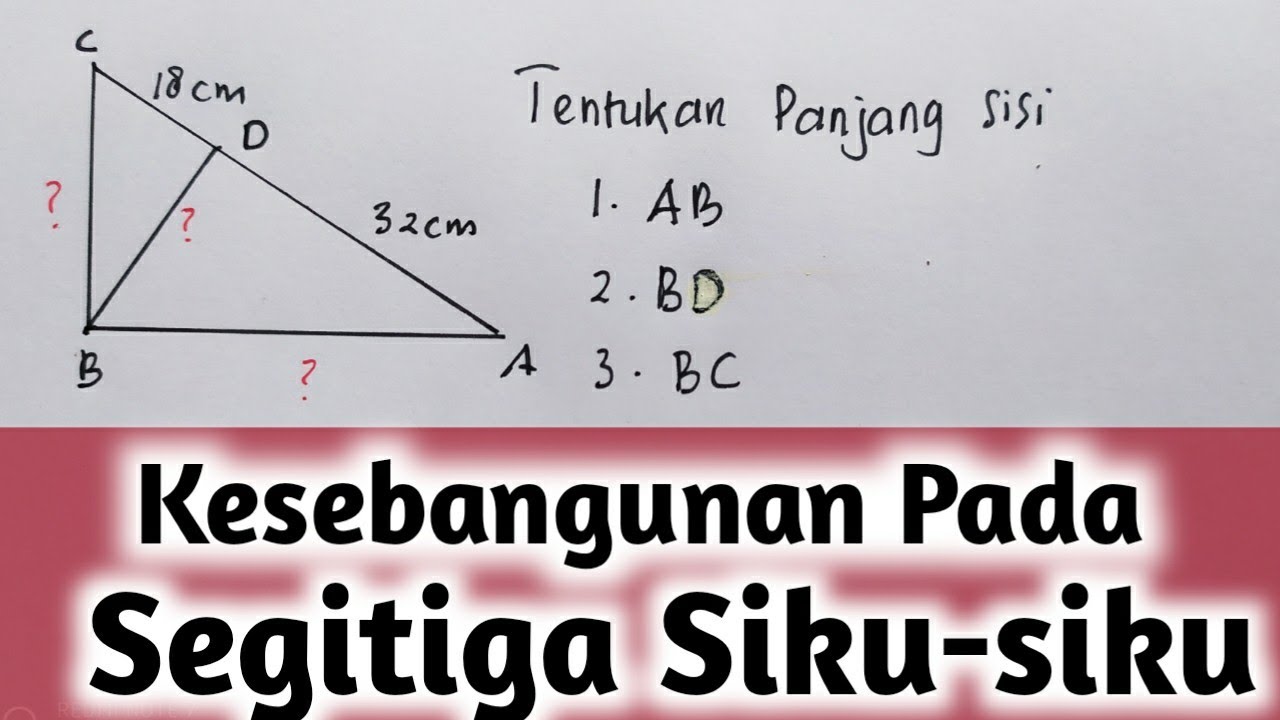
Matematika Kelas 9 | Kesebangunan pada Segitiga Siku-siku
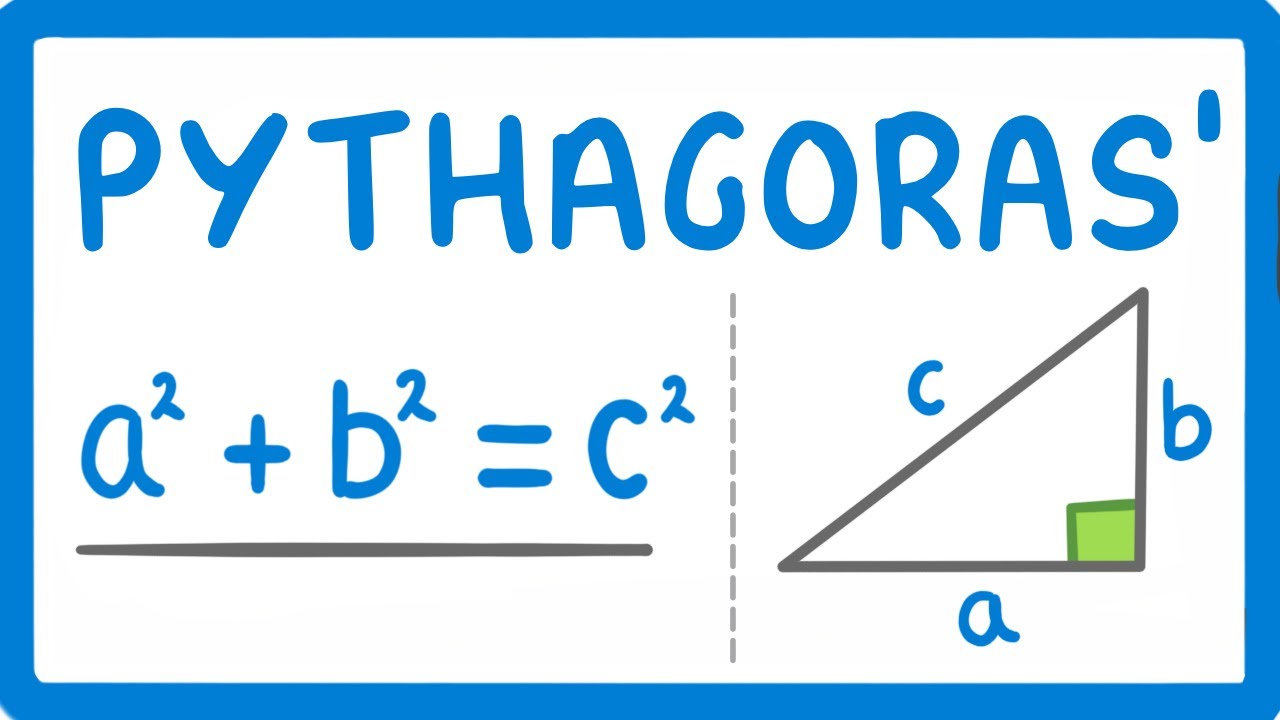
GCSE Maths - Pythagoras' Theorem And How To Use It #120
Triunghiul dreptunghic, teorema 30 60 90, teorema medianei, teorema lui Pitagora si reciproca, arie
teorema pythagoras kelas 8 "bagian 4" (mudah): menentukan perbandingan sisi-sisi segitiga siku-siku

Class 10 Maths | Chapter 6 | Introduction | Triangles | NCERT
Mr Barton's Autograph Video 68 - Trig and Pythag - Part 1
5.0 / 5 (0 votes)

