AP Statistics - Section 5.1, Introduction (pages 1 and 2)
Summary
TLDRThis video script delves into the fascinating world of probability, covering fundamental concepts such as randomness, events, and sample spaces. It explores real-world examples like lottery odds, dice rolls, and coin flips, illustrating common misconceptions like the gambler's fallacy. The script also touches on the famous birthday problem, the pigeonhole principle, and the principle of indifference. Through relatable scenarios, it emphasizes how probability plays a crucial role in predicting and understanding chance events, offering a blend of theory and practical application for a deeper grasp of statistical reasoning.
Takeaways
- 😀 Probability helps us determine the likelihood of events, which can be expressed as a fraction, decimal, or percentage (0% to 100%).
- 😀 In probability experiments, a 'sample space' represents the list of all possible outcomes.
- 😀 The lottery is a great example of probability, where every possible combination of six numbers has an equal chance of being selected.
- 😀 Edgar Allan Poe's idea that rolling five twos in a row changes the probability of getting a two on the next roll is incorrect—dice rolls are independent of each other, a concept known as the 'memoryless property.'
- 😀 Just because there are two possible outcomes (like making or missing a free throw) doesn't mean they are equally likely—probabilities are based on real statistics (e.g., a 70% chance for a free throw shooter).
- 😀 The principle of indifference assumes equal probability for different outcomes, but this doesn't always hold true (e.g., the probability of snow tomorrow isn't necessarily 50-50).
- 😀 The likelihood of winning an instant lottery ticket doesn’t change based on previous results—each ticket has its own independent chance of winning.
- 😀 When considering a lottery with a 1 in 10 chance of winning, buying 10 tickets doesn't guarantee a win. Probability in small samples doesn’t ensure the expected outcome.
- 😀 The 'birthday problem' demonstrates that with just 23 people, there's a greater than 50% chance that at least two people will share the same birthday.
- 😀 In probability, sometimes seemingly random events (like the gender of a baby) have a 50-50 chance, though there can be slight biases in real-world statistics.
- 😀 The 'pigeonhole principle' shows that if there are more 'pigeons' (people) than 'holes' (birthday dates), at least one birthday must be shared by two people.
Q & A
What is the main focus of Chapter 5?
-Chapter 5 is focused on probability, specifically the concepts of randomness, probability, and simulation. It begins with basic ideas about probability before introducing more formal definitions.
What is a sample space in probability experiments?
-A sample space is the list of all possible outcomes in a probability experiment. For example, when rolling dice, the sample space would include all the different possible combinations of dice rolls.
In the lottery example, why is every combination of six numbers equally likely?
-In a true lottery, every combination of six numbers from 1 to 40 has the same probability of being drawn. This highlights the very low probability of winning, as any specific combination is just as likely as any other.
Why is Edgar Allen Poe's argument about the probability of rolling five twos in a row incorrect?
-Poe’s argument is incorrect because each roll of the dice is independent. The probability of rolling a two on the next roll is still one-sixth, regardless of previous rolls. This is an example of the gambler's fallacy.
What does the principle of indifference state?
-The principle of indifference suggests that if we have no reason to favor one outcome over another, we assign equal probabilities to all outcomes. However, it can be misapplied, such as in situations where outcomes are not equally likely.
Why is the chance of winning the lottery not guaranteed even if you buy 10 tickets with a one-in-ten chance?
-Even though the probability of winning on each ticket is one in ten, buying 10 tickets does not guarantee a win. You could still end up with no winning tickets, as probabilities do not guarantee outcomes in small samples.
What is the minimum number of people needed to guarantee that two people have the same birthday, according to the birthday problem?
-To guarantee that at least two people share the same birthday, you need 367 people in the room. This is based on the pigeonhole principle, where you have more people than available birthdays, forcing at least one match.
What is the likelihood of getting tails at least twice in three flips of a fair coin?
-The probability of getting tails at least twice in three flips of a fair coin is greater than the probability of getting tails 200 out of 300 times. The smaller sample size of three flips leads to higher variability in outcomes.
When Ethan draws a white marble from a box with two white and two blue marbles, what is the probability of drawing a blue marble next?
-After drawing a white marble without replacement, the probability of drawing a blue marble next is two-thirds, as there are now two blue marbles and only one white marble left in the box.
What does the principle of indifference explain about roulette wheel probabilities?
-In a roulette game, the ball has an equal chance of landing in any of the 38 slots, which include 18 red, 18 black, and 2 green slots. This makes the probability of landing in any specific slot equally likely, as per the principle of indifference.
Outlines

このセクションは有料ユーザー限定です。 アクセスするには、アップグレードをお願いします。
今すぐアップグレードMindmap

このセクションは有料ユーザー限定です。 アクセスするには、アップグレードをお願いします。
今すぐアップグレードKeywords

このセクションは有料ユーザー限定です。 アクセスするには、アップグレードをお願いします。
今すぐアップグレードHighlights

このセクションは有料ユーザー限定です。 アクセスするには、アップグレードをお願いします。
今すぐアップグレードTranscripts

このセクションは有料ユーザー限定です。 アクセスするには、アップグレードをお願いします。
今すぐアップグレード関連動画をさらに表示
BELAJAR DARI RUMAH (MATEMATIKA MATERI PELUANG KELAS 8, LENGKAP CONTOH SOAL DAN PEMBAHASAN)
peluang koin dan dadu
STATISTIKA | KONSEP DASAR PROBABILITAS
Peluang, Peluang kejadian, frekuensi harapan, peluang komplemen
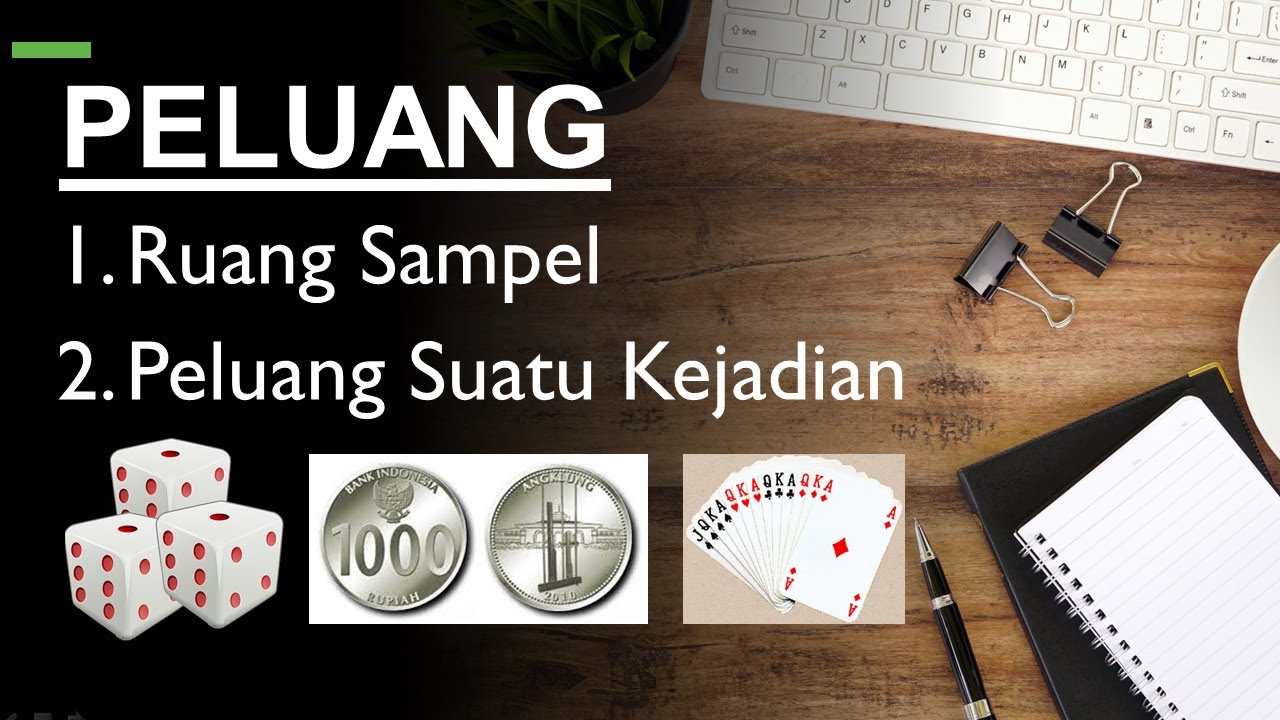
Ruang Sampel dan Peluang Suatu Kejadian (Materi dan Contoh Soal diserta Pembahasan)

Probability, Sample Spaces, and the Complement Rule (6.1)
5.0 / 5 (0 votes)

