Edible/Vegetable/Cooking Oil Deodorization Process
Summary
TLDRThe DVC Deodorization process is a key step in vegetable oil refining, designed to remove unwanted odoriferous volatile impurities at elevated temperatures and low pressure. Using live steam and a vacuum system, the process efficiently deodorizes oil, recovers heat, and ensures product quality through stages of deaeration, heat recovery, and final deodorization. The oil is polished and cooled, with impurities scrubbed and condensed in a vacuum system. Advanced scrubbing separates valuable components like tocopherols, enriching the oil’s quality and yielding a high-quality, refined product.
Takeaways
- 😀 The deodorization process is the final step in vegetable oil refining, designed to remove odoriferous and unwanted volatile impurities.
- 😀 The process operates at high temperatures (240°C) and low vacuum (1.5 mm Hg) to effectively purify the oil.
- 😀 Live steam is used as a carrier to strip volatile impurities from the oil during deodorization.
- 😀 The process begins with deaeration in Tank T-801, which removes dissolved air and prevents double conveying of oil.
- 😀 Heat recovery systems, such as V80 and heat exchangers, recover up to 85% of the heat energy from the outgoing deodorized oil.
- 😀 The feed oil is preheated from 100°C to 200°C, and then further heated under vacuum to 250°C for effective deodorization.
- 😀 Deodorization equipment includes a stripper (D802.1) and deodorization column (D802.2), where volatile impurities are removed through live steam and countercurrent flow.
- 😀 The deodorization process involves structured packing in the stripper to ensure the oil is retained long enough to remove residual impurities.
- 😀 Polishing filters (PF803, PF804) are used to trap foreign impurities, ensuring high-quality oil production.
- 😀 The vacuum scrubber (D802) condenses non-condensable impurities and ensures minimal loss of valuable compounds like tocopherols and tocotrienols during scrubbing.
Q & A
What is the main purpose of the deodorization process in vegetable oil refining?
-The main purpose of the deodorization process is to remove volatile, odoriferous, and unwanted impurities from vegetable oils and fats, ensuring a high-quality, refined oil product.
At what temperature and pressure does the deodorization process operate?
-The deodorization process operates at an elevated temperature of 240°C and a low absolute pressure of 1.5 mm of Hg (vacuum system).
How does the deodorization process utilize live steam?
-Live steam is used as a carrier to separate out impurities from the oil during the deodorization process, aiding in the removal of odoriferous compounds.
What role does the deaeration tank (T-801) play in the deodorization process?
-The deaeration tank (T-801) acts as a buffer for incoming bleached oil and a deaerator to remove dissolved air. This helps avoid double conveying of the oil during the process.
How is heat recovery implemented in the deodorization process?
-Heat recovery is achieved using a vacuum system, where heat is transferred from outgoing deodorized oil to incoming feed oil, allowing 85% of the heat energy to be recovered, ensuring energy efficiency.
What is the function of the final heater (FEV-803) in the deodorization process?
-The final heater (FEV-803) is used to set the desired process temperature by heating the oil to the required elevated temperature before it enters the deodorization column.
How does the deodorization column (D-802.1) strip volatile impurities from the oil?
-The deodorization column (D-802.1) uses countercurrent live steam to strip volatile impurities from the oil. The oil is retained briefly in the column to ensure effective stripping of any residual impurities.
What are the different types of heat exchangers used in the process?
-There are shell-and-tube heat exchangers (E802 and E805) used for cooling the oil and plate-type heat exchangers (E1) used for heating incoming feedstock during the refining process.
What is the purpose of the vacuum scrubber in the deodorization process?
-The vacuum scrubber is used to capture and condense volatile, unwanted impurities from the deodorization process. It ensures that non-condensable impurities are removed, while preventing vapor escape.
How does the scrubbing process enhance the quality of the oil?
-The scrubbing process helps separate low and high boiling components. High-boiling fractions like tocopherols and tocotrienols are enriched, contributing to a higher-quality refined oil with a yield up to 95%.
Outlines

このセクションは有料ユーザー限定です。 アクセスするには、アップグレードをお願いします。
今すぐアップグレードMindmap

このセクションは有料ユーザー限定です。 アクセスするには、アップグレードをお願いします。
今すぐアップグレードKeywords

このセクションは有料ユーザー限定です。 アクセスするには、アップグレードをお願いします。
今すぐアップグレードHighlights

このセクションは有料ユーザー限定です。 アクセスするには、アップグレードをお願いします。
今すぐアップグレードTranscripts

このセクションは有料ユーザー限定です。 アクセスするには、アップグレードをお願いします。
今すぐアップグレード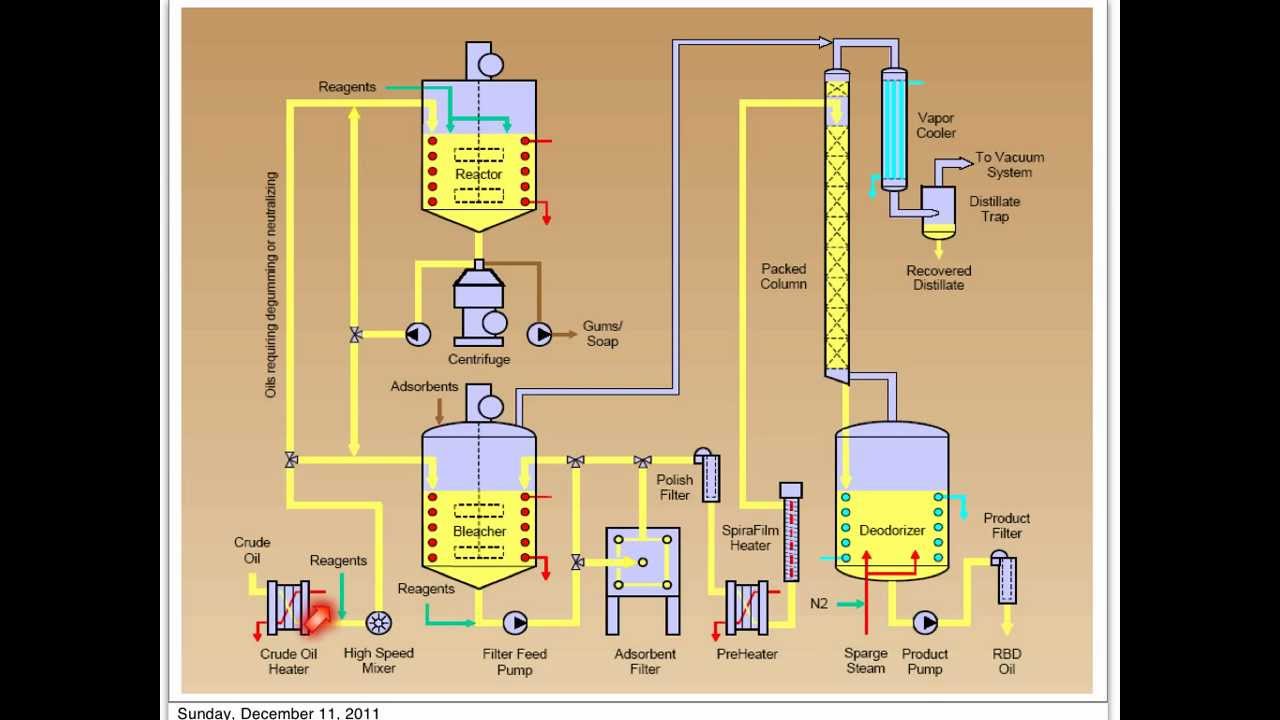


5.0 / 5 (0 votes)

