¿QUÉ es EL DIAMANTE de PORTER? ▶ Tutorial ✅
Summary
TLDRIn this video, Marco Ríos, a university professor, explains Michael Porter's Diamond Theory of Competitive Advantage, which explores why certain nations and industries succeed globally. Porter identifies four key factors: demand conditions, factor conditions, related and supporting industries, and company strategy, structure, and rivalry. These elements contribute to a nation's ability to develop competitive advantages. The theory highlights how competition among companies fosters innovation and drives industries to improve. Marco breaks down each factor in detail, emphasizing its role in enhancing national competitiveness and business success.
Takeaways
- 😀 Michael Porter is considered a key figure in modern management and international business theories.
- 😀 The Diamond Theory explains why certain nations and industries are more competitive globally than others.
- 😀 The theory is based on four key factors that determine a nation's competitive advantage in industries.
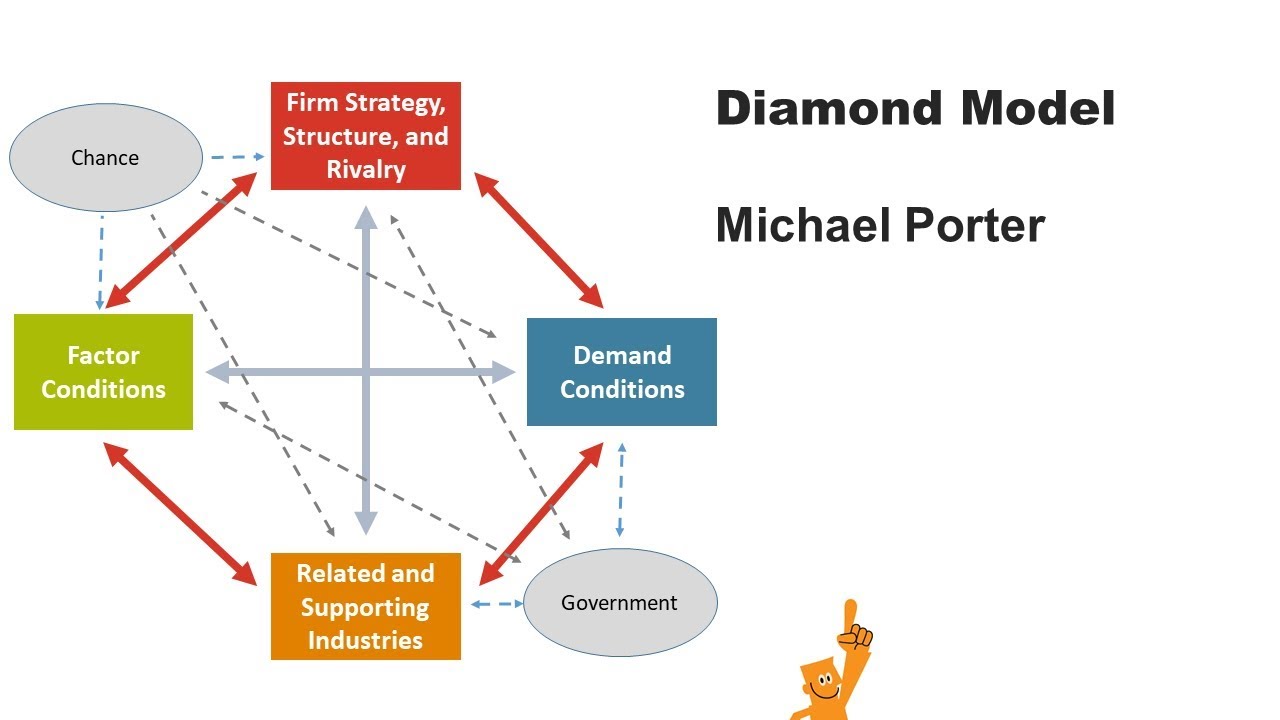
- 😀 The four factors are: demand conditions, factor conditions, related and supporting industries, and firm strategy/structure/rivalry.
- 😀 Demand conditions refer to the presence of demanding consumers who push industries to innovate and improve.
- 😀 Factor conditions highlight the importance of having skilled labor, capital, technology, and infrastructure to foster industry growth.
- 😀 Related and supporting industries are crucial, as they supply necessary inputs, promoting competitiveness.
- 😀 Firm strategy, structure, and rivalry within a country’s industries create a competitive environment that drives innovation and efficiency.
- 😀 Competition is not seen as negative; instead, it promotes higher productivity and better products or services.
- 😀 The theory helps explain the specialization of countries in certain industries based on available factors of production.
- 😀 Porter’s theories, including the Diamond Theory, are widely used by both companies and academic institutions today.
Q & A
Who developed the Diamond Model and why is he significant?
-The Diamond Model was developed by Michael Porter, a scholar considered by many as the father of contemporary management. He is significant for creating influential business theories, including the value chain, the five forces analysis, and generic competitive strategies.
What is the main purpose of the Diamond Model?
-The Diamond Model explains why certain nations and their industries achieve competitive advantage over others in international trade, identifying the factors that make industries within these nations more successful.
What are the four attributes that determine a nation's pattern of trade according to Porter?
-The four attributes are: conditions of demand, conditions of factors, related and supporting industries, and the strategy, structure, and rivalry of firms.
What is meant by 'conditions of demand' in Porter's model?
-'Conditions of demand' refer to the presence of an active and demanding local market for the products or services produced by an industry. Such demand pushes companies to innovate and improve competitiveness.
What are 'conditions of factors' and why are they important?
-'Conditions of factors' refer to the production resources available in a country, such as skilled labor, capital, technology, and infrastructure. They are crucial because a lack of these factors limits the development of competitive advantages.
What role do related and supporting industries play in the Diamond Model?
-Related and supporting industries provide essential components, parts, or services to the main industry. Their presence facilitates efficiency, innovation, and overall competitiveness within the domestic market.
How does rivalry among companies influence competitiveness according to Porter?
-Rivalry drives companies to improve continuously. Competition pushes firms to innovate, enhance productivity, improve products and services, and ultimately benefits consumers by raising quality and efficiency.
Why is the structure and strategy of companies included in the Diamond Model?
-The structure and strategy of companies influence how efficiently resources are used, how decisions are made, and how businesses respond to competition, all of which contribute to national and industry-level competitive advantages.
Why does Porter consider the Diamond Model a contemporary theory in international trade?
-The Diamond Model is contemporary because it reflects modern economic conditions, emphasizing innovation, quality, and competition as critical elements for national and industrial competitiveness in today’s global market.
How can understanding the Diamond Model benefit businesses or students?
-Understanding the Diamond Model helps businesses identify the factors that can enhance their competitiveness and guides students or professionals in analyzing why certain countries and industries succeed, aiding strategic and academic decision-making.
Outlines

このセクションは有料ユーザー限定です。 アクセスするには、アップグレードをお願いします。
今すぐアップグレードMindmap

このセクションは有料ユーザー限定です。 アクセスするには、アップグレードをお願いします。
今すぐアップグレードKeywords

このセクションは有料ユーザー限定です。 アクセスするには、アップグレードをお願いします。
今すぐアップグレードHighlights

このセクションは有料ユーザー限定です。 アクセスするには、アップグレードをお願いします。
今すぐアップグレードTranscripts

このセクションは有料ユーザー限定です。 アクセスするには、アップグレードをお願いします。
今すぐアップグレード関連動画をさらに表示
Michael E Porter's Diamond Model explains The Competitive Advantage of Nations

COMPETITIVE STRATEGY (BY MICHAEL PORTER)
Industry Analysis: Porter's Five Forces Model | Strategic Management | From A Business Professor

Porter's 5 Forces EXPLAINED | B2U | Business To You
E Business Planning, Strategy & Management part 3

Waardestrategieën volgens Treacy & Wiersema
5.0 / 5 (0 votes)

