Learn CONSTRUCTORS in 10 minutes! 🔨
Summary
TLDRThis video explains constructors in Java, focusing on how they initialize objects with specific attributes like name, age, GPA, and enrollment status. The narrator demonstrates how to create a `Student` class with a constructor that accepts parameters, allowing each object to be assigned unique values. It also highlights the use of the `this` keyword to refer to the current object and ensures clarity by printing the attributes of different student objects. By using constructors, Java developers can create customized objects with unique values, making this an essential concept in object-oriented programming.
Takeaways
- 😀 A Constructor is a special method in a Java class used to initialize objects with unique values.
- 😀 Constructors have the same name as the class and do not have a return type.
- 😀 You can pass arguments to a Constructor to set initial values for object attributes.
- 😀 The 'this' keyword refers to the current object and is used to differentiate between class attributes and parameters.
- 😀 Without a Constructor, all objects may have default or identical attribute values.
- 😀 To create an object with a Constructor, you must provide arguments that match the Constructor's parameters.
- 😀 Attributes can be assigned default values directly in the Constructor, such as setting 'isEnrolled' to true.
- 😀 Parameter names in the Constructor do not need to match attribute names, but matching names improve code readability.
- 😀 Objects created with Constructors can have methods that use their initialized attributes.
- 😀 Using a Constructor allows for the creation of multiple objects with unique attributes efficiently.
- 😀 Constructors are automatically called when the 'new' keyword is used to create an object.
- 😀 Methods like 'study()' can access and display the initialized attributes of the object using 'this'.
Q & A
What is a constructor in Java?
-A constructor is a special method within a class used to initialize objects. It has the same name as the class, does not have a return type, and is automatically called when an object is created using the 'new' keyword.
Why do we use constructors instead of regular methods to initialize objects?
-Constructors ensure that objects are created with initial values immediately. Unlike regular methods, they are automatically called when an object is instantiated, preventing uninitialized or default attribute values.
How does the 'this' keyword work in a constructor?
-'This' refers to the current object being constructed. It is used to distinguish between class attributes and constructor parameters when they have the same name, e.g., 'this.name = name;'.
What happens if you create an object without passing the required arguments to a constructor?
-If the constructor expects arguments and none are provided, the code will not compile. The compiler will throw an error indicating that the actual and formal argument lists differ in length.
Can a constructor assign default values to attributes that are not passed as arguments?
-Yes. Attributes can be assigned default values directly within the constructor, such as 'isEnrolled = true;', without requiring them to be passed as arguments.
Is it necessary for parameter names in a constructor to match attribute names?
-No, it is not necessary. Parameter names can be different from attribute names. However, using the same names with 'this' improves readability and clarity.
How do constructors allow creating objects with unique values?
-By passing different arguments to the constructor when creating objects, each object can have its own unique attribute values, ensuring that objects do not all share the same default data.
How are constructor parameters linked to the object's attributes?
-Constructor parameters are linked to attributes using the 'this' keyword. For example, 'this.age = age;' assigns the value of the parameter 'age' to the object's 'age' attribute.
Can methods of a class use the attributes set by a constructor?
-Yes. Once attributes are initialized through a constructor, any method in the class can use or modify those attributes, as demonstrated with the 'study()' method.
What is the difference between creating an object with and without a constructor?
-Without a constructor, all objects may have default or identical values for attributes unless manually changed. With a constructor, objects can be initialized with specific, unique values automatically at creation.
How many arguments are required to create a Student object in the given example?
-Three arguments are required: a String for the name, an int for the age, and a double for the GPA.
Why is it important to have matching constructor parameters when creating an object?
-Matching parameters ensure that the compiler can correctly assign values to the object's attributes. Mismatched parameters will cause compilation errors and prevent object creation.
Outlines

Cette section est réservée aux utilisateurs payants. Améliorez votre compte pour accéder à cette section.
Améliorer maintenantMindmap

Cette section est réservée aux utilisateurs payants. Améliorez votre compte pour accéder à cette section.
Améliorer maintenantKeywords

Cette section est réservée aux utilisateurs payants. Améliorez votre compte pour accéder à cette section.
Améliorer maintenantHighlights

Cette section est réservée aux utilisateurs payants. Améliorez votre compte pour accéder à cette section.
Améliorer maintenantTranscripts

Cette section est réservée aux utilisateurs payants. Améliorez votre compte pour accéder à cette section.
Améliorer maintenantVoir Plus de Vidéos Connexes

☕️ Curso de Java na prática - Construtores - aula 7 - POO - Parte 2/7 #java #javase #javatutorial
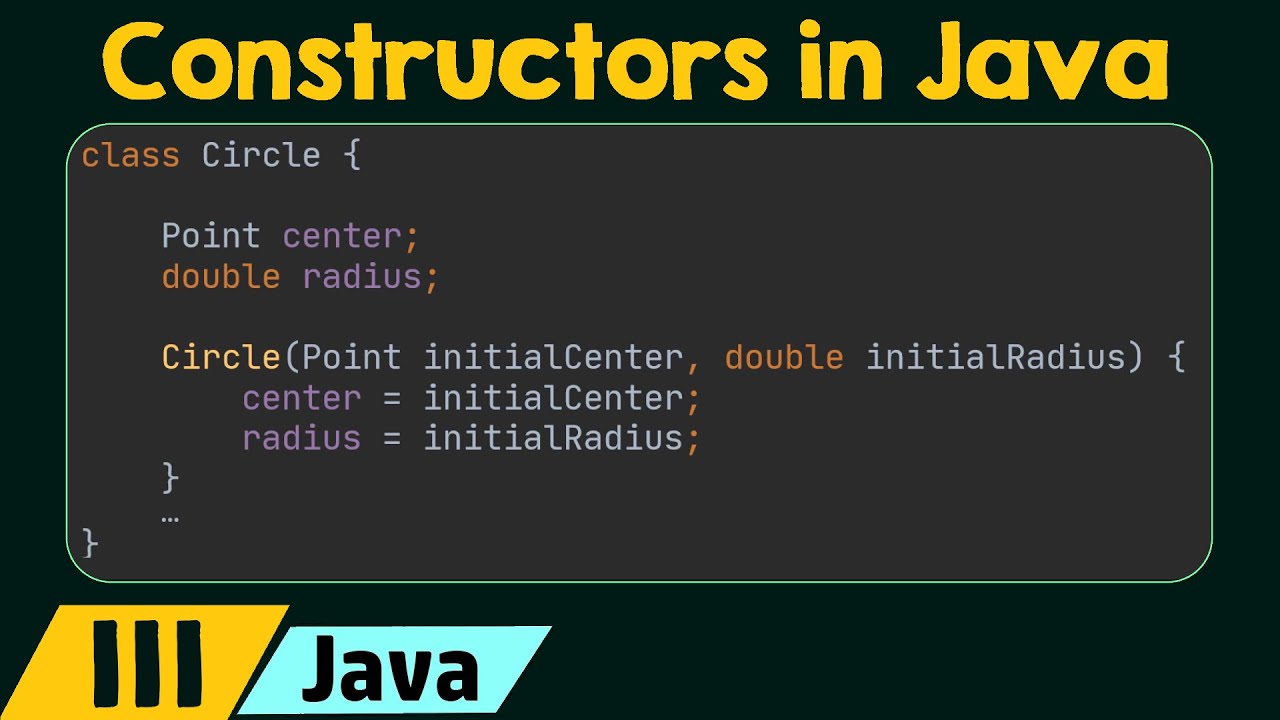
Constructors in Java

5. Constructor

JAVA TECHNICAL QUESTION AND ANSWERS FOR INTERVIEW PART III (Classes & Objects)

Self and __init__() method in Python | Python Tutorials for Beginners #lec86
Object Oriented Programming Dasar pada C++ (Class, Object, Method, dan Constructor)
5.0 / 5 (0 votes)

