Shell and Tube Heat Exchangers Explained (How it Works)
Summary
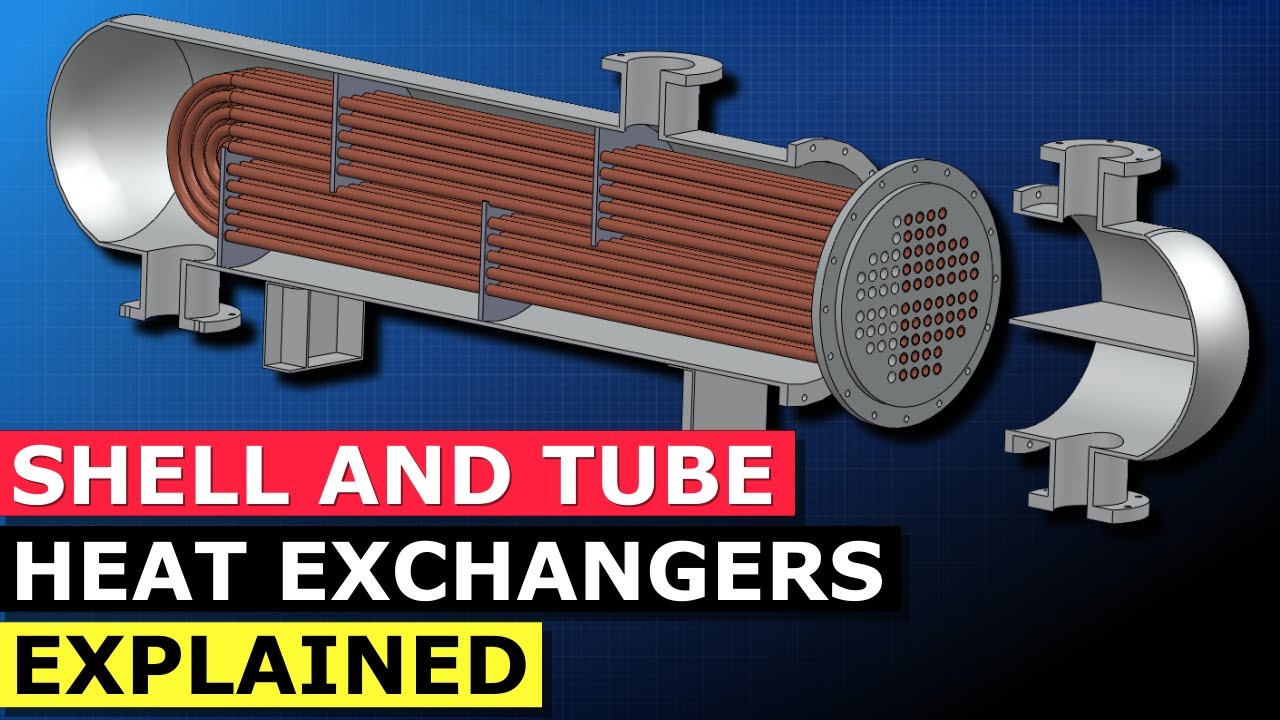
TLDRThis video provides a comprehensive guide to shell and tube heat exchangers, explaining their components, operation, and design variations. It covers the shell, tubes, tube sheets, gaskets, baffles, bonnets, and headers, detailing how tube-side and shell-side fluids flow through one-pass, two-pass, and U-tube configurations. The tutorial highlights advantages such as cost-effectiveness, high heat transfer capacity, versatility under different pressures and temperatures, ease of maintenance, and leak management. It also addresses disadvantages, including large footprint and space requirements for maintenance. The video is ideal for engineers, students, and anyone seeking a clear understanding of this widely used industrial heat exchanger type.
Takeaways
- 😀 A shell and tube heat exchanger consists of a cylindrical shell with tubes running through it, used to transfer heat between two fluids.
- 😀 The fluid inside the tubes is called the 'tube side fluid', while the fluid outside the tubes is called the 'shell side fluid'.
- 😀 Tube sheets at both ends of the tubes provide mechanical strength, keep the tubes in place, and ensure there is no leakage of fluid between the shell and tubes.
- 😀 Baffles are installed inside the shell to direct the flow of the shellside fluid, ensuring it moves over the tubes multiple times to increase heat transfer efficiency.
- 😀 A 'one-pass' shell and tube heat exchanger means the tube side fluid flows through the tubes only once, from one end to the other.
- 😀 The flow arrangement in a heat exchanger can include counterflow, crossflow, and parallel flow, which affect the heat transfer rate.
- 😀 Counterflow and crossflow patterns are used in shell and tube heat exchangers to improve heat transfer between fluids flowing in opposite directions.
- 😀 A two-pass heat exchanger has the tube side fluid flowing in one direction first, then reversing direction, passing through the exchanger twice.
- 😀 U-tube shell and tube heat exchangers feature tubes with U-bends, allowing the tube side fluid to change direction within the same set of tubes.
- 😀 Shell and tube heat exchangers are favored for their cost-effectiveness, ease of maintenance, and good performance across various temperature and pressure conditions.
- 😀 A major disadvantage of shell and tube heat exchangers is their large physical footprint, requiring substantial space for installation and maintenance.
Q & A
What is the main function of a shell and tube heat exchanger?
-A shell and tube heat exchanger is designed to transfer heat between two fluids, where one fluid flows through tubes and the other fluid flows over the tubes in the shell, facilitating efficient heat exchange.
What is the purpose of tube sheets in a shell and tube heat exchanger?
-Tube sheets serve to hold the tubes in place, providing mechanical strength and sealing the ends of the tubes to prevent leakage between the tube side fluid and the shell side fluid.
How do baffles improve the efficiency of a shell and tube heat exchanger?
-Baffles direct the flow of the shell side fluid, causing it to flow over the tubes multiple times, which increases the heat exchange efficiency by maximizing the contact between the fluid and the tubes.
What is the difference between a one-pass and a two-pass shell and tube heat exchanger?
-In a one-pass heat exchanger, the tube side fluid flows through the tubes only once, while in a two-pass heat exchanger, the tube side fluid flows through the tubes twice, traveling in opposite directions in different sections of the heat exchanger.
Why is counterflow used in shell and tube heat exchangers?
-Counterflow is used because it maximizes the temperature gradient between the two fluids, which improves heat transfer efficiency as the cold fluid enters at the opposite end to the hot fluid.
What type of fluid flows inside the tubes of a shell and tube heat exchanger?
-The fluid that flows through the tubes is called the 'tube side fluid.' It passes through the tubes while the shell side fluid flows over the outside of the tubes.
How does the flow direction of the fluids impact the heat exchanger's performance?
-The flow direction impacts heat transfer efficiency. For example, counterflow design is typically the most efficient because it maintains a higher temperature difference between the two fluids, leading to better heat transfer.
What is a YouTube shell and tube heat exchanger, and why is it called that?
-A YouTube shell and tube heat exchanger is a type where the tubes are U-shaped, which allows the fluid to travel through the tubes in a U-turn path. The design is called 'YouTube' due to the U-bend shape of the tubes.
What is the main advantage of using shell and tube heat exchangers over other types like plate or spiral heat exchangers?
-Shell and tube heat exchangers are popular because they are relatively inexpensive, easy to maintain, have a simple design, and can handle a wide range of temperatures and pressures. They are also well-suited for corrosive and erosive environments.
How are leaks detected and managed in shell and tube heat exchangers?
-Leaks in shell and tube heat exchangers are detected by blocking off individual tubes, pressurizing them, and checking for pressure loss. If a leak is found, the affected tube can be blocked off, allowing the heat exchanger to continue operating with reduced capacity.
Outlines

Cette section est réservée aux utilisateurs payants. Améliorez votre compte pour accéder à cette section.
Améliorer maintenantMindmap

Cette section est réservée aux utilisateurs payants. Améliorez votre compte pour accéder à cette section.
Améliorer maintenantKeywords

Cette section est réservée aux utilisateurs payants. Améliorez votre compte pour accéder à cette section.
Améliorer maintenantHighlights

Cette section est réservée aux utilisateurs payants. Améliorez votre compte pour accéder à cette section.
Améliorer maintenantTranscripts

Cette section est réservée aux utilisateurs payants. Améliorez votre compte pour accéder à cette section.
Améliorer maintenantVoir Plus de Vidéos Connexes



5.0 / 5 (0 votes)

