Why Singapore Built a $2BN Dome Over Its Airport
Summary
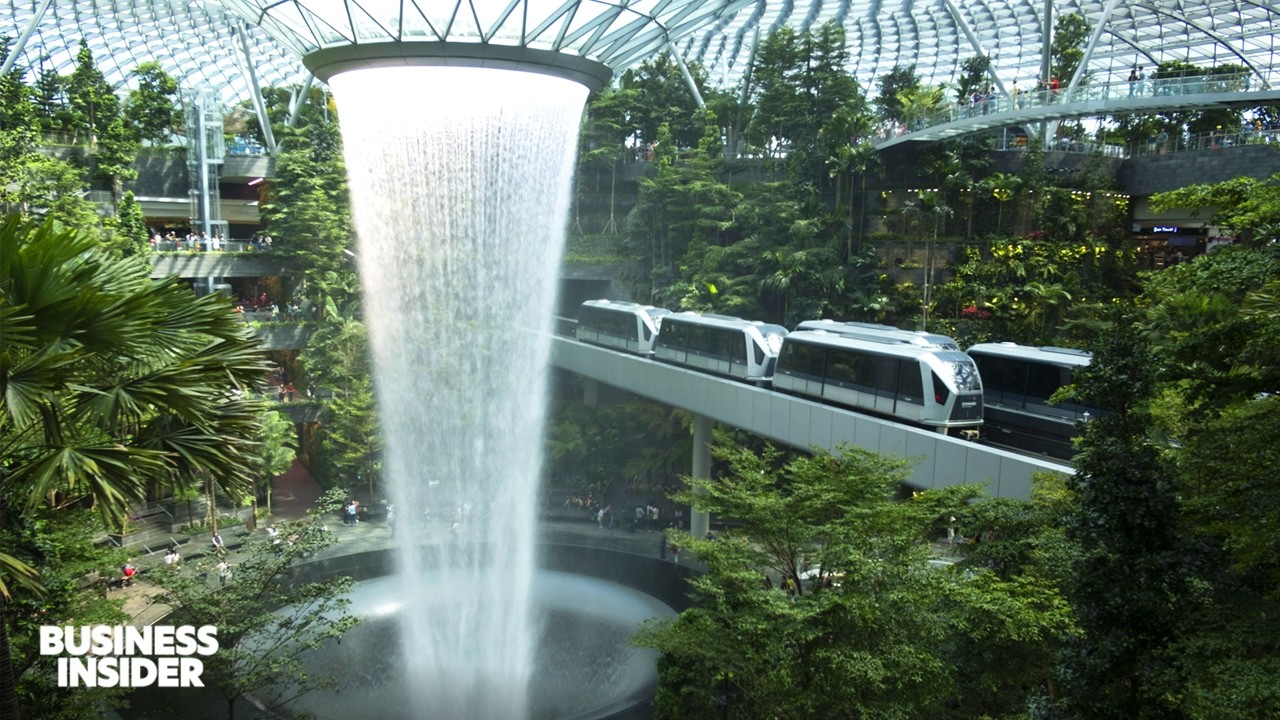
TLDRChangi Airport in Singapore, home to the Jewel, is a marvel of engineering and design. This steel-and-glass structure weighs 3,500 tonnes and features the world’s tallest indoor waterfall, 37,000 liters of water flowing through every minute. Architect Moshe Safdie’s vision transformed the airport into a destination in itself, combining nature and innovation. With over 3,000 trees and 60,000 plants, the Jewel embodies Singapore’s Garden City vision. Built at a cost of $1.3 billion, the Jewel has redefined airport design, with plans for future expansion making Changi a global architectural icon.
Takeaways
- 🏗️ Changi Airport's Jewel is a steel and glass structure weighing 3,500 tonnes, rising 10 stories, and featuring the tallest indoor waterfall in the world.
- 🌳 The Jewel houses over 3,000 trees and 60,000 plants, creating a lush indoor garden that doubles as a public attraction.
- 💧 The indoor waterfall, called the Vortex, circulates 37,000 liters of water per minute, equivalent to an Olympic pool every hour.
- 🏛️ Architect Moshe Safdie designed the Jewel, known for his gravity-defying and iconic works like Marina Bay Sands.
- 🛫 Changi Airport aimed to transform from a transit point into a destination, encouraging more passengers to visit Singapore rather than just pass through.
- 🔧 The Jewel's structure is a toid (donut-like) design, requiring complex engineering including a shell phase, tension cone, and compression ring to support the off-center waterfall.
- 🪟 High-strength steel and laminated tempered glass were used to ensure durability, safety, and resistance to environmental stress.
- 🌡️ Climate control was carefully implemented with chilled water pipes and hidden air conditioning to keep both plants and visitors comfortable.
- 📈 The Jewel opened in 2019, exceeding expectations by welcoming over 50 million visitors in just six months, solidifying Changi Airport as a destination in its own right.
- 🚀 Singapore plans to expand Changi with Terminal 5, adding 1,080 hectares and space for an additional 50 million passengers, reflecting ongoing innovation and ambition.
Q & A
What makes Changi Airport's Jewel an engineering marvel?
-Changi Airport's Jewel is an engineering marvel because it is a steel and glass structure weighing 3,500 tonnes and rising 10 stories above the ground. The building's design defies traditional gravity concepts and features the tallest indoor waterfall in the world, with 37,000L of water flowing through it every minute.
How does the design of Changi Airport's Jewel differ from traditional domes?
-Instead of a traditional dome, the Jewel was designed as a toid or donut shape, with a structure that pushes inward rather than outward. This unique design was chosen to avoid creating a typical dome and to accommodate the space for the waterfall and other features.
What is the significance of the Garden City vision in the creation of Changi Airport?
-The Garden City vision, introduced by Singapore's first prime minister in 1967, aimed to create a world-class city by integrating greenery and urban development. Changi Airport, as part of this vision, was designed to reflect that ambition by being not just an airport but also a destination filled with gardens and plants.
How does Moshe Safdie's architectural philosophy play a role in Changi's Jewel design?
-Moshe Safdie, the architect behind Jewel, is known for defying conventional building designs. His past works, including Marina Bay Sands, showcase his approach of creating structures that challenge gravity. For the Jewel, Safdie wanted to design a building that would be both a functional airport hub and a beautiful garden oasis.
How does the waterfall in Changi's Jewel function and contribute to the structure?
-The waterfall in Jewel is the tallest indoor waterfall in the world, pouring 37,000 liters of water every minute. The water cascades from the Oculus at the top of the building and falls into the basement, where it is collected, filtered, and pumped back up. The waterfall helps maintain the unique aesthetic and natural atmosphere of the space.
What engineering challenges were faced when constructing the Jewel, particularly with the off-center waterfall?
-The waterfall was originally planned to be in the center of the structure, but this would have conflicted with the skytrain and control tower. To resolve this, the waterfall was shifted slightly off-center, creating a complex engineering challenge. This off-center placement required precise calculations to ensure structural integrity.
What materials were used in the construction of the Jewel to ensure durability and resistance to weather?
-The Jewel’s structure uses high-strength steel and tempered glass. These materials were chosen for their durability, ability to bear significant loads, and resistance to environmental stresses like wind and extreme weather conditions. Special laminated glass was also used to prevent shattering.
What is the role of the 'tension cone' in the Jewel’s architecture?
-The tension cone is a key part of the Jewel's design, located between the columns and the waterfall. This section of the structure is held up by tension, supported by a compression ring created by the surrounding columns. This engineering solution helps the building maintain stability despite its unconventional design.
How does Changi Airport manage to maintain a comfortable environment for both visitors and plants inside the Jewel?
-To create a comfortable environment for both people and plants, Changi used chilled water pipes embedded in the floor and hidden air conditioning vents under benches. These features help control the temperature and humidity levels within the massive greenhouse-like space.
What are the future plans for Changi Airport and how does the Jewel fit into the vision?
-Changi Airport is undergoing further expansion with the construction of Terminal 5, which will accommodate an additional 50 million passengers per year. The Jewel plays a crucial role in the airport's identity as a global destination, blending its functional role as an airport with a unique architectural and natural experience for visitors.
Outlines

Cette section est réservée aux utilisateurs payants. Améliorez votre compte pour accéder à cette section.
Améliorer maintenantMindmap

Cette section est réservée aux utilisateurs payants. Améliorez votre compte pour accéder à cette section.
Améliorer maintenantKeywords

Cette section est réservée aux utilisateurs payants. Améliorez votre compte pour accéder à cette section.
Améliorer maintenantHighlights

Cette section est réservée aux utilisateurs payants. Améliorez votre compte pour accéder à cette section.
Améliorer maintenantTranscripts

Cette section est réservée aux utilisateurs payants. Améliorez votre compte pour accéder à cette section.
Améliorer maintenantVoir Plus de Vidéos Connexes




5.0 / 5 (0 votes)

