4 Step Problem Solving George Polya
Summary
TLDRIn this video, the speaker introduces George Polya's 4-step problem-solving method, focusing on understanding the problem, planning a strategy, executing it, and reviewing the solution. Polya’s heuristics guide how to break down complex problems, offering strategies like pattern finding, guess and check, and working backward. The speaker also emphasizes the importance of persistence and careful evaluation throughout the problem-solving process, ensuring that each step is completed thoroughly to reach the best solution. This approach is crucial for tackling a wide range of mathematical and logical problems effectively.
Takeaways
- 😀 George Pólya, born on December 13, 1887, in Budapest, Hungary, was a mathematician influential in areas such as complex analysis, probability, and combinatorics.
- 😀 His famous book *How to Solve It* became a bestseller, translating the concept of heuristics into problem-solving steps.
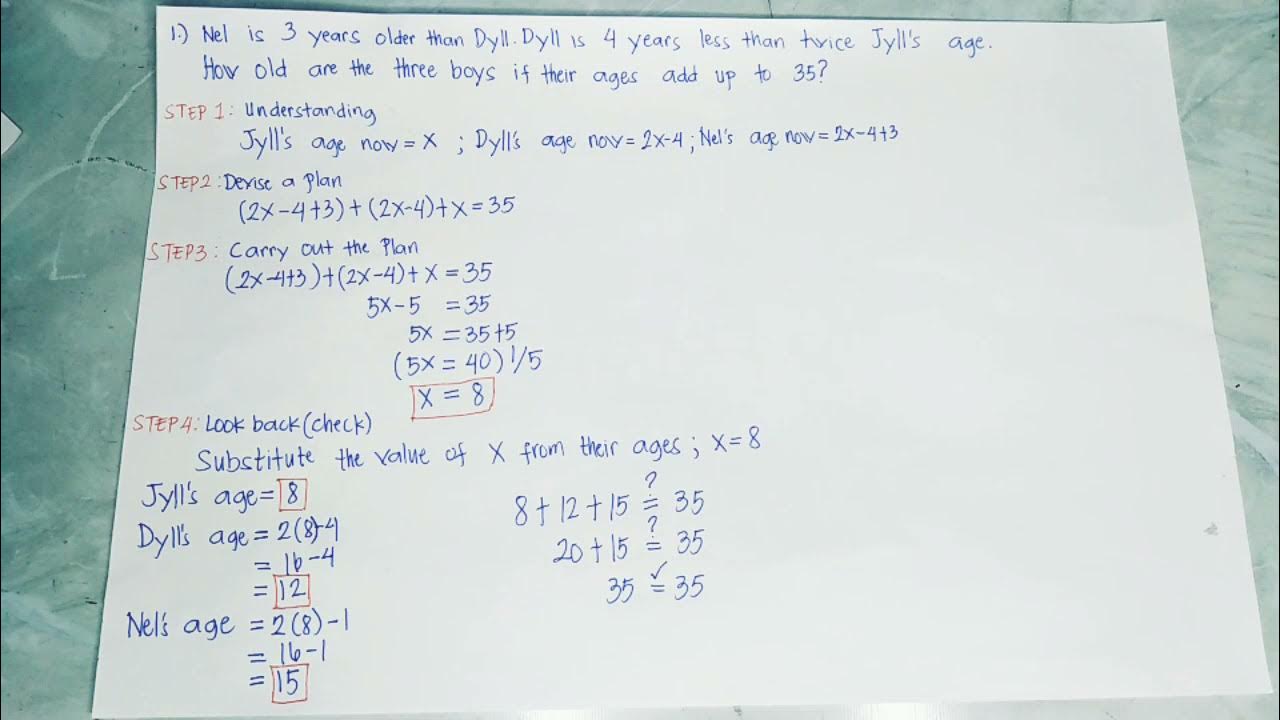
- 😀 Pólya's 4-step problem-solving process is designed to guide problem solvers through understanding, planning, execution, and review.
- 😀 Step 1: Understanding the problem involves clarifying every detail, asking whether we understand the terms, the question, the goal, and if there's enough information.
- 😀 Step 2: Planning the strategy includes strategies like guessing and testing, finding patterns, drawing diagrams, and using simpler cases to break down the problem.
- 😀 Step 3: Executing the strategy requires persistence, attention to detail, and the flexibility to adapt or try new approaches if the chosen strategy fails.
- 😀 Step 4: Reviewing and checking involves evaluating whether the solution is correct, if it meets the problem's requirements, and if alternative methods could provide a better answer.
- 😀 Pólya's heuristic approach encourages a structured yet flexible method for solving problems by guiding one through key questions at each step.
- 😀 The 4-step process is a universal approach that can be applied to any problem, not just mathematical ones, offering a broad framework for problem-solving.
- 😀 The book *How to Solve It* had a significant impact on education and problem-solving, becoming a key reference for students, teachers, and professionals alike.
- 😀 Understanding a problem is key before jumping to solutions; identifying gaps in knowledge can lead to better strategies in subsequent steps.
Q & A
Who developed the 4-step problem-solving method discussed in the video?
-The 4-step problem-solving method was developed by George Pólya.
What is the title of George Pólya's famous book, and why is it significant?
-The book is titled 'How to Solve It.' It is significant because it introduced the 4-step problem-solving method and became a bestseller, translated into 17 languages.
When and where was George Pólya born?
-George Pólya was born on December 13, 1887, in Budapest, Hungary.
What are the four steps of problem solving according to Pólya?
-The four steps are: 1) Understanding the problem, 2) Planning a strategy, 3) Executing the strategy, and 4) Reviewing the solution.
What are some questions to ask when trying to understand a problem?
-Questions include: Do I understand every word? What is given? What is the goal? Is the information sufficient? Do I need additional information? Are there similar problems? Is there unknown information?
List at least five strategies suggested by Pólya for planning a solution.
-Five strategies are: 1) Guess and check, 2) Using variables, 3) Finding patterns, 4) Making a table, 5) Using simpler cases.
Why is perseverance important when executing a problem-solving strategy?
-Perseverance is important because executing the chosen strategy may require careful work, and if it fails, trying a new approach or checking different situations can lead to success.
What should you do during the review step of problem solving?
-During the review step, evaluate your answer by checking if it is correct, if it matches the problem, and whether the problem can be solved in a different way.
In what areas of mathematics did George Pólya contribute?
-He contributed to analysis, complex physics mathematics, probability theory, geometry, and combinatorics.
Why are heuristics important in problem solving according to Pólya?
-Heuristics are important because they provide general steps or strategies that guide the problem-solving process and help in finding solutions systematically.
Can the strategies suggested by Pólya be applied to different types of problems?
-Yes, Pólya's strategies are flexible and can be adapted to a wide range of mathematical and logical problems.
Outlines

Esta sección está disponible solo para usuarios con suscripción. Por favor, mejora tu plan para acceder a esta parte.
Mejorar ahoraMindmap

Esta sección está disponible solo para usuarios con suscripción. Por favor, mejora tu plan para acceder a esta parte.
Mejorar ahoraKeywords

Esta sección está disponible solo para usuarios con suscripción. Por favor, mejora tu plan para acceder a esta parte.
Mejorar ahoraHighlights

Esta sección está disponible solo para usuarios con suscripción. Por favor, mejora tu plan para acceder a esta parte.
Mejorar ahoraTranscripts

Esta sección está disponible solo para usuarios con suscripción. Por favor, mejora tu plan para acceder a esta parte.
Mejorar ahoraVer Más Videos Relacionados


5.0 / 5 (0 votes)

