Belajar Bahasa Inggris - Subject Verb Agreement
Summary
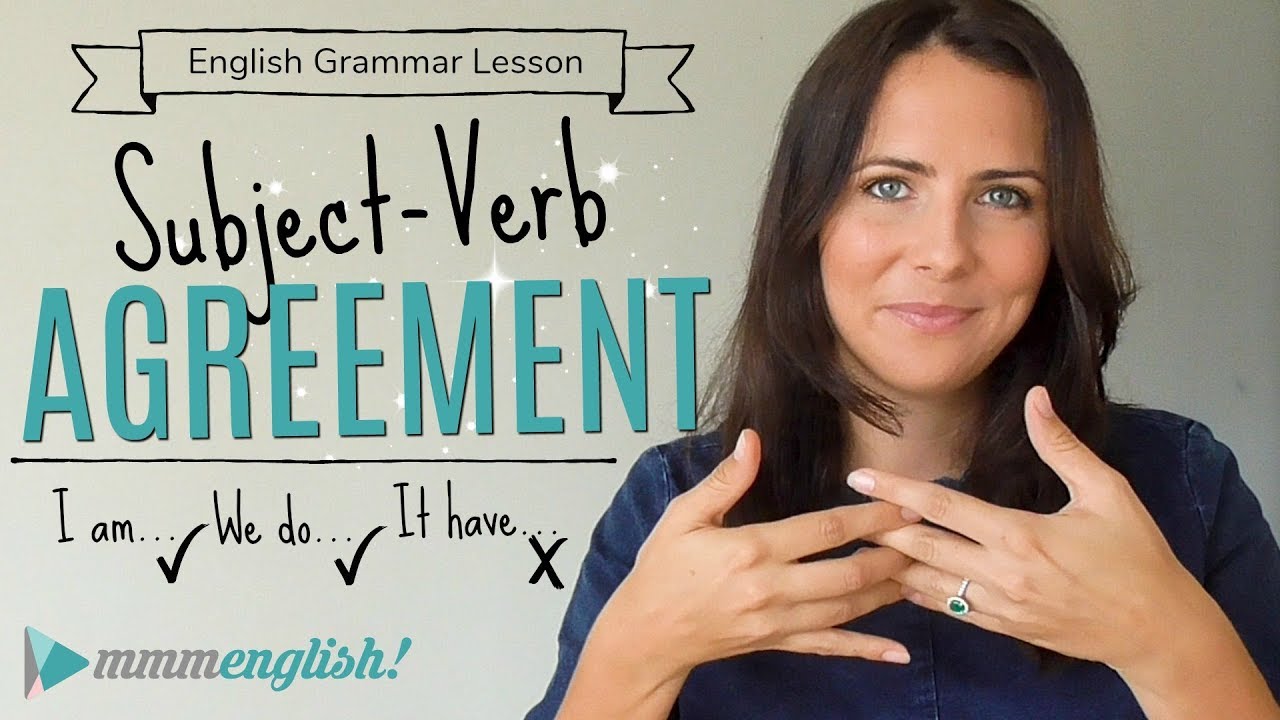
TLDRIn this video, Fitra explains the concept of Subject-Verb Agreement (SV Agreement) in English, focusing on how the subject and verb must match in number. He covers the rules of matching singular subjects with singular verbs and plural subjects with plural verbs, with examples in both present and past tenses. The video also addresses common mistakes, such as confusion with prepositional phrases and special cases like 'everyone' and 'some of.' The goal is to make understanding SV Agreement easy, especially for learners preparing for tests like IELTS or TOEFL. Fitra encourages viewers to share the video for greater reach.
Takeaways
- 😀 Subject-Verb Agreement (SV Agreement) ensures the subject and verb in a sentence match in number (singular/plural).
- 😀 In Simple Present tense, singular subjects require singular verbs, and plural subjects require plural verbs.
- 😀 For subjects like 'I', 'You', 'We', and 'They', always use the base verb (Verb 1).
- 😀 For subjects like 'He', 'She', and 'It', use the base verb with an 'S' (Verb 1 + S).
- 😀 Common mistake: People often confuse 'You' with singular forms. Remember, 'You' uses the base verb like 'I', 'We', and 'They'.
- 😀 'One of my friends' is singular, so it requires a singular verb like 'is', not 'are'.
- 😀 Don't confuse the subject of a sentence with prepositional phrases. For example, 'The books on the table' uses 'are', not 'is', because 'books' is plural.
- 😀 Words like 'Everybody', 'Anyone', and 'Nobody' are singular, even though they refer to groups. They always take a singular verb.
- 😀 In phrases like 'Most of', 'Some of', 'Part of', the verb agrees with the noun following 'of'. For example, 'Most of the students' is plural, so it uses 'are'.
- 😀 Subject-Verb Agreement is especially important in tests like TOEFL or IELTS and can affect writing accuracy.
- 😀 Always return the subject to its pronoun form (I, You, We, They, He, She, It) to make it easier to determine the correct verb form.
Q & A
What is Subject-Verb Agreement (SVA)?
-Subject-Verb Agreement (SVA) refers to the rule that the subject and verb in a sentence must match in number (singular or plural). For instance, a singular subject requires a singular verb, and a plural subject requires a plural verb.
Why is Subject-Verb Agreement important in English?
-Subject-Verb Agreement is crucial for clarity and correctness in writing and speaking. It helps ensure that sentences are grammatically sound, which is essential for effective communication.
Which tense is most commonly associated with Subject-Verb Agreement issues?
-Subject-Verb Agreement issues are most common in the Simple Present tense, especially when people are unsure of whether to use singular or plural verbs with various subjects.
What is the rule for Subject-Verb Agreement when the subject is singular?
-When the subject is singular, the verb must also be singular. For example, 'The cat eats' where 'cat' is singular, and 'eats' is the singular form of the verb.
What is the rule for Subject-Verb Agreement when the subject is plural?
-When the subject is plural, the verb must also be plural. For example, 'The cats eat' where 'cats' is plural, and 'eat' is the plural form of the verb.
What is the correct form of the verb when the subject is 'I' or 'You'?
-When the subject is 'I' or 'You', the verb should always be in its base form (Verb 1), such as 'I run' or 'You eat'.
How do you form the verb for subjects 'He', 'She', or 'It'?
-For subjects 'He', 'She', or 'It', the verb should take the form of Verb + 's' in the Simple Present tense. For example, 'She runs', 'He eats', and 'It flies'.
Can you provide an example where the Subject-Verb Agreement might confuse a learner?
-One common confusion is with subjects like 'You', where learners might incorrectly use 'was' instead of 'were'. For instance, 'You were late' is correct, not 'You was late'.
What is a Prepositional Phrase and how does it affect Subject-Verb Agreement?
-A Prepositional Phrase consists of a preposition and its object. In the sentence 'The books on the table are mine', the subject is 'the books', not 'the table'. So, the verb must be plural, as in 'are' (not 'is').
How do words like 'everyone', 'everybody', and 'someone' affect Subject-Verb Agreement?
-'Everyone', 'everybody', and similar words are singular. Despite referring to multiple people, they are treated as singular subjects. For example, 'Everybody comes on time' uses the singular verb 'comes'.
Outlines

Esta sección está disponible solo para usuarios con suscripción. Por favor, mejora tu plan para acceder a esta parte.
Mejorar ahoraMindmap

Esta sección está disponible solo para usuarios con suscripción. Por favor, mejora tu plan para acceder a esta parte.
Mejorar ahoraKeywords

Esta sección está disponible solo para usuarios con suscripción. Por favor, mejora tu plan para acceder a esta parte.
Mejorar ahoraHighlights

Esta sección está disponible solo para usuarios con suscripción. Por favor, mejora tu plan para acceder a esta parte.
Mejorar ahoraTranscripts

Esta sección está disponible solo para usuarios con suscripción. Por favor, mejora tu plan para acceder a esta parte.
Mejorar ahoraVer Más Videos Relacionados




5.0 / 5 (0 votes)

