Kebijakan Publik tahapan kebijakan
Summary
TLDRThe video lecture introduces public policy by explaining how public issues evolve into formal policies. It outlines key concepts such as public issues, agendas, and policy formulation, drawing on William's framework. The lecture details the policy-making process: setting the agenda, formulating policies, adopting and legitimizing them, and finally evaluating their impact. Students are tasked with studying these stages, supported by credible sources, and analyzing real government policies up to the evaluation phase. Emphasis is placed on understanding the mechanisms behind policy development, critical thinking, and producing original analyses rather than copying existing material.
Takeaways
- 😀 Understanding of public policy concepts such as public issues, public agenda, and public policy is important for further learning.
- 😀 Public issues can be transformed into public policies when they reach critical points, often involving emotions and large-scale societal interests.
- 😀 A public issue gains attention when it impacts a broad audience and challenges the legitimacy of existing power structures.
- 😀 The process of public policy formulation involves several key stages: agenda setting, policy formulation, adoption, legitimacy, and evaluation.
- 😀 According to William, the process of policy formulation starts with the establishment of the public agenda based on pressing societal issues.
- 😀 Policy formulation is carried out by authorized bodies, which create the framework for the policies.
- 😀 The next step in the policy process is the adoption or legitimization of the policy, which involves applying or enforcing the policy after it’s formulated.
- 😀 Evaluation and assessment of the policy’s effectiveness is the final step in the public policy process.
- 😀 Students are tasked with researching and understanding the stages of policy formation, particularly focusing on evaluation and assessment.
- 😀 To demonstrate their understanding, students should use credible sources and real-life policy examples to support their work and analysis.
- 😀 The importance of avoiding plagiarism and ensuring original, thoughtful work is emphasized in the assignment.
Q & A
What is the main topic discussed in the transcript?
-The main topic is public policy, specifically the process of public policy formulation, from public issues to agenda setting, formulation, adoption, implementation, and evaluation.
How does an issue become a public problem according to William?
-An issue becomes a public problem when it reaches a critical point, affects a significant number of people, involves emotions, challenges power, or has legitimacy concerns.
What is the first stage in the public policy process?
-The first stage is agenda setting, where public issues are selected to be addressed as part of the government's policy agenda.
What happens during the formulation stage of public policy?
-During formulation, authorized bodies develop detailed solutions and strategies to address the selected public problem, creating a draft policy.
What does the adoption or legitimacy stage involve?
-This stage involves officially approving the formulated policy through formal processes, such as legislative approval or presidential decrees, giving it legal legitimacy.
What is the purpose of policy implementation?
-Policy implementation is the stage where the approved policy is carried out by relevant government institutions to achieve the intended objectives.
Why is evaluation important in the public policy process?
-Evaluation assesses the effectiveness and impact of a policy, determines if objectives are met, and provides feedback for potential revisions or improvements.
Can you give an example of a government policy that has been evaluated?
-The Indonesian 'Kartu Prakerja' program is an example. It addresses unemployment by providing training and incentives, and has been evaluated for its effectiveness in helping participants gain employment.
What is the relationship between public issues and agenda setting?
-Not all public issues make it onto the agenda. Only issues that are urgent, widely impactful, and relevant to public interest are selected to become part of the government's policy agenda.
What guidance is given for completing the assignment based on this transcript?
-Students are instructed to read the material thoroughly, use credible sources, construct original insights, avoid plagiarism, and provide examples of policies that have reached the evaluation stage.
Who is responsible for formulating public policies?
-Formulation is carried out by authorized bodies or institutions that have the legal authority and expertise to design and draft policy solutions.
What should students focus on when analyzing a policy example?
-Students should focus on how the issue became a public problem, how it was selected for the agenda, how the policy was formulated, adopted, implemented, and finally evaluated.
Outlines

Esta sección está disponible solo para usuarios con suscripción. Por favor, mejora tu plan para acceder a esta parte.
Mejorar ahoraMindmap

Esta sección está disponible solo para usuarios con suscripción. Por favor, mejora tu plan para acceder a esta parte.
Mejorar ahoraKeywords

Esta sección está disponible solo para usuarios con suscripción. Por favor, mejora tu plan para acceder a esta parte.
Mejorar ahoraHighlights

Esta sección está disponible solo para usuarios con suscripción. Por favor, mejora tu plan para acceder a esta parte.
Mejorar ahoraTranscripts

Esta sección está disponible solo para usuarios con suscripción. Por favor, mejora tu plan para acceder a esta parte.
Mejorar ahoraVer Más Videos Relacionados

Proses Kebijakan Publik - Eko Budi Sulistio, S.Sos., M.AP.
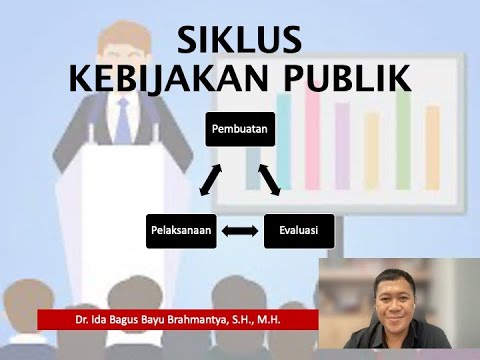
SIKLUS KEBIJAKAN PUBLIK | DR. IDA BAGUS BAYU BRAHMANTYA, S.H., M.H.

Hukum dan Kebijakan Publik - Perencanaan Kebijakan
Novos Direitos e Políticas Públicas Parte I

Hukum dan Kebijakan Publik - Hukum Sebagai Pembentuk Kebijakan

ANALISIS KEBIJAKAN PUBLIK | TEORI KEBIJAKAN PUBLIK | BAG. 1 | Oleh Fadillah Putra, MPAff., Ph.D
5.0 / 5 (0 votes)

