An Overview of American Imperialism
Summary
TLDRThis video explores the rise of American Imperialism, from the philosophy of Manifest Destiny to the U.S.'s growing global power in the 19th and early 20th centuries. The script outlines key events, such as territorial annexations, the Spanish-American War, and the implementation of policies like Roosevelt's Corollary and Taft's Dollar Diplomacy. The video emphasizes how America’s economic and military expansion sought to secure international respect, markets, and territories. However, as the U.S. engaged more globally, neutrality became increasingly difficult, setting the stage for its involvement in World War I and subsequent conflicts.
Takeaways
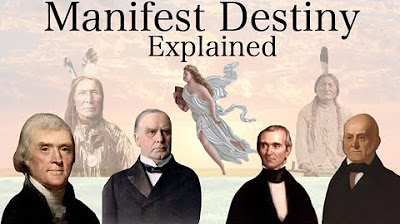
- 😀 Manifest Destiny was a key philosophy that drove the expansion of the U.S., with leaders believing the country would inevitably span from the Atlantic to the Pacific Ocean.
- 😀 America's international reputation was crucial, as the U.S. sought to prove itself as a global power after its conflict with Great Britain during the War of 1812.
- 😀 Population and economic growth, especially after the Industrial Revolution, fueled the push for both westward and global expansion.
- 😀 The timeline of American imperialism includes several key events, such as President Polk asserting dominance in Oregon and Texas (1845) and the annexation of Hawaii (1898).
- 😀 The U.S. aggressively expanded its territory, annexing islands like the Midway Islands (1867) and Samoa (1899), while increasing its naval power, particularly under Theodore Roosevelt.
- 😀 The Spanish-American War in 1898 led to U.S. control over the Philippines, Puerto Rico, and Guam, marking a significant expansion of American imperial power.
- 😀 Voices of opposition to imperialism grew toward the end of the 19th century, with some questioning the morality and legality of American control over foreign territories.
- 😀 Imperialists like Alfred Thayer Mahan believed that controlling global markets and maintaining a strong navy was essential for America's economic growth and security.
- 😀 Theodore Roosevelt's intervention in Latin America and the implementation of the Roosevelt Corollary exemplified U.S. foreign policy designed to protect American economic interests.
- 😀 President Taft's Dollar Diplomacy aimed to promote stability abroad while advancing U.S. commercial interests, often replacing military force with economic influence.
- 😀 America's involvement in international commerce made it difficult to remain neutral during global conflicts, as seen during World War I when the U.S. was drawn in due to German actions against American interests.
Q & A
What was Manifest Destiny and how did it contribute to American Imperialism?
-Manifest Destiny was a belief in the early 1800s that the United States was destined to expand across the North American continent, from the Atlantic to the Pacific Ocean. This philosophy fueled the notion of American territorial expansion, contributing to imperialist ambitions as the U.S. sought to extend its influence beyond its borders.
Why was the international reputation of the U.S. important during the 19th century?
-The United States was a relatively new power, still competing with older European powers like Great Britain. American leaders were eager to establish the U.S. as a major player on the world stage, especially after the War of 1812, and sought to prove that the U.S. was here to stay by expanding its territories and influence.
How did the industrial revolution influence American imperialism?
-The industrial revolution boosted America's economy, creating a massive workforce and production capacity. As a result, there was increased pressure to find new international markets for American goods, making global expansion and imperialism appear necessary for continued economic growth.
What role did Admiral Alfred Thayer Mahan play in American imperialism?
-Admiral Mahan was a key advocate for American imperialism, arguing that the U.S. needed a powerful navy to protect trade routes and secure access to international markets. His ideas, particularly in his book on naval strategy, greatly influenced Theodore Roosevelt and other American leaders in shaping imperial policies.
What was the Roosevelt Corollary and how did it affect U.S. foreign policy?
-The Roosevelt Corollary, added to the Monroe Doctrine in 1904, asserted that the U.S. had the right to intervene in Latin American countries to maintain stability and protect American interests. This policy justified American actions in the Western Hemisphere and expanded U.S. influence in the region.
How did Theodore Roosevelt and William Taft expand U.S. influence abroad?
-Roosevelt expanded U.S. influence through the Roosevelt Corollary, which justified intervention in Latin America. Taft followed up with Dollar Diplomacy, aiming to use economic investments and loans to promote stability and protect American commercial interests in Latin America and Asia.
What were the main territorial acquisitions of the U.S. during the late 19th and early 20th centuries?
-During this period, the U.S. annexed several territories, including Hawaii, the Philippines, Puerto Rico, Guam, American Samoa, and Wake Island. These acquisitions marked significant expansion of U.S. territorial control and influence across the Pacific and Caribbean.
How did the Spanish-American War contribute to American imperialism?
-The Spanish-American War of 1898 resulted in the U.S. gaining control of several Spanish colonies, including Puerto Rico, Guam, and the Philippines. This victory marked the U.S.'s emergence as a global imperial power and helped fuel further expansionist policies.
What was the significance of the Panama Canal in U.S. imperialism?
-The Panama Canal, completed in 1914, was a major engineering feat that connected the Atlantic and Pacific Oceans, dramatically improving U.S. trade routes. Its construction demonstrated American power and influence in Latin America and the Caribbean, further solidifying U.S. dominance in the region.
How did World War I affect America's approach to imperialism?
-World War I highlighted the challenges of being involved in international commerce and maintaining a neutral stance. The conflict, particularly Germany's attempts to sway Mexico against the U.S., demonstrated the complications of global influence and reduced the appetite for further imperial conquests, although U.S. involvement in international affairs would continue to grow in the 20th century.
Outlines

Esta sección está disponible solo para usuarios con suscripción. Por favor, mejora tu plan para acceder a esta parte.
Mejorar ahoraMindmap

Esta sección está disponible solo para usuarios con suscripción. Por favor, mejora tu plan para acceder a esta parte.
Mejorar ahoraKeywords

Esta sección está disponible solo para usuarios con suscripción. Por favor, mejora tu plan para acceder a esta parte.
Mejorar ahoraHighlights

Esta sección está disponible solo para usuarios con suscripción. Por favor, mejora tu plan para acceder a esta parte.
Mejorar ahoraTranscripts

Esta sección está disponible solo para usuarios con suscripción. Por favor, mejora tu plan para acceder a esta parte.
Mejorar ahora



5.0 / 5 (0 votes)

