T cell Activation and differentiation (FL-Immuno/31)
Summary
TLDRT-cell activation is a complex process involving two critical signals. First, antigen-presenting cells (APCs) process and present antigens on MHC II molecules, which naïve CD4+ T-cells recognize. This triggers the first signal, followed by a co-stimulatory signal, often through the B7-CD28 interaction, which prevents T-cell inactivity. Activated T-cells proliferate, secrete interleukin-2, and differentiate into effector and memory T-cells. A similar process occurs for CD8+ T-cells, but they respond to MHC I molecules. These T-cells protect the body by attacking infected cells and remembering pathogens for faster response in the future.
Takeaways
- 😀 Activation of T-cells is a complex process involving multiple steps, but can be simplified into key stages.
- 😀 There are two main types of mature T-cells: CD4+ and CD8+ T-cells, both of which are initially naive.
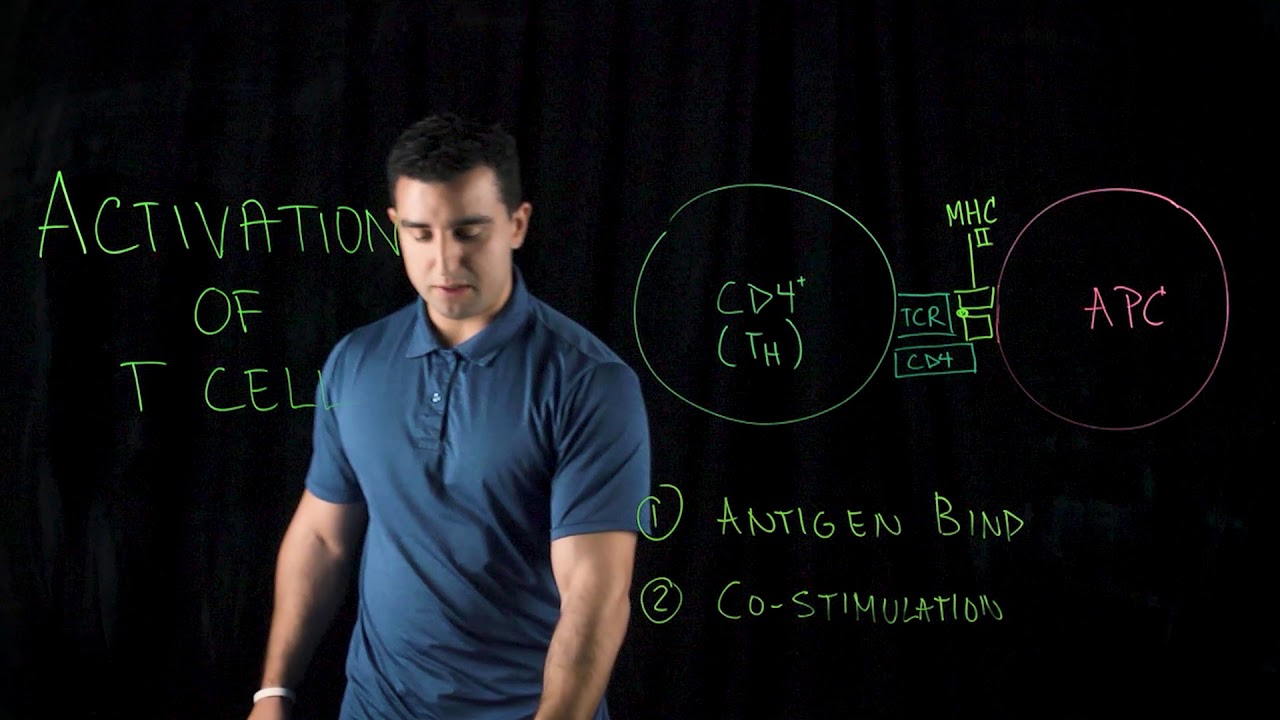
- 😀 Naive CD4+ T-cells first recognize antigen-presenting cells (APCs) that display antigen fragments via MHC2 peptide complexes.
- 😀 Antigen presentation is a key process where APCs engulf, digest, and present antigens on their surface using MHC2 molecules.
- 😀 The first signal in T-cell activation occurs when the TCR binds to the antigen and the CD4 co-receptor binds to MHC2 molecules on the APC.
- 😀 Full T-cell activation requires a second signal, called co-stimulation, which enhances the first signal and prevents inactivity (anergy).
- 😀 The most important co-stimulatory molecules are CD28 on T-cells and B7 on APCs.
- 😀 Activated T-cells secrete interleukin-2 (IL-2), which binds to its own receptor on the same T-cell, promoting its proliferation and differentiation.
- 😀 Proliferation and differentiation of T-cells result in the generation of effector T-cells and memory T-cells.
- 😀 CD4+ effector T-cells can differentiate into various subsets, such as T-helper cells, while memory T-cells provide long-term immunity.
- 😀 The activation of CD8+ T-cells follows a similar process to CD4+ T-cells, but these cells recognize antigen presented by MHC1 molecules.
- 😀 Once activated, CD8+ T-cells differentiate into cytotoxic T-cells that target and destroy infected cells, as well as memory T-cells for future immunity.
Q & A
What are the two main types of T cells discussed in the transcript?
-The two main types of T cells discussed are CD4+ T cells (helper T cells) and CD8+ T cells (cytotoxic T cells).
What is the significance of the two-signal process in T cell activation?
-The two-signal process is crucial for full T cell activation. The first signal involves the binding of the T cell receptor (TCR) to the antigen, and the second signal involves co-stimulation to prevent T cell inactivation (anergy).
How do antigen-presenting cells (APCs) contribute to T cell activation?
-APCs engulf antigens through phagocytosis, digest them into peptide fragments, and display these fragments on their surface using MHCII molecules. This presentation is crucial for recognizing and activating T cells.
What role do MHC molecules play in T cell activation?
-MHC (Major Histocompatibility Complex) molecules present peptide fragments from antigens on the surface of APCs. CD4+ T cells recognize these fragments on MHCII molecules, while CD8+ T cells recognize antigens on MHC1 molecules.
Why is co-stimulation important for T cell activation?
-Co-stimulation is essential to ensure full T cell activation. Without it, the T cells that recognize the antigen remain inactive, a state known as anergy. Co-stimulatory molecules like CD28 and B7 facilitate this second signal.
What are some examples of co-stimulatory molecules mentioned in the transcript?
-Examples of co-stimulatory molecules include CD28 on T cells and B7 on APCs. Other co-stimulatory molecules include CD2 and CD45.
What happens after T cells receive both activation signals?
-After receiving both signals, T cells undergo rapid proliferation and differentiation. They generate effector cells (e.g., helper T cells or cytotoxic T cells) and memory cells that can respond more quickly in future encounters with the same antigen.
What is the function of IL-2 in T cell activation?
-IL-2 is a cytokine secreted by activated T cells that binds to receptors on the same T cell. It functions in autocrine signaling, promoting T cell proliferation and the generation of effector and memory cells.
What is the difference between the activation of CD4+ and CD8+ T cells?
-Both CD4+ and CD8+ T cells undergo a similar activation process, but CD4+ T cells recognize antigens presented on MHCII molecules, while CD8+ T cells recognize antigens on MHC1 molecules. CD8+ T cell activation also relies on cytokines produced by helper T cells.
What is the importance of memory T cells?
-Memory T cells are crucial for faster immune responses in case of future encounters with the same pathogen. They can quickly proliferate and differentiate into effector cells, providing long-term immunity.
Outlines

Esta sección está disponible solo para usuarios con suscripción. Por favor, mejora tu plan para acceder a esta parte.
Mejorar ahoraMindmap

Esta sección está disponible solo para usuarios con suscripción. Por favor, mejora tu plan para acceder a esta parte.
Mejorar ahoraKeywords

Esta sección está disponible solo para usuarios con suscripción. Por favor, mejora tu plan para acceder a esta parte.
Mejorar ahoraHighlights

Esta sección está disponible solo para usuarios con suscripción. Por favor, mejora tu plan para acceder a esta parte.
Mejorar ahoraTranscripts

Esta sección está disponible solo para usuarios con suscripción. Por favor, mejora tu plan para acceder a esta parte.
Mejorar ahoraVer Más Videos Relacionados
Activation of T Cells

110 Signaling Examples

ATIVAÇÃO DE LINFÓCITOS B (ENSINO SUPERIOR) - IMUNOLOGIA
Peripheral T cell Tolerance - Clonal Deletion and Anergy (FL-Immuno/78)

Imunosupresan (1): Aktivasi dan Diferensiasi Sel Limfosit T

B cell Activation and Differentiation (PART 1): T Independent Activation (FL-Immuno/48)
5.0 / 5 (0 votes)

