How to tell the difference between permutation and combination
Summary
TLDRThis video explains the key differences between permutation and combination, highlighting when to use each concept. It walks through examples, starting with how prizes are distributed among 10 people (permutation), followed by distributing identical prizes (combination). The video also covers how to form committees with specific requirements, such as a school board selecting a committee of 3 people from 8 candidates. Throughout, the video emphasizes the importance of considering order in permutations and ignoring it in combinations, while demonstrating various scenarios with clear mathematical explanations.
Takeaways
- 😀 Permutation involves scenarios where the order matters, while combination is used when the order does not matter.
- 😀 If you count permutations when combinations are needed, you may end up overcounting, which is why it's important to distinguish between the two.
- 😀 In a permutation problem, such as distributing three different bills to 10 people, the number of ways to distribute is calculated by multiplying the number of choices for each prize (10 * 9 * 8 = 720).
- 😀 For a permutation with 3 items out of 10, the formula is 10P3, which simplifies to 10! / (10-3)!, or 10 * 9 * 8.
- 😀 When solving combination problems, you must account for overcounting by dividing by the factorial of the number of items being chosen (e.g., 3! in a combination problem).
- 😀 In a combination problem, like giving out three $5 prizes among 10 people, the formula becomes 10 choose 3, or 10C3, which simplifies to 120.
- 😀 The difference between combinations and permutations becomes clear when order doesn't matter: combinations divide by the factorial of the number of chosen items to eliminate overcounting.
- 😀 In problems involving committees or selections, such as forming a committee from 8 people, if order doesn't matter, a combination is used (e.g., 8 choose 3 = 56).
- 😀 If a committee has roles with different responsibilities, then a permutation must be used (e.g., 8P3 = 336).
- 😀 Complex problems can involve conditions, such as selecting two girls and one boy from a group of 5 girls and 3 boys. This can be solved by calculating the number of ways to choose the girls and boys separately, then multiplying the results (e.g., 5C2 * 3C1 = 30).
Q & A
What is the main difference between permutations and combinations?
-The main difference is that in permutations, order matters, while in combinations, order does not matter.
In the first example, why is the distribution of prizes a permutation problem?
-The distribution of the prizes is a permutation because the order in which the prizes (the $20, $10, and $5 bills) are given out matters to the recipients.
How do you solve the permutation problem where 3 prizes are distributed among 10 people?
-You solve it by multiplying the possibilities for each prize: 10 choices for the first, 9 for the second, and 8 for the third. This results in 10 * 9 * 8 = 720 possibilities.
What formula is used to solve the permutation problem?
-The formula for permutations is nP3 = n! / (n - r)!, where n is the total number of items, and r is the number of selections. In this case, it’s 10P3 = 10! / 7!.
Why is the second example a combination problem rather than a permutation?
-This is a combination problem because the order of the $5 prizes does not matter. The goal is simply to choose 3 people from 10, not to assign specific prizes to specific people.
How do you calculate the number of ways to distribute 3 identical $5 prizes among 10 people?
-You use the combination formula 10 choose 3 (10C3). After solving for the possible selections, you divide by the number of ways to arrange the 3 identical prizes, resulting in 120 ways.
How is the formula for a combination different from the permutation formula?
-The combination formula is nCr = n! / (r! * (n - r)!), which includes an additional r! to account for the fact that the order does not matter.
How many ways can a committee of 3 people be formed from a school board of 8 members?
-There are 56 ways to form a committee of 3 people from 8 members, which can be calculated using the combination formula 8C3 = 8! / (3! * 5!).
In the example with 3 different responsibilities, why is this a permutation problem?
-This is a permutation problem because the responsibilities are distinct, and the order in which the committee members are assigned these responsibilities matters.
How do you calculate the number of ways to assign 3 different responsibilities to 3 people from a group of 8?
-You use the permutation formula 8P3, which is calculated as 8 * 7 * 6 = 336 ways.
How do you handle a scenario where a committee needs to have specific numbers of girls and boys?
-You calculate the number of ways to choose the required number of girls and boys separately, and then multiply those results. For example, if you need 2 girls and 1 boy, you calculate the combination for selecting 2 girls from 5 and 1 boy from 3, then multiply those results.
How do you solve the problem where a committee of 3 must consist of 2 girls and 1 boy from 5 girls and 3 boys?
-First, calculate the combination for choosing 2 girls from 5 (5C2) and then multiply it by the combination for choosing 1 boy from 3 (3C1). The result is 30 ways.
Outlines

Esta sección está disponible solo para usuarios con suscripción. Por favor, mejora tu plan para acceder a esta parte.
Mejorar ahoraMindmap

Esta sección está disponible solo para usuarios con suscripción. Por favor, mejora tu plan para acceder a esta parte.
Mejorar ahoraKeywords

Esta sección está disponible solo para usuarios con suscripción. Por favor, mejora tu plan para acceder a esta parte.
Mejorar ahoraHighlights

Esta sección está disponible solo para usuarios con suscripción. Por favor, mejora tu plan para acceder a esta parte.
Mejorar ahoraTranscripts

Esta sección está disponible solo para usuarios con suscripción. Por favor, mejora tu plan para acceder a esta parte.
Mejorar ahoraVer Más Videos Relacionados

PERMUTATIONS AND COMBINATIONS || GRADE 10 MATHEMATICS Q3

Faktorial, permutasi, dan kombinasi
STATISTIKA Part 4 - PERBEDAAN BOX PLOT, HISTOGRAM DAN DOT PLOT
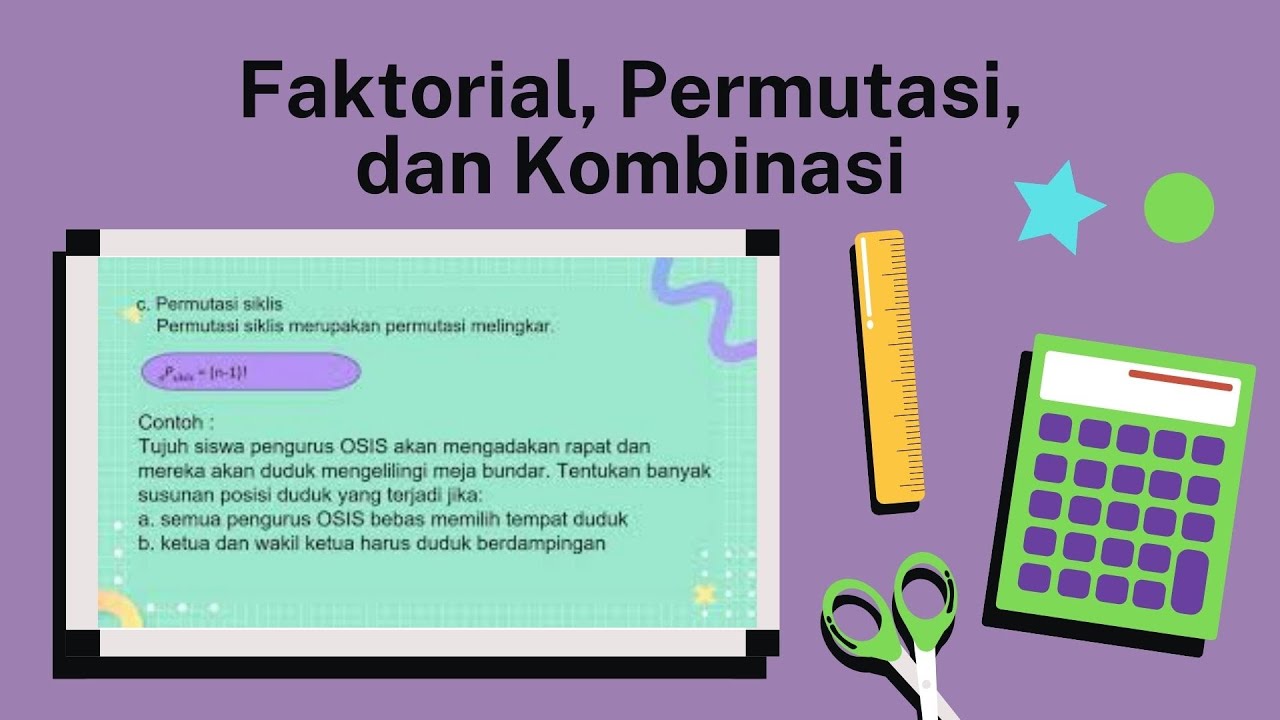
FAKTORIAL, PERMUTASI, DAN KOMBINASI | Video Pembelajaran Matematika

Difference Between Volatile, Atomic And Synchronized in Java | Race Condition In Multi-Threading

Percent Solutions
5.0 / 5 (0 votes)

