Fungsi Eksponen dan Grafiknya Materi Matematika Kelas 10 Semester 1
Summary
TLDRThis video provides a comprehensive guide to exponential functions and their graphs. It explains the basic and complex forms of exponential functions, demonstrates how to calculate function values using substitution, and shows step-by-step methods for plotting graphs. Viewers learn to determine functions from given points, analyze the behavior of graphs based on the base and coefficients, and understand key properties such as monotonicity and the effect of negative or fractional bases. The tutorial includes multiple examples and visual guidance to make exponential functions easier to grasp, offering practical insights for both learning and applying these mathematical concepts.
Takeaways
- 😀 Exponential functions are mathematical functions of the form f(x) = a^x, where 'a' is the base and 'x' is the exponent.
- 😀 A more complex exponential function can include additional variables in the exponent and a constant multiplier, such as f(x) = b * a^(g(x)) + c.
- 😀 Understanding the properties of exponents is essential for mastering exponential functions. These properties were covered in earlier lessons on powers and roots.
- 😀 The basic form of an exponential function is f(x) = a^x, while more complex forms might involve coefficients or more complex exponents.
- 😀 Examples of exponential functions include f(x) = 2^x, f(x) = 3^(5x), and f(x) = 3 * 5^x, showing the variation in base, exponent, and coefficients.
- 😀 To find the value of an exponential function, substitute the value of 'x' into the function. For example, for f(x) = 3^x + 1 - 2, substituting x = 1 gives f(1) = 7.
- 😀 When graphing an exponential function, create a table with x-values and their corresponding f(x)-values, then plot the points on a Cartesian plane.
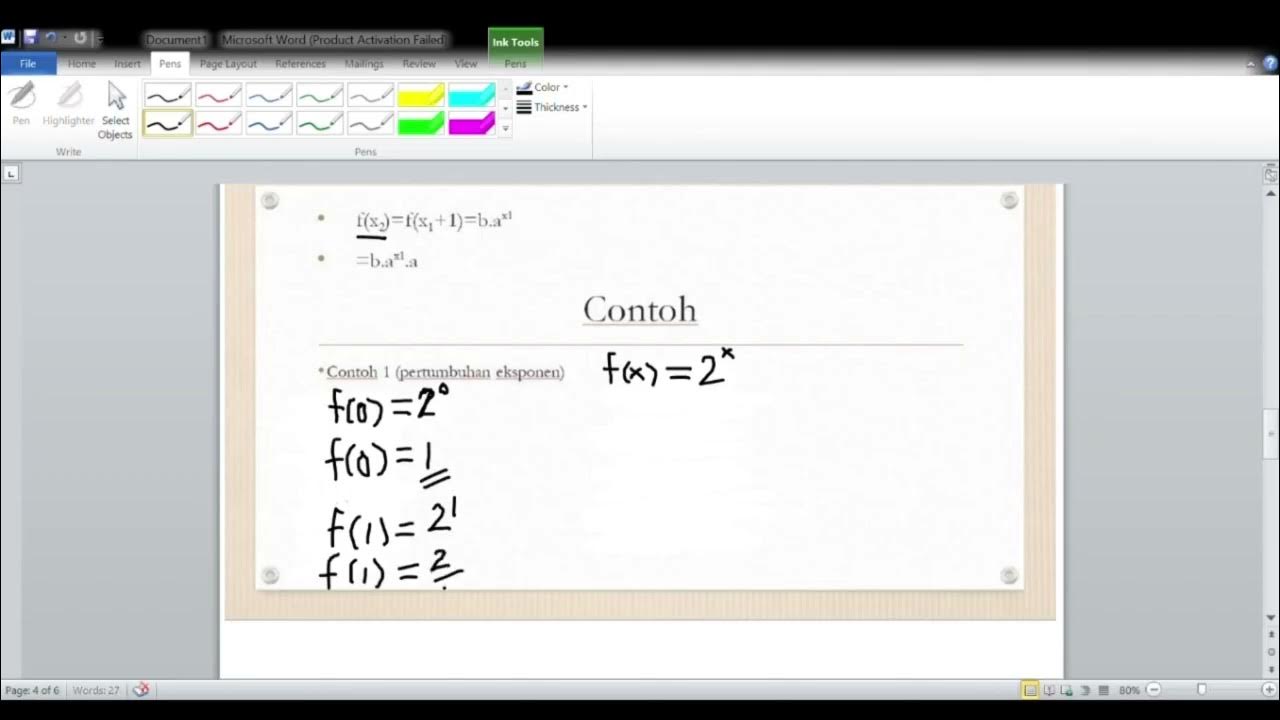
- 😀 Graphing an exponential function like f(x) = 2^x involves using values such as f(0) = 1, f(1) = 2, f(2) = 4, and f(-1) = 1/2.
- 😀 Exponential graphs tend to have a smooth curve and pass through the point (0, 1) for any function of the form a^x, where 'a' is a positive constant.
- 😀 The behavior of the graph changes depending on the base: if the base is greater than 1 (e.g., 2^x), the graph increases exponentially, while bases less than 1 cause the graph to decrease.
- 😀 Analyzing the graphs of exponential functions helps identify key features like the y-intercept, whether the function is increasing or decreasing, and its asymptotic behavior.
Q & A
What is an exponential function?
-An exponential function is a function in which the variable appears in the exponent. Its general form can be simple, like f(x) = a^x, or more complex, like f(x) = b * a^(g(x)) + c, where a is the base, g(x) is the exponent, b is a coefficient, and c is a constant.
What are the forms of exponential functions discussed in the video?
-The video explains two main forms: the simple form f(x) = a^x, and the complex form f(x) = b * a^(g(x)) + c, where the exponent g(x) can be linear, quadratic, or another expression.
How do you evaluate an exponential function for a specific x value?
-To evaluate an exponential function, substitute the given x value into the exponent and calculate the result using the base. For example, for f(x) = 3^(x+1) - 2 and x = 1, f(1) = 3^(1+1) - 2 = 9 - 2 = 7.
How do you solve an equation involving an exponential function?
-To solve an exponential equation, isolate the exponential term, express the number on the other side as a power of the same base, and then equate the exponents. Example: Solve 2^(x-1) - 1 = 31. Add 1: 2^(x-1) = 32 = 2^5 → x-1 = 5 → x = 6.
What are the steps to plot the graph of an exponential function?
-1. Create a table of x and y = f(x) values. 2. Plot these points on a Cartesian plane. 3. Connect the points smoothly to form the curve.
What is the behavior of exponential functions based on the base value?
-If the base a > 1, the exponential function increases (monotonically rising). If 0 < a < 1, the function decreases (monotonically falling).
How can you determine an exponential function given two points?
-Use the general form f(x) = k * a^x. Substitute the first point to find k, then substitute the second point to solve for a. Example: points (0,1) and (2,16) give k = 1 and a = 4 → f(x) = 4^x.
What is the effect of a coefficient in an exponential function, like in y = k * a^x?
-The coefficient k scales the graph vertically. The function passes through (0,k) instead of (0,1) if k ≠ 1, but the general exponential growth or decay behavior remains the same.
How does a negative exponent affect the function values?
-A negative exponent inverses the base raised to the corresponding positive exponent. For example, 2^-1 = 1/2, 2^-2 = 1/4, 2^-3 = 1/8, making the function values smaller for negative x.
How do you analyze the graph of an exponential function?
-To analyze an exponential graph, observe: 1) whether it is increasing or decreasing based on the base, 2) the point it passes through at x=0, and 3) the vertical scale if there is a coefficient multiplying the exponential term.
Can the exponent in an exponential function be a non-linear expression?
-Yes, the exponent can be a more complex expression, such as a quadratic or any function of x, for example, f(x) = 2^(x^2 + 2x - 8), which affects the shape of the graph accordingly.
Outlines

Dieser Bereich ist nur für Premium-Benutzer verfügbar. Bitte führen Sie ein Upgrade durch, um auf diesen Abschnitt zuzugreifen.
Upgrade durchführenMindmap

Dieser Bereich ist nur für Premium-Benutzer verfügbar. Bitte führen Sie ein Upgrade durch, um auf diesen Abschnitt zuzugreifen.
Upgrade durchführenKeywords

Dieser Bereich ist nur für Premium-Benutzer verfügbar. Bitte führen Sie ein Upgrade durch, um auf diesen Abschnitt zuzugreifen.
Upgrade durchführenHighlights

Dieser Bereich ist nur für Premium-Benutzer verfügbar. Bitte führen Sie ein Upgrade durch, um auf diesen Abschnitt zuzugreifen.
Upgrade durchführenTranscripts

Dieser Bereich ist nur für Premium-Benutzer verfügbar. Bitte führen Sie ein Upgrade durch, um auf diesen Abschnitt zuzugreifen.
Upgrade durchführen




5.0 / 5 (0 votes)

