Cause And Effect | Bahasa Inggris SMA Kelas 11
Summary
TLDRIn this video, the host teaches viewers about conjunctions used for expressing cause and effect in English. Through examples, the video explains how to use words like 'because', 'since', 'due to', and others to link causes and results in sentences. The host covers both causal conjunctions that emphasize the cause and those that highlight the effect, providing examples in both English and Indonesian. Viewers are encouraged to understand and practice these concepts through exercises, with the aim of mastering the use of conjunctions in everyday communication.
Takeaways
- 😀 Cause and effect (sebab-akibat) conjunctions help connect reasons (cause) with outcomes (effect) in sentences.
- 😀 The conjunction 'because' is used to explain the cause and is followed by a subject + verb.
- 😀 The conjunction 'since' also explains the cause and is followed by a subject + verb.
- 😀 'As a result of' is used for cause and is followed by a noun (thing), not a verb.
- 😀 'Because of' is used when referring to a noun (thing) as the cause.
- 😀 'So' connects the cause with the effect and is followed by a subject + verb.
- 😀 'Therefore' is another conjunction used for effect, followed by a subject + verb.
- 😀 'Accordingly' can be used to indicate effect and is also followed by a subject + verb.
- 😀 When explaining cause or reason, the sentence structure requires the use of conjunctions such as 'because,' 'since,' and 'as a result of.'
- 😀 When showing the effect or result, conjunctions like 'so,' 'therefore,' and 'accordingly' are used, also requiring subject + verb.
- 😀 Example sentences demonstrate the proper use of conjunctions, such as 'Susan is studying economics because she wants to be a financial advisor.'
Q & A
What is the meaning of the phrase 'I will never play hide and seek with you because someone like you is impossible to find'?
-This phrase is a playful compliment, implying that the person is so unique or special that they can't be found, just like how it's difficult to find someone in a game of hide and seek.
What is a conjunction in the context of the script?
-A conjunction is a word that connects clauses or sentences. In this video, the focus is on conjunctions used to show cause and effect, such as 'because', 'since', and 'as a result of'.
How is 'because' used in English sentences?
-'Because' is used to introduce the reason or cause in a sentence. It must be followed by a subject and a verb. For example, 'Susan is studying economics because she wants to be a financial advisor.'
What are the differences between 'because', 'since', and 'as' when used as conjunctions?
-'Because' and 'since' are followed by a subject and verb, while 'as a result of' and 'because of' must be followed by a noun or noun phrase.
Give an example of how 'as a result of' is used in a sentence.
-An example sentence is: 'She fell ill as a result of overworking.' In this case, 'overworking' is a noun phrase that follows the conjunction.
What is the meaning of 'due to' in conjunction with a noun?
-'Due to' is used to show the cause of something and must be followed by a noun. For example, 'Due to the traffic, I was late for the meeting.' Here, 'traffic' is the noun after 'due to'.
How does 'so' function as a conjunction?
-'So' is used to introduce the effect or result of an action. It is followed by a subject and verb. For example, 'My sister doesn't know how to drive, so she always asks our brother to drive for her.'
What is the purpose of 'therefore' in English?
-'Therefore' is used to introduce a conclusion or result based on the information given before. For example, 'He was late for the meeting; therefore, he missed the presentation.'
How is 'thanks to' used in a sentence?
-'Thanks to' is used to express gratitude or give credit for a positive outcome. For example, 'Thanks to my teacher's patience, I passed the test with a good score.'
What is the difference between cause and effect in a sentence?
-The cause is the reason something happens, while the effect is the result. For example, in the sentence 'Tobi failed his exam because he didn't study', 'didn't study' is the cause, and 'failed his exam' is the effect.
Outlines

Dieser Bereich ist nur für Premium-Benutzer verfügbar. Bitte führen Sie ein Upgrade durch, um auf diesen Abschnitt zuzugreifen.
Upgrade durchführenMindmap

Dieser Bereich ist nur für Premium-Benutzer verfügbar. Bitte führen Sie ein Upgrade durch, um auf diesen Abschnitt zuzugreifen.
Upgrade durchführenKeywords

Dieser Bereich ist nur für Premium-Benutzer verfügbar. Bitte führen Sie ein Upgrade durch, um auf diesen Abschnitt zuzugreifen.
Upgrade durchführenHighlights

Dieser Bereich ist nur für Premium-Benutzer verfügbar. Bitte führen Sie ein Upgrade durch, um auf diesen Abschnitt zuzugreifen.
Upgrade durchführenTranscripts

Dieser Bereich ist nur für Premium-Benutzer verfügbar. Bitte führen Sie ein Upgrade durch, um auf diesen Abschnitt zuzugreifen.
Upgrade durchführenWeitere ähnliche Videos ansehen

Cause and Effect Expressions | Because of, Due to .. | Materi Bahasa Inggris Kelas 11

Internal & External Conjunctions || EAP Week 7
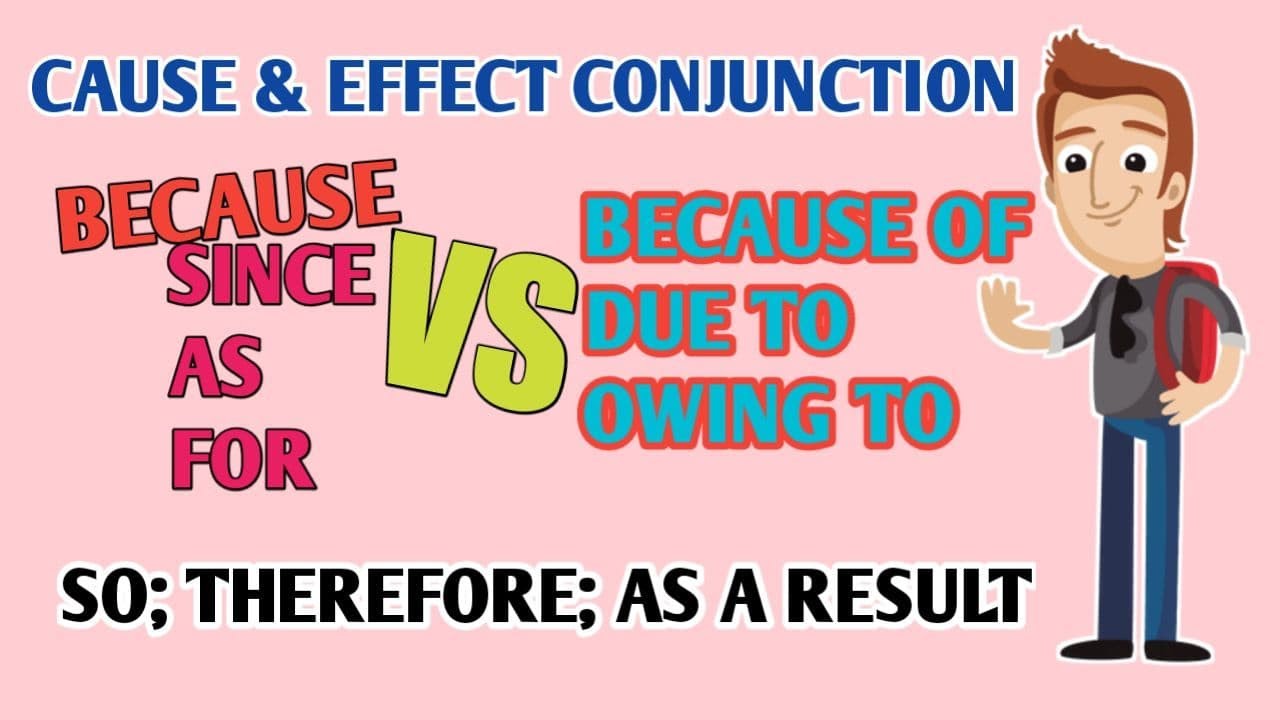
CAUSE & EFFECT CONJUNCTION (BECAUSE; SINCE; AS; FOR vs BECAUSE OF; DUE TO; OWING TO)

Penggunaan Sub Coordinate Conjunction dan Contohnya Dalam Bahasa Inggris (English Grammar Eps:13)
SO...THAT vs SUCH...THAT | BAHASA & SASTRA INGGRIS KELAS XII

CAUSE AND EFFECT/KALIMAT SEBAB AKIBAT/ MATERI BAHASA INGGRIS KELAS 12
5.0 / 5 (0 votes)

