Trigonometri Dasar: Sin Cos Tan | Depan Samping Miring | Matematika SMA
Summary
TLDRThis video provides a clear and beginner-friendly introduction to basic trigonometry, focusing on right-angled triangles. It explains the core concepts of sine, cosine, and tangent, including how to identify the opposite, adjacent, and hypotenuse sides relative to a given angle. Using practical examples and Pythagorean triples, the video demonstrates step-by-step calculations for different angles, emphasizing that trigonometric values depend on the chosen reference angle. Viewers also learn simple mnemonic techniques to remember formulas. The tutorial concludes by encouraging further learning on special angles and inviting engagement through comments, likes, and subscriptions.
Takeaways
- 😀 Trigonometry is based on right-angled triangles and the relationship between their sides and angles.
- 😀 The three main trigonometric ratios are sine (sin), cosine (cos), and tangent (tan).
- 😀 Sine (sin) is calculated as the opposite side divided by the hypotenuse.
- 😀 Cosine (cos) is calculated as the adjacent side divided by the hypotenuse.
- 😀 Tangent (tan) is calculated as the opposite side divided by the adjacent side.
- 😀 The sides of a triangle can be remembered relative to an angle as opposite, adjacent, and hypotenuse.
- 😀 Mnemonics like 'Depan / Miring' for sin, 'Samping / Miring' for cos, and 'Depan / Samping' for tan help memorize the formulas.
- 😀 The trigonometric values depend on which angle is chosen as the reference; changing the angle changes which sides are opposite or adjacent.
- 😀 Classic Pythagorean triples (like 3-4-5) are useful for quickly calculating trigonometric ratios.
- 😀 Beginners should first focus on understanding trigonometry in right-angled triangles before moving to special angles like 30°, 45°, and 60°.
- 😀 Visualizing the triangle and labeling sides clearly is essential to correctly apply trigonometric ratios.
- 😀 Practice applying these formulas with different angles to strengthen understanding of how trigonometric values change with angle perspective.
Q & A
What is the main topic of the video?
-The main topic of the video is basic trigonometry, specifically focusing on trigonometric ratios in a right-angled triangle.
What is the relationship between trigonometry and a right-angled triangle?
-Trigonometry is based on the properties of a right-angled triangle, where the ratios of the sides of the triangle (opposite, adjacent, and hypotenuse) are used to define the trigonometric functions.
What does the sine function (sin) represent in trigonometry?
-The sine function (sin) represents the ratio of the length of the side opposite an angle to the length of the hypotenuse in a right-angled triangle.
What is the mnemonic used to remember the sine function?
-The mnemonic used is 'Demi' which stands for 'depan per miring', meaning 'opposite over hypotenuse'.
What does the cosine function (cos) represent in trigonometry?
-The cosine function (cos) represents the ratio of the length of the adjacent side to the length of the hypotenuse in a right-angled triangle.
How is the tangent function (tan) defined?
-The tangent function (tan) is defined as the ratio of the length of the side opposite an angle to the length of the adjacent side in a right-angled triangle.
What is the key difference between sine, cosine, and tangent?
-The key difference is that sine uses the opposite side and hypotenuse, cosine uses the adjacent side and hypotenuse, and tangent uses the opposite side and adjacent side of the triangle.
How are the values of trigonometric functions different for different angles?
-The values of sine, cosine, and tangent depend on the angle in question. For example, the values for sin, cos, and tan of angle X will differ from those of angle C, even if the sides of the triangle are the same.
What is the significance of the Pythagorean theorem in trigonometry?
-The Pythagorean theorem helps to determine the length of the hypotenuse in a right-angled triangle, which is essential for calculating trigonometric ratios like sine, cosine, and tangent.
What is the next topic the video suggests learning after basic trigonometry?
-The video suggests learning about trigonometry for special angles, which is a more advanced topic in trigonometry.
Outlines

هذا القسم متوفر فقط للمشتركين. يرجى الترقية للوصول إلى هذه الميزة.
قم بالترقية الآنMindmap

هذا القسم متوفر فقط للمشتركين. يرجى الترقية للوصول إلى هذه الميزة.
قم بالترقية الآنKeywords

هذا القسم متوفر فقط للمشتركين. يرجى الترقية للوصول إلى هذه الميزة.
قم بالترقية الآنHighlights

هذا القسم متوفر فقط للمشتركين. يرجى الترقية للوصول إلى هذه الميزة.
قم بالترقية الآنTranscripts

هذا القسم متوفر فقط للمشتركين. يرجى الترقية للوصول إلى هذه الميزة.
قم بالترقية الآنتصفح المزيد من مقاطع الفيديو ذات الصلة
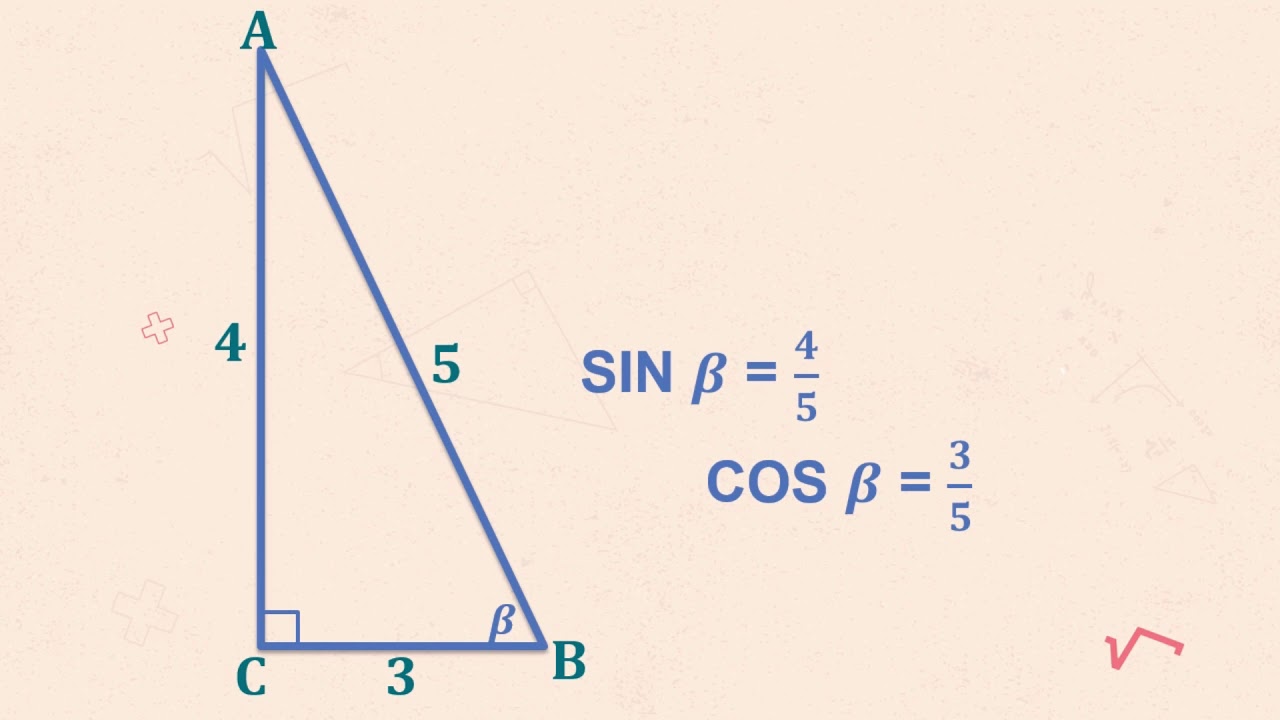
Video Pembelajaran Perbandingan Trigonometri Kelas X SMK

Grade 10 Trigonometry: Trig Ratios Sin, Cos and Tan
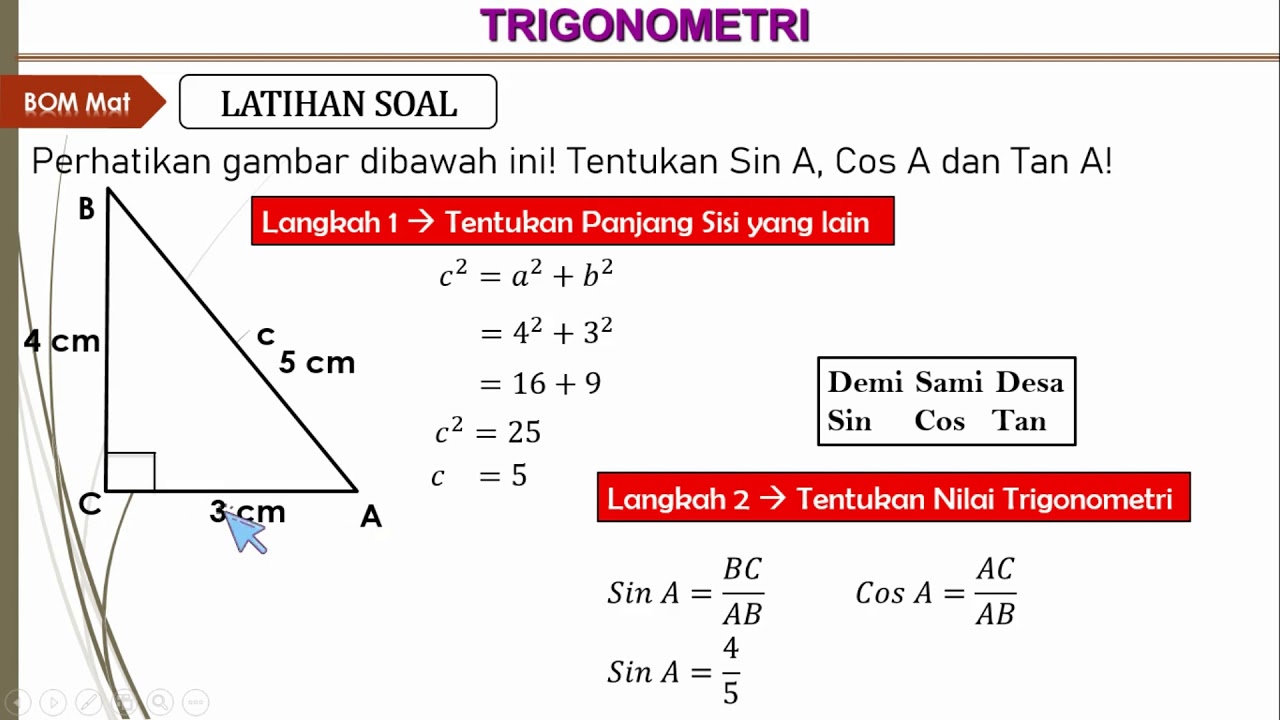
Perbandingan trigonometri pada segitiga siku siku, Menjelaskan rasio trigonometri
Triunghiul dreptunghic, teorema 30 60 90, teorema medianei, teorema lui Pitagora si reciproca, arie

(Trigono I)perbandingan trigono
¿Qué son las razones trigonométricas? @MatematicasprofeAlex
5.0 / 5 (0 votes)

