Aplikasi Trigonometri (Soal Cerita) - Part 1
Summary
TLDRThis video explains how trigonometry can be applied to solve real-world problems involving right triangles. It demonstrates the use of sine, cosine, and tangent to calculate heights, distances, and lengths, using examples like calculating the height of a wall from a ladder and the length of a supporting cable for an electrical pole. The script covers essential trigonometric concepts, including elevation and depression angles, and provides step-by-step instructions on how to apply these concepts to various practical scenarios, offering clear and concise solutions.
Takeaways
- 😀 Trigonometric ratios (sine, cosine, tangent) are essential for solving real-world problems, such as determining the height of buildings or distances.
- 😀 It's crucial to understand the problem's characteristics before building a mathematical model. Key variables include height, distance, and angles.
- 😀 Variables should be defined clearly before solving the problem. For example, height could be represented by 'T' and distance by 'D'.
- 😀 A model for the problem can be created by using trigonometric functions based on known variables (e.g., using tangent for finding height).
- 😀 After formulating the mathematical model, substitute known values and solve for the unknown variables to find the answer.
- 😀 The results should be interpreted correctly. For example, a height calculation should consider the eye level of the observer.
- 😀 Elevation and depression angles are fundamental concepts in trigonometry, where elevation refers to looking upwards and depression refers to looking downwards.
- 😀 The application of trigonometry can be demonstrated using real-world problems such as determining the height of a building using a ladder at an angle.
- 😀 In the example of a ladder leaning against a building, the sine and cosine functions are used to determine the height of the building and the distance from the building.
- 😀 A real-world application also included the calculation of the length of a supporting wire for a utility pole, using trigonometric functions like sine and cosine.
Q & A
What is the main focus of this video?
-The main focus of the video is on applying trigonometry to real-life problems, particularly in determining the height of buildings, the distance between objects, and the length of supporting ropes using trigonometric functions like sine, cosine, and tangent.
What are the key concepts discussed in the video?
-The key concepts discussed include the identification of variables, understanding the relationships between angles and sides of triangles, and using trigonometric functions (sine, cosine, tangent) to solve real-world problems such as calculating height, distance, and length.
Why is it important to define variables when solving trigonometric problems?
-Defining variables is essential because it helps in translating the problem into a mathematical model. By assigning appropriate variables to known and unknown quantities, we can apply the correct trigonometric functions to find the solution.
How do we choose which trigonometric function to use in a problem?
-The choice of trigonometric function depends on the given information in the problem. For example, if the opposite and adjacent sides are involved, tangent is used; if the opposite side and hypotenuse are involved, sine is used; and if the adjacent side and hypotenuse are involved, cosine is used.
What is the role of angle elevation and depression in trigonometric problems?
-Angle of elevation refers to the angle formed when looking upward from a point, while angle of depression refers to the angle when looking downward. These angles help in determining the height of objects and distances when using trigonometric functions.
In the ladder example, how do we calculate the height of the building?
-In the ladder example, the height of the building is calculated using the tangent function. The formula is tan(60°) = height / distance. By rearranging and substituting known values, the height is found to be 3√3 meters.
How do we find the distance between the ladder and the wall?
-The distance between the ladder and the wall is found using the cosine function. The formula cos(60°) = distance / ladder length is used, and after solving, the distance is found to be 3 meters.
What is the significance of using sine in the rope problem?
-In the rope problem, sine is used to calculate the length of the rope, as it relates the height of the pole (opposite side) to the rope length (hypotenuse). The formula sin(45°) = height / rope length is applied to find the rope length.
What can be learned from the example of the utility pole and rope?
-The example of the utility pole and rope demonstrates how trigonometry can be used to calculate the length of a rope needed to support a pole. By applying the sine function, the length of the rope is determined to be 10√2 meters.
Why is it important to understand the relationship between trigonometric functions and real-world objects?
-Understanding the relationship between trigonometric functions and real-world objects is important because it allows us to apply mathematical concepts to solve practical problems, such as determining the height of a building, the distance between objects, or the length of a supporting structure.
Outlines

هذا القسم متوفر فقط للمشتركين. يرجى الترقية للوصول إلى هذه الميزة.
قم بالترقية الآنMindmap

هذا القسم متوفر فقط للمشتركين. يرجى الترقية للوصول إلى هذه الميزة.
قم بالترقية الآنKeywords

هذا القسم متوفر فقط للمشتركين. يرجى الترقية للوصول إلى هذه الميزة.
قم بالترقية الآنHighlights

هذا القسم متوفر فقط للمشتركين. يرجى الترقية للوصول إلى هذه الميزة.
قم بالترقية الآنTranscripts

هذا القسم متوفر فقط للمشتركين. يرجى الترقية للوصول إلى هذه الميزة.
قم بالترقية الآنتصفح المزيد من مقاطع الفيديو ذات الصلة

Geometry 8-3: The Law of Sines

TRIGONOMETRI SUDUT ISTIMEWA
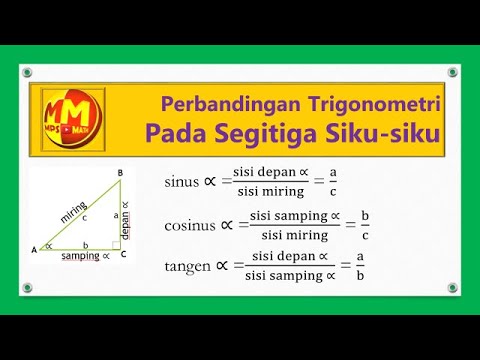
Perbandingan Trigonometri Pada Segitiga SIku-siku #Trigonometri
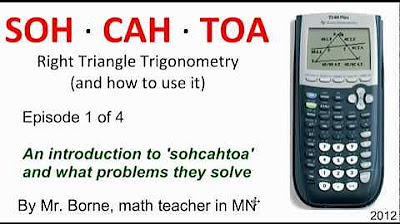
SOHCAHTOA using the TI-84 Plus

Manipulating the Trig Ratios in Geometry (example question)
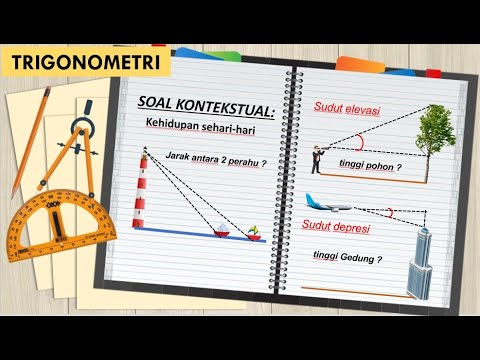
TRIGONOMETRI (5): PEMBAHASAN SOAL KONTEKSTUAL PERBANDINGAN TRIGONOMETRI ATAU APLIKASI SEHARI-HARI
5.0 / 5 (0 votes)

