Angles in Polygons | GCSE Maths
Summary
TLDRThis educational video provides an in-depth look at calculating angles in polygons. It covers finding the sum of interior angles, calculating individual interior and exterior angles, and solving related problems. The video explores irregular polygons and offers practical examples, demonstrating the step-by-step process of using formulas like 'n - 2' to determine the number of triangles in a polygon. It also guides viewers through finding unknown angles in various polygons, offering practice questions and problem-solving tips for real exam scenarios.
Takeaways
- 😀 The sum of interior angles in any polygon can be found by dividing the shape into triangles and multiplying the number of triangles by 180°.
- 😀 To find the number of triangles in a polygon, subtract 2 from the number of sides (n - 2).
- 😀 The formula for the sum of interior angles is: (n - 2) * 180°, where n is the number of sides.
- 😀 To find one interior angle of a regular polygon, divide the sum of interior angles by the number of sides.
- 😀 The exterior angle of a polygon is calculated by subtracting the interior angle from 180°.
- 😀 For irregular polygons, the same principles apply, just count the sides to calculate the sum of interior angles and then divide by the number of sides to find one angle.
- 😀 The sum of interior angles of a polygon increases with the number of sides. For example, a decagon (10 sides) has 8 triangles, and the sum of its interior angles is 1440°.
- 😀 To calculate the exterior angle, first find the interior angle, then subtract it from 180° (since angles on a straight line add up to 180°).
- 😀 Angles around a point always add up to 360°, which can help in solving problems involving missing angles or calculating unknowns.
- 😀 In exam-style problems, knowing how to break down the shape into triangles and apply the formula correctly is crucial for solving angle-related questions.
Q & A
What is the formula for finding the sum of interior angles of a polygon?
-The formula to find the sum of the interior angles of a polygon is (n - 2) * 180°, where 'n' is the number of sides of the polygon.
How do you calculate the sum of interior angles for irregular polygons?
-For irregular polygons, the sum of interior angles is calculated the same way as for regular polygons. First, determine the number of sides 'n', then use the formula (n - 2) * 180° to find the total sum of the interior angles.
How do you find the interior angle of a regular polygon?
-To find the interior angle of a regular polygon, first calculate the sum of the interior angles using the formula (n - 2) * 180°, and then divide the sum by the number of sides 'n' to find the measure of each interior angle.
What is the relationship between the number of sides and triangles in a polygon?
-In any polygon, the number of triangles formed by drawing diagonals from one vertex is equal to (n - 2), where 'n' is the number of sides of the polygon.
How do you find the exterior angle of a polygon?
-To find the exterior angle of a regular polygon, subtract the interior angle from 180°. The exterior angle is the angle between one side of the polygon and the extended adjacent side.
How do you find the interior angle of a hexagon?
-A hexagon has six sides. Using the formula (n - 2) * 180°, we calculate the sum of the interior angles as (6 - 2) * 180° = 720°. Then, divide the sum by the number of sides (6) to get the interior angle: 720° ÷ 6 = 120°.
What do you do when asked to find the size of one interior angle for a polygon with an even number of sides?
-First, calculate the sum of the interior angles using the formula (n - 2) * 180°. Then, divide the result by the number of sides to get the size of one interior angle.
What happens when you extend the sides of a polygon to calculate the exterior angle?
-When you extend a side of a polygon, the exterior angle is the angle between the extended side and the adjacent side. The sum of the exterior and interior angles at any vertex of a polygon is always 180°.
How do you approach problems involving angles around a point?
-When dealing with angles around a point, remember that the sum of all angles around a point is 360°. To find an unknown angle, subtract the sum of the known angles from 360°.
What is the approach for solving complex exam-style problems involving polygons?
-In complex problems, first identify the type of polygon and use the appropriate formulas for sum of interior angles or exterior angles. Then, use logical steps such as subtraction from 360° (for angles around a point) or division to find individual angles, applying knowledge of the polygon's sides and properties.
Outlines

هذا القسم متوفر فقط للمشتركين. يرجى الترقية للوصول إلى هذه الميزة.
قم بالترقية الآنMindmap

هذا القسم متوفر فقط للمشتركين. يرجى الترقية للوصول إلى هذه الميزة.
قم بالترقية الآنKeywords

هذا القسم متوفر فقط للمشتركين. يرجى الترقية للوصول إلى هذه الميزة.
قم بالترقية الآنHighlights

هذا القسم متوفر فقط للمشتركين. يرجى الترقية للوصول إلى هذه الميزة.
قم بالترقية الآنTranscripts

هذا القسم متوفر فقط للمشتركين. يرجى الترقية للوصول إلى هذه الميزة.
قم بالترقية الآنتصفح المزيد من مقاطع الفيديو ذات الصلة
Matematika Kelas 8 Bab 4 - Sudut Luar Segi Banyak - hal. 113 - 114 - Kurikulum Merdeka
Matematika Kelas 8 Bab 4 - Sudut Dalam Segi Banyak - hal. 110 - 112 - Kurikulum Merdeka

Angles in Polygons
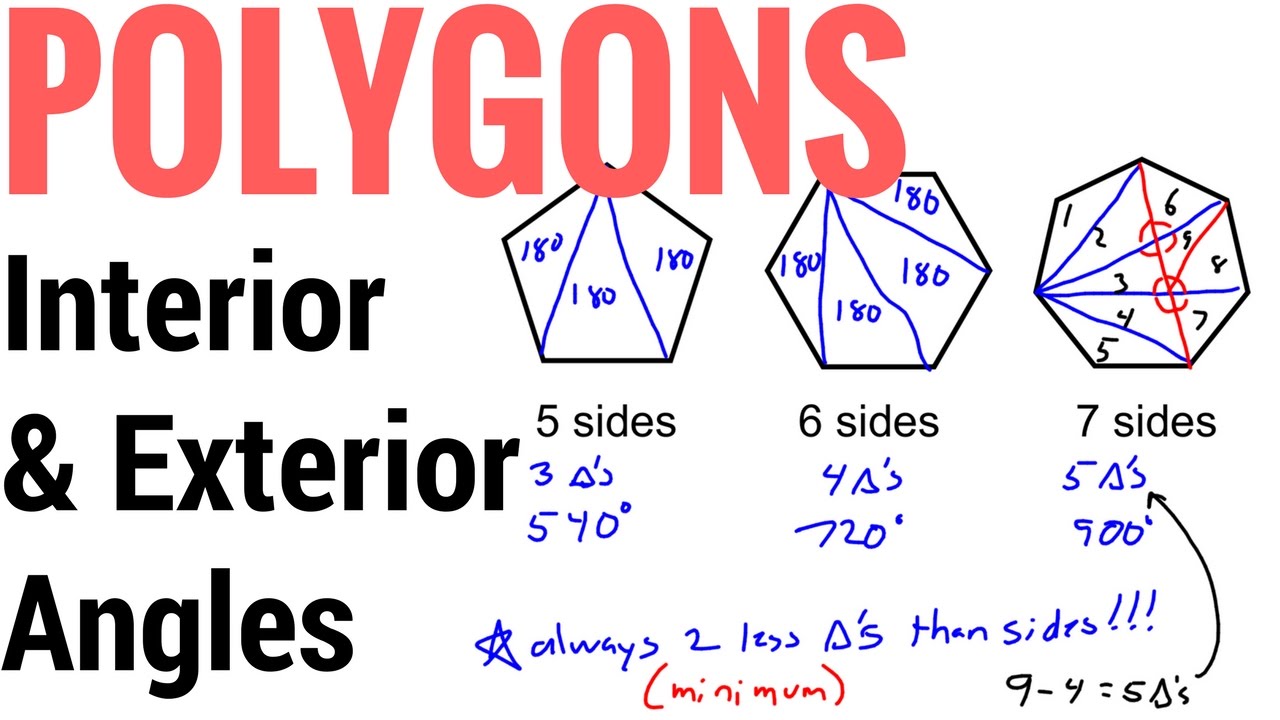
Interior and Exterior angles of polygons

Grade 7 Classify and illustrate polygons first quarter week 1 #kindsofpolygon #polygon #matatag

Segi Banyak | Matematika Kelas 4 SD
5.0 / 5 (0 votes)

