MATEMATIKA KELAS 8 HALAMAN 174-175 KURIKULUM MERDEKA EDISI 2021
Summary
TLDRThis video from 1001 Ide explains probability for 8th-grade mathematics, focusing on relative frequency and the likelihood of events. Using experiments like rolling a die and flipping bottle caps, it demonstrates how to calculate relative frequencies and observe their trends over multiple trials. As the number of trials increases, the relative frequency approaches a fixed value, representing the event's probability. Examples include finding the probability of rolling a 3 on a die, rolling an even number, and a bottle cap landing upside down. The video emphasizes understanding probability through practical experiments and interpreting results, making abstract concepts tangible and relatable.
Takeaways
- 😀 The video covers probability for 8th-grade mathematics, based on pages 174–175 of the 2021 Merdeka Learning curriculum.
- 😀 Probability is defined as a number representing the likelihood of a particular event occurring.
- 😀 Frequency relative is calculated by dividing the number of occurrences of an event by the total number of trials.
- 😀 In an experiment of rolling a die 50 times, the occurrence of a specific number like 3 can vary and is initially an estimate.
- 😀 As the number of trials increases, the relative frequency stabilizes and approaches a fixed value, representing the event's probability.
- 😀 Example: The probability of rolling a 3 on a die approaches 0.17 after many trials.
- 😀 The probability of rolling an even number on a die is calculated as 3 favorable outcomes out of 6 total, giving 0.5.
- 😀 Another example involves flipping a bottle to see it land upside down, with frequency relative calculated at each trial count.
- 😀 As the number of bottle flips increases up to 1000, the frequency relative of it landing upside down stabilizes around 0.42, which is the probability.
- 😀 The video emphasizes that probability derived from experiments becomes more accurate as the number of trials increases.
- 😀 The key lesson is that experimental probability is a practical way to understand real-world chance and outcomes.
- 😀 Understanding relative frequency helps in predicting probabilities even when exact outcomes cannot be guaranteed.
Q & A
What is the main topic discussed in the video?
-The main topic of the video is probability (peluang) in mathematics for 8th-grade students, specifically discussing experiments with dice and bottle caps to understand relative frequency and probability.
What is meant by 'relative frequency' in the context of this video?
-Relative frequency is the ratio of the number of times a specific outcome occurs to the total number of trials. For example, the relative frequency of rolling a '3' on a dice is calculated by dividing the number of times '3' appears by the total number of dice rolls.
How is probability estimated from experimental data according to the video?
-Probability can be estimated by conducting multiple trials, recording outcomes, and calculating the relative frequency. As the number of trials increases, the relative frequency tends to stabilize and approach the actual probability of the event.
What is the estimated probability of rolling a '3' on a dice based on the experiment?
-Based on repeated experiments with many dice rolls, the relative frequency of rolling a '3' approaches 0.17, which is taken as the estimated probability of this event.
How is the probability of rolling an even number on a dice calculated?
-The probability of rolling an even number (2, 4, or 6) on a six-sided dice is calculated as the number of favorable outcomes divided by the total outcomes: 3 favorable outcomes ÷ 6 total outcomes = 1/2 = 0.5.
Why does the relative frequency change as more dice rolls are conducted?
-Relative frequency fluctuates initially due to the randomness of small sample sizes. As the number of trials increases, the effect of randomness decreases, and the relative frequency converges toward the true probability.
In the bottle cap experiment, what does a 'tutelungkup' event mean?
-'Tertelungkup' refers to the bottle cap landing upside down when thrown. The experiment measured how often this event occurred in multiple trials to determine its probability.
What was the estimated probability of a bottle cap landing upside down?
-After many trials (up to 1000 throws), the relative frequency of the cap landing upside down stabilized around 0.42, which is used as the estimated probability.
What lesson does the video convey about probability and repeated experiments?
-The video emphasizes that probability can be understood through experimentation. As the number of trials increases, the relative frequency of an event tends to approach a fixed value, which represents the probability of that event.
How can students practically apply the concepts explained in this video?
-Students can apply these concepts by performing their own experiments, such as rolling dice or flipping coins, recording results, calculating relative frequencies, and observing how these frequencies converge toward the theoretical probabilities.
Why is it important to conduct many trials when estimating probability experimentally?
-Many trials reduce the effect of random variation and give a more accurate estimate of the true probability, demonstrating the law of large numbers in practice.
Outlines

此内容仅限付费用户访问。 请升级后访问。
立即升级Mindmap

此内容仅限付费用户访问。 请升级后访问。
立即升级Keywords

此内容仅限付费用户访问。 请升级后访问。
立即升级Highlights

此内容仅限付费用户访问。 请升级后访问。
立即升级Transcripts

此内容仅限付费用户访问。 请升级后访问。
立即升级浏览更多相关视频
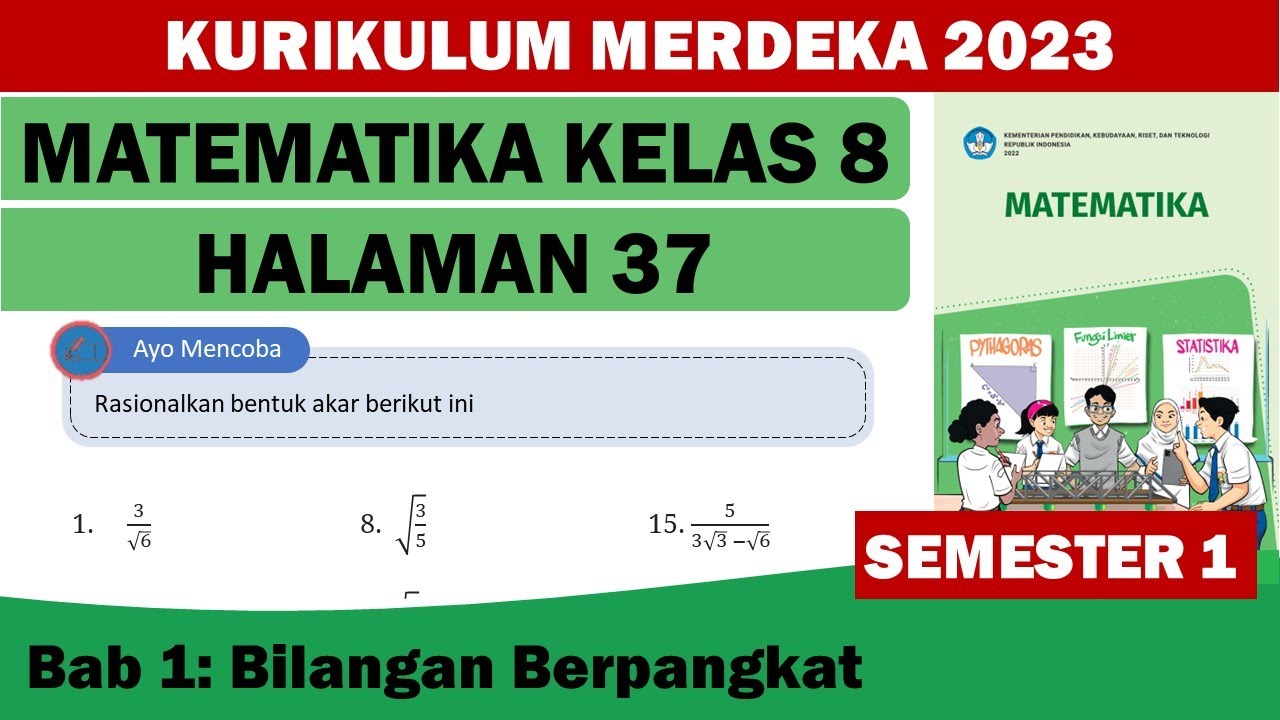
MATEMATIKA KELAS 8 HALAMAN 37 KURIKULUM MERDEKA 2022 || AYO MENCOBA

Materi Peluang Lengkap | Matematika SMP Kelas 8

Peluang • Part 1: Percobaan, Ruang Sampel, Kejadian, dan Peluang Suatu Kejadian

Peluang ~ Menentukan Nilai Peluang dan Frekuensi Harapan Suatu Kejadian (Materi PJJ Klas VIII/8 SMP)

Frekuensi Relatif dan Frekuensi Harapan

BELAJAR DARI RUMAH (MATEMATIKA MATERI PELUANG KELAS 8, LENGKAP CONTOH SOAL DAN PEMBAHASAN)
5.0 / 5 (0 votes)

