INCOTERMS COMO NUNCA TE EXPLICARAM 😱 FOB CIF EXW FCA DAT
Summary
TLDRThis video explains the concept of Incoterms, essential terms used in international trade to define responsibilities, risks, and costs related to shipping. Created by the International Chamber of Commerce (ICC) in 1936, Incoterms have been updated periodically, with the latest version from 2020. The video covers the four main families of Incoterms (F, C, D), explaining how each affects the exporter and importer's responsibilities. Key terms like FOB, CFR, and DDP are explored, along with updates on mandatory insurance coverage. Viewers will gain practical knowledge on applying Incoterms in global trade, particularly in maritime logistics.
Takeaways
- 😀 Incoterms are a set of rules defining the responsibilities of exporters and importers in international trade, particularly regarding costs and risks.
- 😀 Created by the International Chamber of Commerce (ICC) in 1936, Incoterms are updated every 10 years to keep pace with changes in global trade.
- 😀 Incoterms simplify contracts by providing predefined codes (3-letter acronyms) that outline who pays for shipping, insurance, and other responsibilities.
- 😀 There are four main families of Incoterms: E, F, C, and D, each representing a different level of responsibility for the exporter.
- 😀 Family F Incoterms (e.g., FOB) are common and indicate that the exporter has a limited responsibility, with the importer taking on more once the goods are in transit.
- 😀 Family D Incoterms (e.g., DDP) mean that the exporter assumes almost all responsibility, including delivery to the destination and customs clearance.
- 😀 Incoterms are optional, but they are widely used because they offer clarity and make contracts simpler in international trade.
- 😀 Incoterms also define the point of delivery, which refers to when the exporter transfers responsibility for goods to the importer, typically at the point of shipment.
- 😀 The 2020 revision of Incoterms included a mandatory update for insurance coverage, requiring broader coverage for international cargo transport.
- 😀 Some Incoterms, like FOB, are exclusive to maritime transport, meaning they should not be used for air or road freight.
- 😀 When dealing with freight payment, Incoterms from Family C and D typically indicate that the exporter pays for the shipping costs, whereas in Family F, the importer is responsible for paying.
Q & A
What are Incoterms and who created them?
-Incoterms (International Commercial Terms) are standardized trade terms that define responsibilities between exporters and importers in international transactions. They were created in 1936 by the International Chamber of Commerce (ICC) in Paris.
What is the main purpose of Incoterms in international trade?
-The main purpose of Incoterms is to define the allocation of costs and the transfer of risks between exporter and importer, particularly regarding freight, insurance, and responsibility for damage to goods.
Are Incoterms mandatory in international trade contracts?
-No, Incoterms are not legally mandatory. However, they are widely used because they simplify contracts and clearly define responsibilities using standardized three-letter acronyms.
How often are Incoterms updated?
-Incoterms are typically updated every 10 years. The current version in use is Incoterms 2020.
How are the 11 Incoterms in the 2020 version organized?
-The 11 Incoterms are divided into four groups: Group E, Group F, Group C, and Group D. These groups reflect increasing levels of responsibility for the exporter.
What is the significance of the progression from Group E to Group D?
-Responsibility increases from Group E to Group D. In Group E, the exporter has minimal responsibility, while in Group D, the exporter assumes the highest level of responsibility, potentially including customs clearance in the destination country.
What does FOB (Free On Board) mean in practical terms?
-Under FOB, the exporter is responsible for costs and risks until the goods are loaded onto the ship. Once the goods are on board, the risk transfers to the importer, who then assumes responsibility for freight and further risks.
What does 'delivery' mean under Incoterms?
-In Incoterms, delivery does not mean physical receipt by the buyer. It refers to the moment when the risk of loss or damage transfers from the exporter to the importer.
Which Incoterms are exclusive to maritime transport?
-The maritime-only Incoterms are FAS, FOB, CFR, and CIF. These terms should only be used for sea or inland waterway transport.
What important insurance change was introduced in Incoterms 2020?
-In Incoterms 2020, CIP now requires broader insurance coverage (Clause A – All Risks), whereas previously it required only minimum coverage (Clause C).
What is the difference between Freight Collect and Freight Prepaid in relation to Incoterms?
-Under Groups E and F, freight is usually Freight Collect, meaning the importer pays at destination. Under Groups C and D, freight is typically Freight Prepaid, meaning the exporter pays for the main transport.
Do Incoterms regulate ownership transfer of goods?
-No, Incoterms do not regulate the transfer of ownership. They only define the allocation of costs and risks related to the transportation of goods.
Outlines

此内容仅限付费用户访问。 请升级后访问。
立即升级Mindmap

此内容仅限付费用户访问。 请升级后访问。
立即升级Keywords

此内容仅限付费用户访问。 请升级后访问。
立即升级Highlights

此内容仅限付费用户访问。 请升级后访问。
立即升级Transcripts

此内容仅限付费用户访问。 请升级后访问。
立即升级浏览更多相关视频
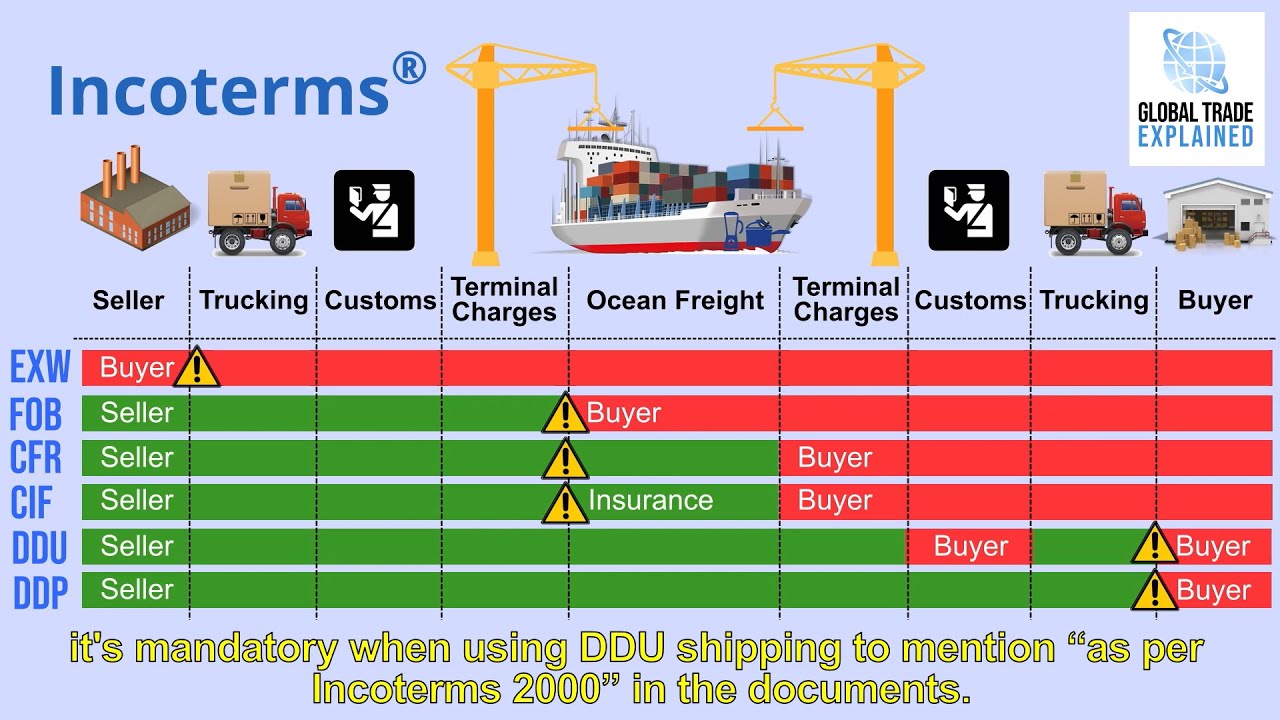
Incoterms for beginners | Global Trade Explained
CARA NEGO DENGAN BUYER - APA ITU INCOTERMS? DEFINISI FOB FCA DPP CIF DAP DALAM EKSPOR IMPOR

Incoterms® 2020 Explained for Import Export Global Trade
Incoterms (International commercial Terms) 2020 #1 Ekspor Impor

Incoterms 2020 - TBS open teaching
Incoterms 2020 detailed explanation
5.0 / 5 (0 votes)

