THE PRESENT PERFECT TENSE || MATERI BAHASA INGGRIS SMP DAN SMA
Summary
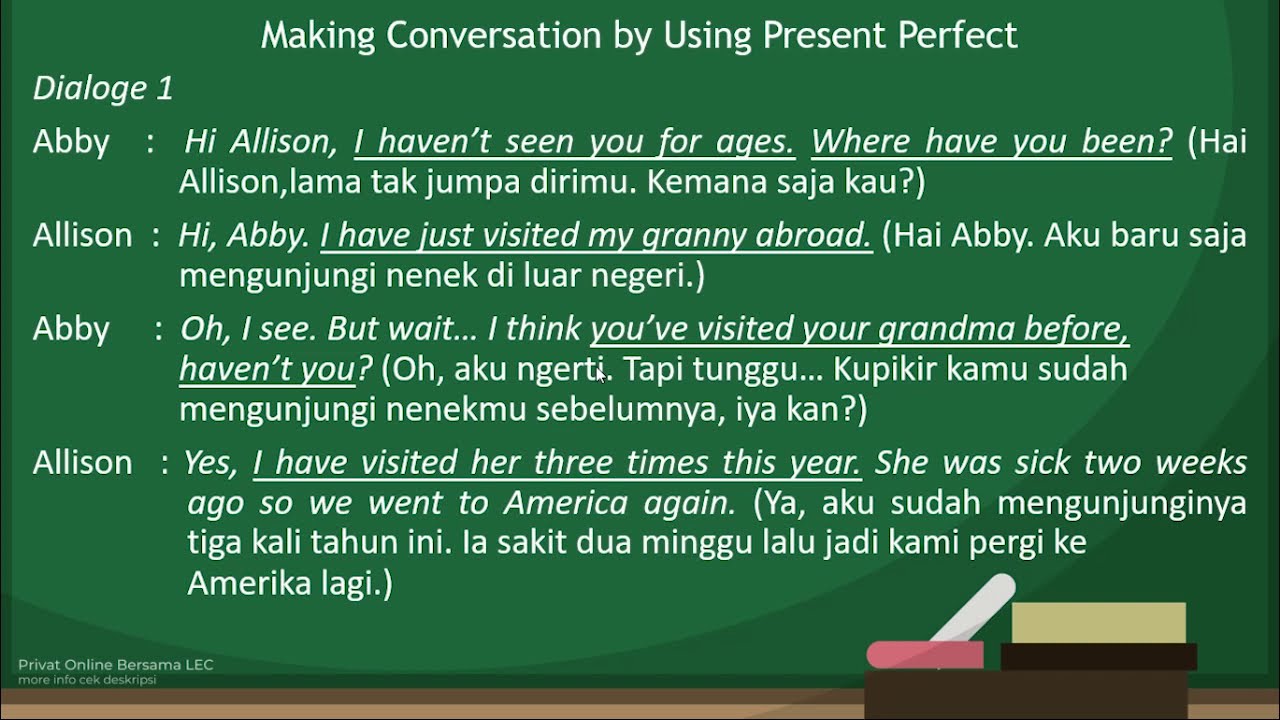
TLDRIn this video, the instructor explains the concept of the present perfect tense in English, breaking down its usage into three main sentence forms: affirmative, negative, and interrogative. The video covers key grammatical elements such as verb conjugations, the use of 'have' and 'has,' and when to apply the present perfect tense. Examples clarify how it refers to actions that started in the past and continue in the present, or actions that have a present effect. The video ends with a brief exercise for viewers to practice the tense.
Takeaways
- 😀 The Present Perfect Tense is used to show actions that started in the past and are still relevant or continuing in the present.
- 😀 The three main forms in the Present Perfect Tense are affirmative, negative, and interrogative.
- 😀 In affirmative sentences, we use 'have' or 'has' followed by the past participle of the verb.
- 😀 To form negative sentences, simply add 'not' after 'have' or 'has'. Example: 'I have not eaten.'
- 😀 Interrogative sentences in the Present Perfect Tense involve using question words like 'have' or 'has' at the start. Example: 'Have you eaten?'
- 😀 The Present Perfect Tense is used for actions that began in the past and continue to the present. Example: 'I have been sitting here for an hour.'
- 😀 It is also used to refer to actions that happened in the past but still have an effect on the present. Example: 'I have shut the door.'
- 😀 To express actions that just happened, we use 'just' with the Present Perfect Tense. Example: 'I have just eaten.'
- 😀 The verb in the Present Perfect Tense is always in its third form (past participle).
- 😀 The exercise given in the video asks learners to fill in the blanks using the Present Perfect Tense, helping them practice forming correct sentences.
Q & A
What is the present perfect tense used for?
-The present perfect tense is used to describe actions that started in the past and are still relevant or have effects in the present.
How do you form a positive sentence in the present perfect tense?
-In a positive sentence, the structure is 'Subject + have/has + past participle (verb 3)'. For example, 'I have eaten.'
What is the structure for negative sentences in the present perfect tense?
-To make a negative sentence, simply add 'not' after 'have' or 'has'. For example, 'I have not eaten.'
What is the structure for an interrogative (question) sentence in the present perfect tense?
-In an interrogative sentence, invert 'have/has' and the subject. For example, 'Have you eaten?'
What are the two main groups of pronouns in the present perfect tense?
-The two groups of pronouns are: 'I, you, we, they' which use 'have', and 'he, she, it' which use 'has'.
What is the verb form used in the present perfect tense?
-The present perfect tense uses the past participle (verb 3). For example, 'eaten' from 'eat', 'gone' from 'go', and 'seen' from 'see'.
Can the present perfect tense describe actions that just happened?
-Yes, the present perfect tense can be used to describe actions that have just happened by adding the word 'just'. For example, 'I have just eaten.'
How do you express an action that has started in the past and continues into the present using the present perfect tense?
-You can express this by using the present perfect tense with time expressions like 'for' or 'since'. For example, 'I have lived here for 2 years.'
What is the significance of 'have' and 'has' in the present perfect tense?
-'Have' is used with 'I, you, we, they', and 'has' is used with 'he, she, it'. These auxiliary verbs help form the present perfect tense.
What kind of actions does the present perfect tense refer to in terms of their effect on the present?
-The present perfect tense refers to actions that happened in the past but still have a relevant effect on the present situation. For example, 'I have closed the door' implies the door is still closed.
Outlines

此内容仅限付费用户访问。 请升级后访问。
立即升级Mindmap

此内容仅限付费用户访问。 请升级后访问。
立即升级Keywords

此内容仅限付费用户访问。 请升级后访问。
立即升级Highlights

此内容仅限付费用户访问。 请升级后访问。
立即升级Transcripts

此内容仅限付费用户访问。 请升级后访问。
立即升级浏览更多相关视频




5.0 / 5 (0 votes)

