0. Design Thinking & Doing
Summary
TLDRProfessor Hastings provides an overview of the design thinking process, emphasizing its human-centered approach. In the interactive media and communications program, students apply design thinking to create innovative products like websites, mobile apps, and physical items. The five main steps of design thinking—empathize, define, ideate, prototype, and test—are explored, stressing the importance of creativity, iteration, and learning from failure. The process integrates systems thinking, logic, imagination, and exploration, encouraging students to fail fast and refine their designs for optimal results.
Takeaways
- 😀 Design Thinking is a problem-solving methodology that integrates both thinking and doing to create innovative products for human use.
- 😀 The process is human-centered, focusing on designing products and services that meet human needs and improve user experiences.
- 😀 While Design Thinking is presented as a linear process, in practice it is flexible and iterative, with steps often overlapping or revisiting earlier stages.
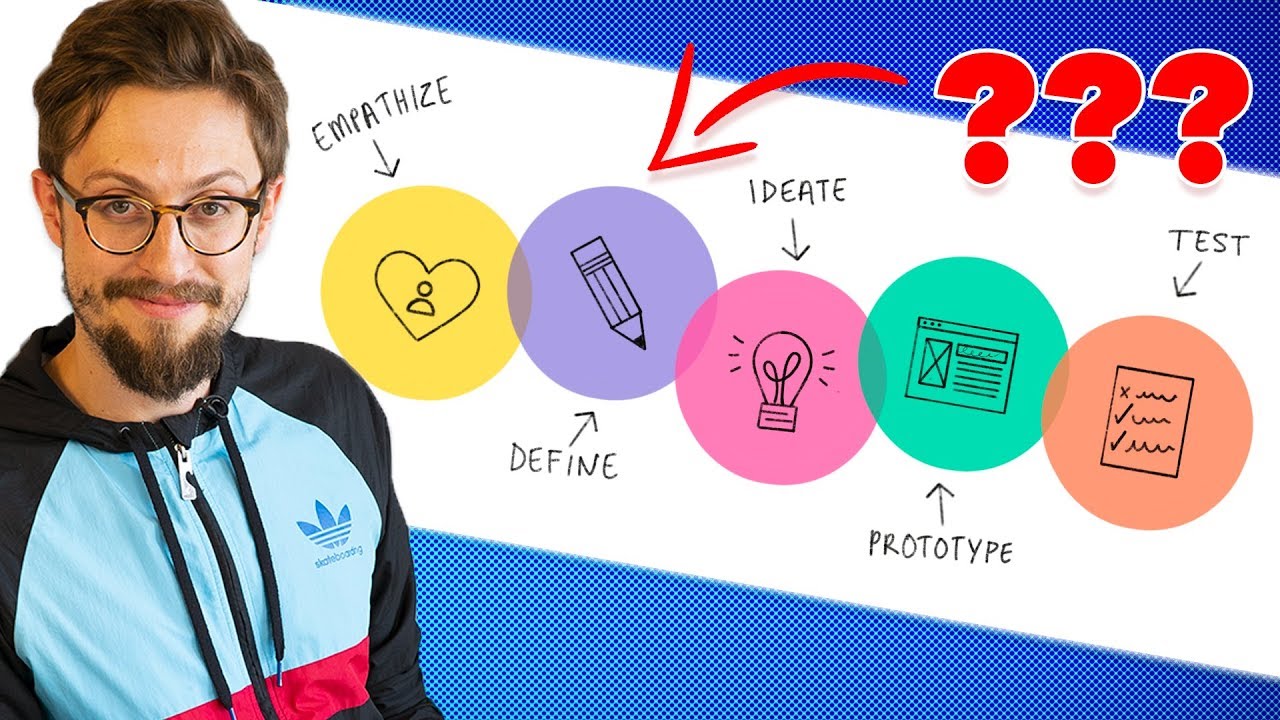
- 😀 The five core steps in Design Thinking are: Empathize, Define, Ideate, Prototype, and Test.
- 😀 The Empathize stage involves understanding the people you are designing for and their needs.
- 😀 Define is about framing the problem by developing a clear problem statement or hypothesis, similar to scientific hypothesis testing.
- 😀 Ideate encourages creativity by generating multiple ideas and exploring potential solutions without limitations.
- 😀 In the Prototype stage, ideas are translated into tangible models or demos to test and refine.
- 😀 Testing involves evaluating prototypes with real users to gather feedback and iteratively improve the design.
- 😀 Key principles in Design Thinking include creativity, logic, intuition, systems thinking, and a willingness to fail fast and learn from mistakes.
Q & A
What is the main focus of design thinking in the Interactive Media and Communications program?
-The main focus is human-centered design, emphasizing creating products and services that meet the needs and experiences of humans.
How does the program define 'design thinking and doing'?
-'Design thinking and doing' combines the conceptual process of design thinking with active implementation, integrating methods to create innovative products and services.
Why is design thinking considered a non-linear process?
-Design thinking is non-linear because the steps often overlap, can loop back on each other, and may involve repeated iterations, especially for projects that evolve over time.
What are the five core steps of design thinking as outlined in the transcript?
-The five core steps are: 1) Empathize – understand users, 2) Define – articulate the problem, 3) Ideate – generate ideas, 4) Prototype – create demos or models, and 5) Test – validate with users.
How does the program encourage creativity within the design thinking process?
-Creativity is encouraged through ideation, exploring endless possibilities, combining logic, imagination, and intuition, and generating multiple solutions before refinement.
What is meant by 'learning to fail fast' in the context of design thinking?
-'Learning to fail fast' refers to quickly identifying and addressing what doesn't work in prototypes, using failure as a learning tool to refine and improve the final product.
What types of products and services can design thinking be applied to?
-Design thinking can be applied to websites, mobile apps, physical products, books, magazines, gadgets, and services like banking and airport services—essentially anything designed for human use.
How does systems thinking integrate into the design thinking process?
-Systems thinking helps designers understand the relationships and interconnections between various elements of a product or service, ensuring a holistic and effective design solution.
Why does the speaker emphasize producing multiple prototypes?
-Multiple prototypes allow designers to refine solutions, identify and remove flaws, and iterate towards a functional, user-centered final product.
What is the significance of iteration and refinement in design thinking?
-Iteration and refinement ensure continuous improvement, allowing designers to explore, test, and enhance solutions based on feedback and observed outcomes.
How does the program approach the integration of new methods in design thinking?
-The program encourages ongoing research, noting that new methods are constantly being developed and integrated by companies and individuals worldwide, keeping the process innovative and adaptable.
Outlines

This section is available to paid users only. Please upgrade to access this part.
Upgrade NowMindmap

This section is available to paid users only. Please upgrade to access this part.
Upgrade NowKeywords

This section is available to paid users only. Please upgrade to access this part.
Upgrade NowHighlights

This section is available to paid users only. Please upgrade to access this part.
Upgrade NowTranscripts

This section is available to paid users only. Please upgrade to access this part.
Upgrade Now


5.0 / 5 (0 votes)
