Revisão Momento Linear - Prof. Alex Mossmann
Summary
TLDRThis script provides a detailed revision of impulse and linear momentum, explaining key concepts such as the relationship between force and velocity, and how impulse affects the movement of objects. Through examples like billiards, the script discusses how forces acting on a system result in changes to the momentum of objects. It covers the principles of internal and external forces, conservation of momentum, and the types of collisions, from elastic to inelastic, highlighting energy transformations. This overview is essential for students studying physics and preparing for exams like the ENEM and UFRGS.
Takeaways
- 😀 Impulse is a vector quantity that is produced by a force applied to a body, causing a change in velocity over a period of time.
- 😀 A common example of impulse is hitting a ball with a cue stick in billiards, where the force changes the ball's velocity.
- 😀 Impulse can also occur due to action and reaction forces, such as when one ball strikes another in billiards, creating impulses between them.
- 😀 Impulse always has the same direction and sense as the force that created it. If the force is constant, impulse is the product of force and the time it acts.
- 😀 The momentum of a body is the product of its mass and velocity and is also a vector quantity, pointing in the direction of the velocity.
- 😀 There is a direct relationship between the impulse applied to an object and the change in its linear momentum.
- 😀 The change in momentum is calculated by subtracting the initial momentum from the final momentum, and the signs of the quantities indicate direction.
- 😀 In a system of particles, internal forces (like collisions between the balls) do not change the total momentum, but external forces (like the cue stick hitting the ball) do.
- 😀 The principle of conservation of linear momentum states that the total momentum of a system remains constant if no external forces are acting on it.
- 😀 In elastic collisions, the total momentum of a system remains the same before and after the collision, while inelastic collisions result in a loss of kinetic energy.
- 😀 A completely inelastic collision is one where the loss of kinetic energy is maximized, and the objects stick together after the collision.
Q & A
What is impulse and how is it defined in physics?
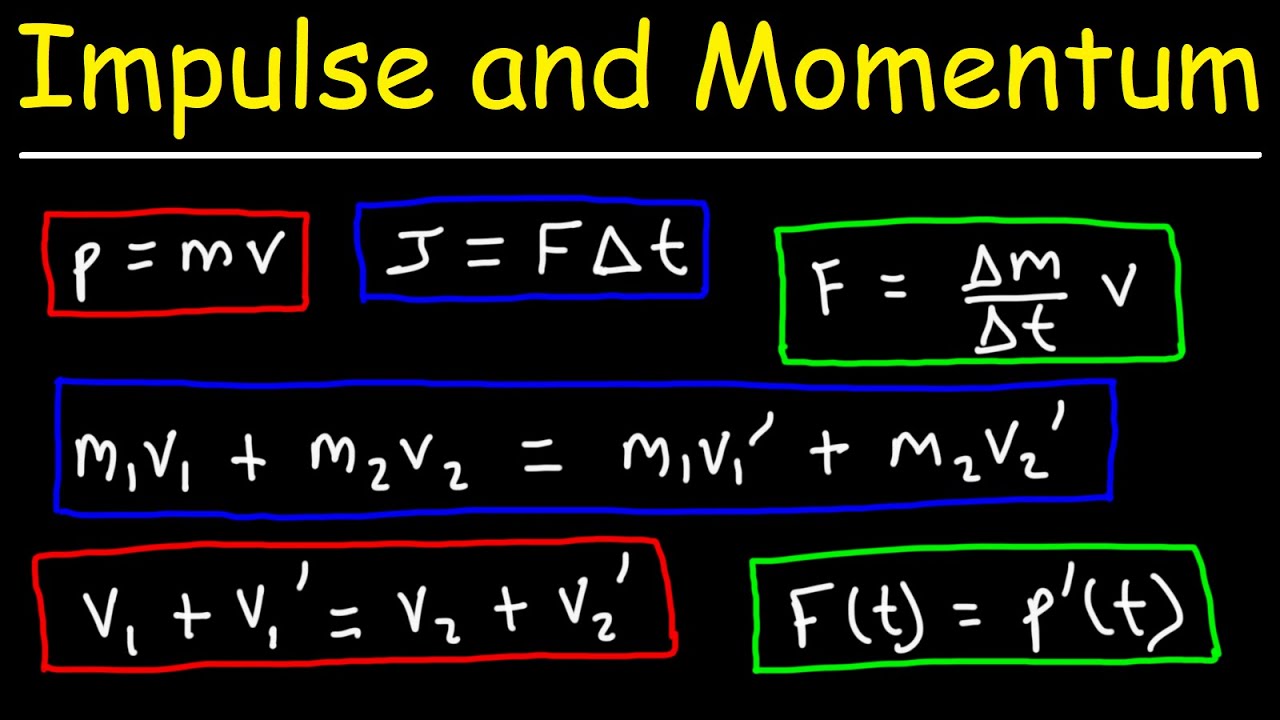
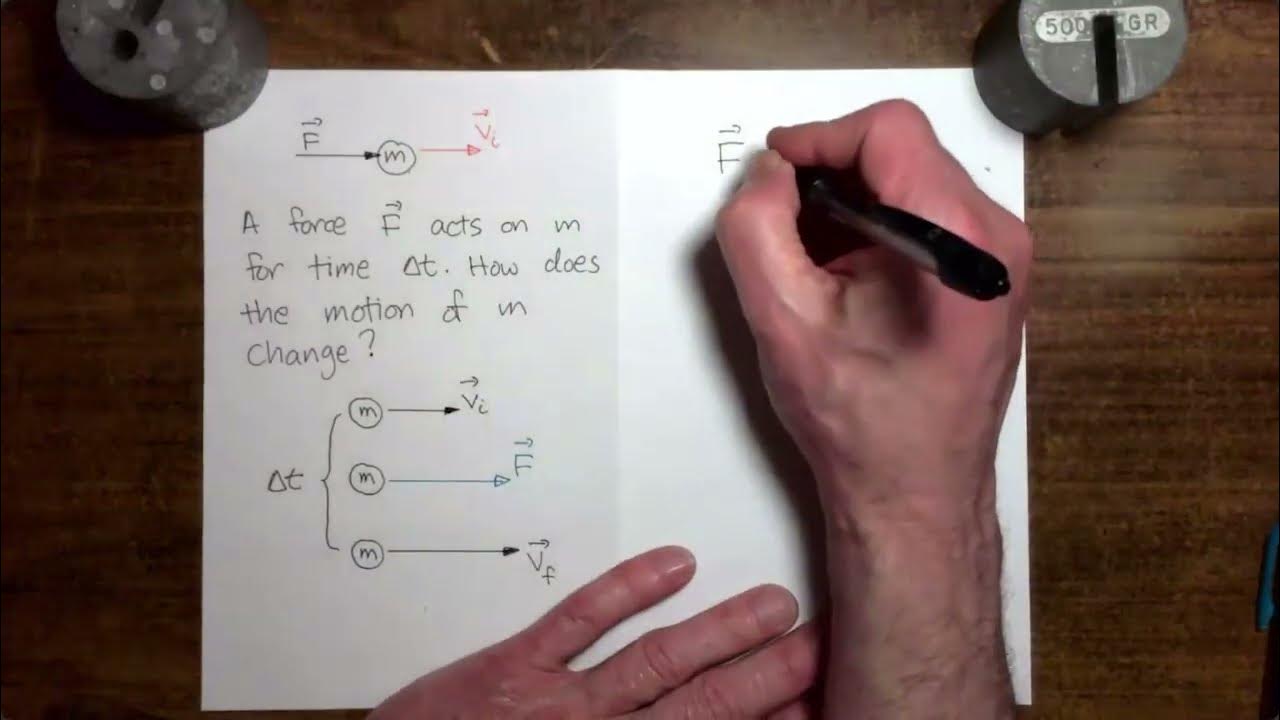
-Impulse is a vector quantity that represents the change in momentum of a body caused by a force applied over a certain time interval. For a constant force, it is calculated as the product of the force and the time during which it acts.
How is linear momentum defined and what is its relationship with velocity?
-Linear momentum, also called quantity of motion, is a vector quantity defined as the product of a body's mass and its velocity. Its direction is the same as that of the velocity.
What is the mathematical relationship between impulse and linear momentum?
-The resultant impulse on a body is equal to the change in its linear momentum: I_resultant = Δp = p_final - p_initial.
How does a force applied by a cue stick on a billiard ball illustrate impulse?
-The cue stick applies an external force over a short period of time, causing a change in the ball's velocity. This force produces an impulse that alters the ball's momentum.
What is the difference between internal and external forces in a system of particles?
-Internal forces are exerted between particles within the system and do not change the total momentum of the system. External forces come from outside the system and can change the system's total momentum.
Under what condition is the total linear momentum of a system conserved?
-The total linear momentum of a system is conserved when the resultant external force acting on the system is zero.
What distinguishes elastic, inelastic, and completely inelastic collisions?
-In elastic collisions, both total momentum and kinetic energy are conserved. In inelastic collisions, total momentum is conserved but kinetic energy is partially lost. In completely inelastic collisions, the bodies stick together after the collision, resulting in the maximum loss of kinetic energy.
How do forces between billiard balls during a collision affect the system's momentum?
-Forces between billiard balls are internal forces within the system. While they change the individual momenta of the balls, the total momentum of the system remains unchanged because these forces cancel out.
Why is the area under a force-time graph significant?
-The area under a force-time graph represents the impulse applied to a body. For non-constant forces, this area must be calculated to determine the change in momentum accurately.
How can the principle of momentum conservation be applied in multi-body systems moving in different directions?
-In multi-body systems, the total momentum is the vector sum of each body's momentum. For bodies moving in opposite directions, their momenta subtract from each other, and for bodies moving in the same direction, their momenta add together. This allows calculation of the system's total momentum before and after interactions.
What role does the concept of system boundaries play in analyzing momentum and forces?
-Defining a system's boundaries is crucial because only forces originating outside the system are considered external and can change the total momentum. Forces within the system are internal and cancel out in pairs, leaving the total momentum unchanged.
Outlines

This section is available to paid users only. Please upgrade to access this part.
Upgrade NowMindmap

This section is available to paid users only. Please upgrade to access this part.
Upgrade NowKeywords

This section is available to paid users only. Please upgrade to access this part.
Upgrade NowHighlights

This section is available to paid users only. Please upgrade to access this part.
Upgrade NowTranscripts

This section is available to paid users only. Please upgrade to access this part.
Upgrade NowBrowse More Related Video




5.0 / 5 (0 votes)
