DEGREES OF COMPARISON (TINGKAT PERBANDINGAN #videobelajar degree of comparison
Summary
TLDRThe video features an interactive classroom session focused on teaching comparatives and superlatives in English. The instructor engages students in identifying the biggest, smallest, and most outstanding objects and people, using colorful examples like red and blue bottles and asking questions about relative size and ability. The lesson alternates between English and Indonesian, reinforcing understanding through direct participation, repetition, and practical examples. Students practice using terms like 'bigger,' 'the biggest,' and 'the most,' while also learning to apply these concepts to describe people and objects. The session is lively, hands-on, and encourages active student involvement.
Takeaways
- 😀 The lesson is about comparison, specifically in terms of size and degrees of comparison.
- 😀 The speaker uses both English and Indonesian terms, mixing languages for clarity and emphasis.
- 😀 'Comparation' refers to comparison, and in Bahasa Indonesia, it's described as 'tingkat tingkat' (degrees of comparison).
- 😀 The comparison focuses on identifying which object is the largest and smallest, using colors like blue, red, and purple.
- 😀 There is a focus on comparing sizes with phrases like 'Which one is the biggest?' and 'Which one is the smallest?'
- 😀 'Bigger' and 'smaller' are frequently used to describe objects in the comparison exercise.
- 😀 The levels of comparison mentioned are positive, comparative (more), and superlative (most).
- 😀 The term 'degrees of operation' refers to these three levels of comparison.
- 😀 The speaker confirms that the second level of comparison uses 'more,' and the third uses 'most' or the '-est' suffix.
- 😀 There is also a playful exchange where students are asked who is the smallest or the smartest in the group, with the answer being the speaker or students themselves.
Q & A
What is the main topic discussed in the transcript?
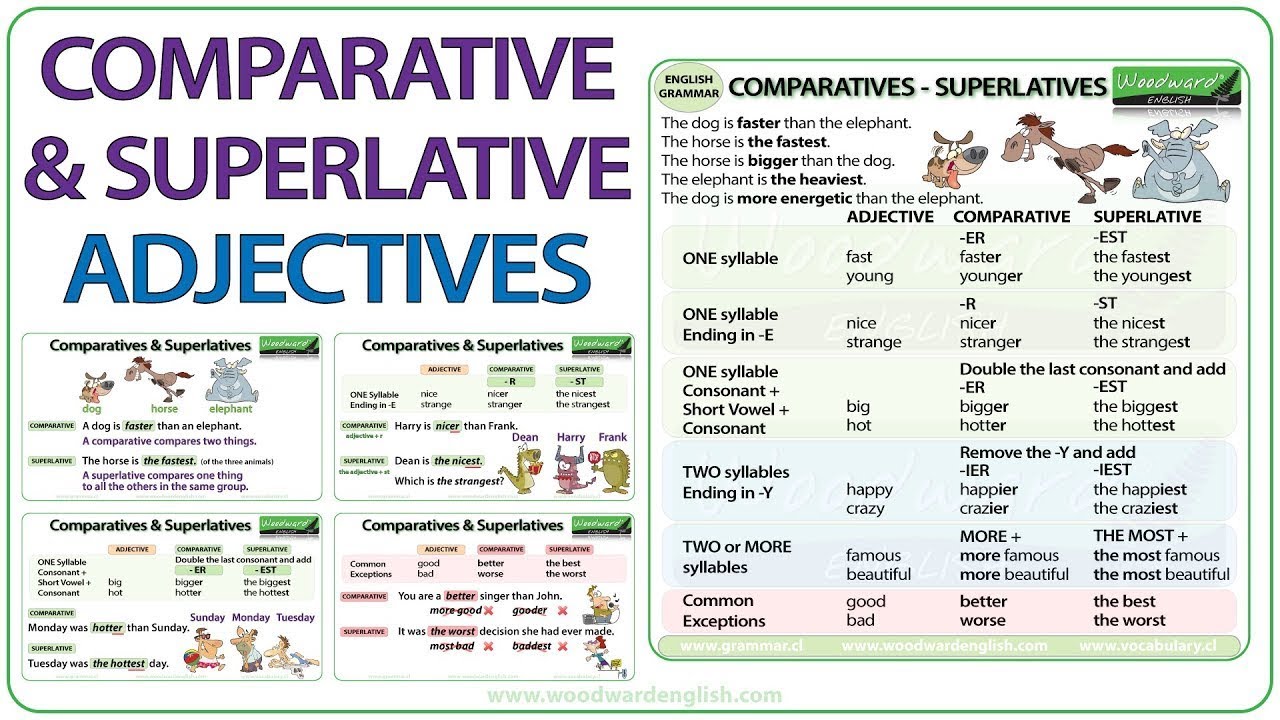
-The main topic is comparatives and superlatives in English, referred to as 'comparation,' including how to identify and use different degrees of comparison.
What does 'comparation' mean in Indonesian according to the transcript?
-'Comparation' is explained as the concept of comparing things, translated as 'tingkat-tingkat' in Indonesian, which refers to different levels or degrees.
Which colors are used in the transcript to explain comparative sizes?
-The colors mentioned are blue, red, and purple. They are used to compare objects in terms of size.
How does the transcript illustrate the comparative degree?
-The comparative degree is shown by asking questions like 'Which one is bigger?' and using words like 'bigger' to compare two objects or people.
How is the superlative degree demonstrated in the transcript?
-The superlative degree is demonstrated with phrases like 'the biggest' and 'the most' when identifying the largest object or the most skilled person among a group.
What examples are given to show the positive degree?
-The positive degree is briefly mentioned as the base form of the adjective, like 'big' or 'smart,' without any comparison.
How are students involved in the learning activity?
-Students are actively asked questions about size and intelligence, such as 'Who is the smallest?' or 'Who is the smartest?' to practice comparative and superlative forms.
What is meant by 'degrees of operation' in the transcript?
-'Degrees of operation' refers to the three levels of adjectives: positive, comparative, and superlative, explaining how adjectives change to indicate comparison.
Can you give an example from the transcript comparing two objects?
-Yes, an example from the transcript is: 'The red bottle is bigger than the blue one.' This illustrates the comparative form 'bigger.'
How is the question 'Which one is the biggest?' answered in the transcript?
-The answer given in the transcript is 'Purple,' indicating that among the compared objects, the purple one is the largest, demonstrating the superlative form 'the biggest.'
What does 'positive, usually using S' refer to in the transcript?
-This seems to be a slight confusion in the transcript; it likely refers to the positive degree of an adjective as the base form, which does not require 'er' or 'est' endings.
Why are both colors and people used in examples?
-Colors and people are used to make the comparison exercises more interactive and relatable, helping students understand the use of comparative and superlative forms in different contexts.
Outlines

This section is available to paid users only. Please upgrade to access this part.
Upgrade NowMindmap

This section is available to paid users only. Please upgrade to access this part.
Upgrade NowKeywords

This section is available to paid users only. Please upgrade to access this part.
Upgrade NowHighlights

This section is available to paid users only. Please upgrade to access this part.
Upgrade NowTranscripts

This section is available to paid users only. Please upgrade to access this part.
Upgrade NowBrowse More Related Video

Degree of Comparison in English (Perbandingan Dalam Bahasa Inggris)

Comparative vs superlative adjectives. Comparativos vs superlativos en inglés.
Comparative and Superlative Adjectives - English Grammar Lesson
Problem Based Learning, Teaching Descriptive Text

PPL/ PPG Pendidikan Bahasa Inggris Universitas Negeri Malang

Guru Inspiratif
5.0 / 5 (0 votes)
