Konsep, Rumus, dan Soal Gerak Parabola || Fisika Kelas X || #OprekMafiki
Summary
TLDRThis video provides an in-depth explanation of projectile motion, focusing on its parabolic trajectory. It breaks down the motion into horizontal and vertical components, explaining how horizontal motion is uniform while vertical motion experiences constant acceleration due to gravity. Key points include decomposing initial velocity, calculating velocities at the highest point, and determining maximum height and range. The video demonstrates these concepts through clear formulas and step-by-step examples, showing how to solve typical exam questions. Viewers gain a practical understanding of projectile motion, including time to reach the peak, horizontal displacement, and velocity components at critical points, making it a thorough study guide for students.
Takeaways
- 😀 The script explains the concept of projectile motion, with a focus on parabolic trajectories.
- 😀 Parabolic motion combines two types of motion: uniform linear motion (GLBB) in the x-direction and uniformly accelerated motion (GLBB) in the y-direction.
- 😀 The script defines key parameters: initial velocity (v0), elevation angle (α), and gravity's effect on the motion.
- 😀 The components of the initial velocity are broken down into v0x (horizontal component) and v0y (vertical component).
- 😀 The script covers the highest point of the trajectory (Point B), where the vertical velocity (vby) is zero.
- 😀 The motion equation for horizontal velocity remains constant throughout the trajectory, while vertical velocity is affected by gravity.
- 😀 At the highest point (Point B), the object's speed is determined only by its horizontal velocity (vbx).
- 😀 The total time to reach the highest point (TB) is calculated using the formula: TB = v0 * sin(α) / g.
- 😀 The script shows how to calculate the maximum height (YB) and horizontal distance (XB) using known formulas.
- 😀 The maximum horizontal distance (XC) occurs at the farthest point of the trajectory and is calculated using XC = v0^2 * sin(2α) / g.
Q & A
What is parabolic motion?
-Parabolic motion refers to the type of motion where an object follows a curved trajectory, known as a parabola. This happens when the motion combines both horizontal motion (uniform velocity) and vertical motion (uniformly accelerated motion due to gravity).
What is the significance of the 'elevation angle' (alpha) in parabolic motion?
-The elevation angle, denoted as alpha, is the angle between the initial velocity of the object and the horizontal axis (x-axis). It determines the direction of the initial velocity and impacts the range and height of the projectile's trajectory.
What does the script mention about the motion components in the x and y directions?
-In the x-direction (horizontal motion), the object moves with constant velocity (uniform motion), while in the y-direction (vertical motion), the object experiences uniformly accelerated motion due to gravity. These two motions combine to create the parabolic trajectory.
What is the difference between GLB and GLBB as described in the video?
-GLB (Gerak Lurus Beraturan) refers to uniform linear motion, where velocity remains constant. GLBB (Gerak Lurus Berubah Beraturan) refers to uniformly accelerated linear motion, where the object's velocity changes at a constant rate, typically due to gravitational acceleration.
How is the velocity at the highest point of the parabola (point B) calculated?
-At the highest point (point B), the velocity in the y-direction becomes zero because the object momentarily stops before falling down. The velocity in the x-direction remains constant and is equal to the initial horizontal velocity, v0x = v0 * cos(alpha).
What is the formula for the time to reach the highest point in a parabolic trajectory?
-The time to reach the highest point (tB) is calculated using the formula: tB = (v0 * sin(alpha)) / g, where v0 is the initial velocity, alpha is the elevation angle, and g is the acceleration due to gravity.
How is the maximum horizontal distance (xC) or range of a projectile calculated?
-The maximum horizontal distance, or range, (xC) is given by the formula: xC = (v0^2 * sin(2alpha)) / g, where v0 is the initial velocity, alpha is the elevation angle, and g is the acceleration due to gravity.
What is the significance of the symmetry of the parabolic trajectory mentioned in the video?
-The symmetry of the parabolic trajectory implies that the time and distance taken to reach the highest point are equal to the time and distance taken to fall from the highest point back to the ground. This symmetry helps in calculating various parameters of the motion.
How is the velocity at the highest point related to the horizontal velocity?
-At the highest point of the trajectory, the vertical velocity component becomes zero. Therefore, the velocity at that point is entirely determined by the horizontal velocity, which remains constant throughout the motion.
In the example problem, how is the velocity at the highest point determined when the initial speed is 40 m/s and the angle is 60°?
-The velocity at the highest point is calculated by using the formula: v = v0 * cos(alpha). Given v0 = 40 m/s and alpha = 60°, the horizontal velocity at the highest point is v = 40 * cos(60°) = 20 m/s.
Outlines

This section is available to paid users only. Please upgrade to access this part.
Upgrade NowMindmap

This section is available to paid users only. Please upgrade to access this part.
Upgrade NowKeywords

This section is available to paid users only. Please upgrade to access this part.
Upgrade NowHighlights

This section is available to paid users only. Please upgrade to access this part.
Upgrade NowTranscripts

This section is available to paid users only. Please upgrade to access this part.
Upgrade NowBrowse More Related Video
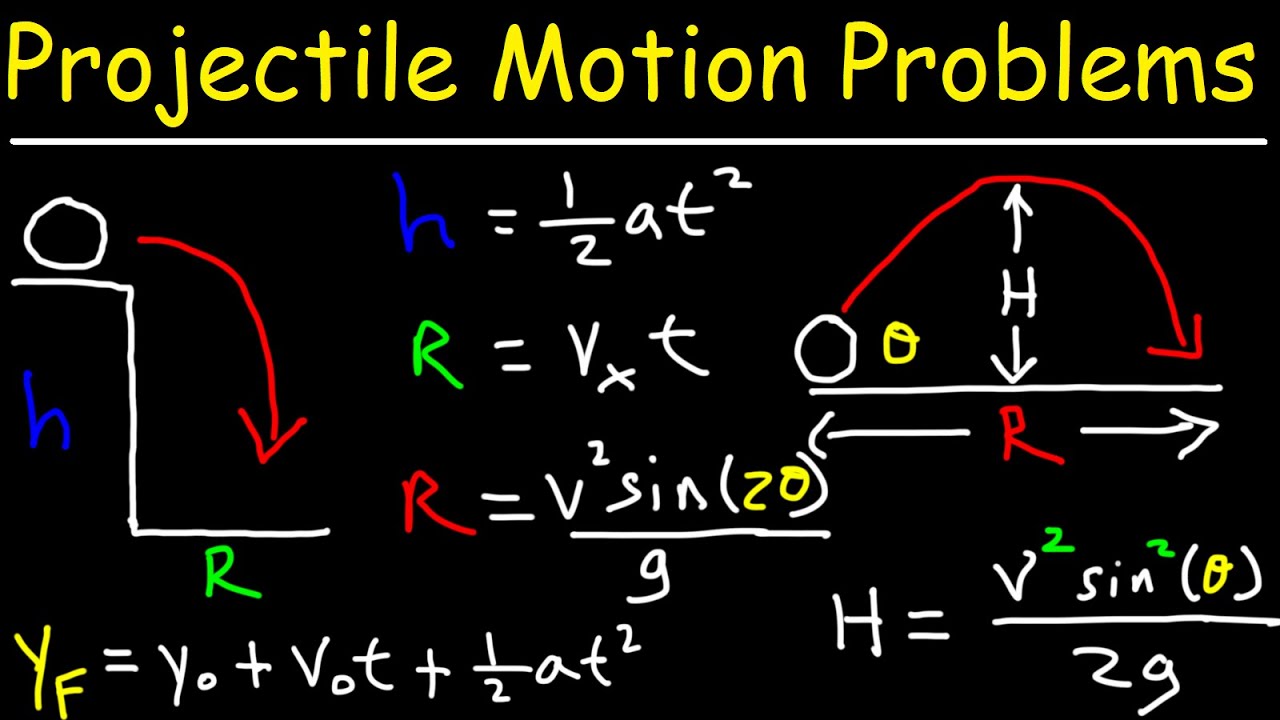
How To Solve Projectile Motion Problems In Physics
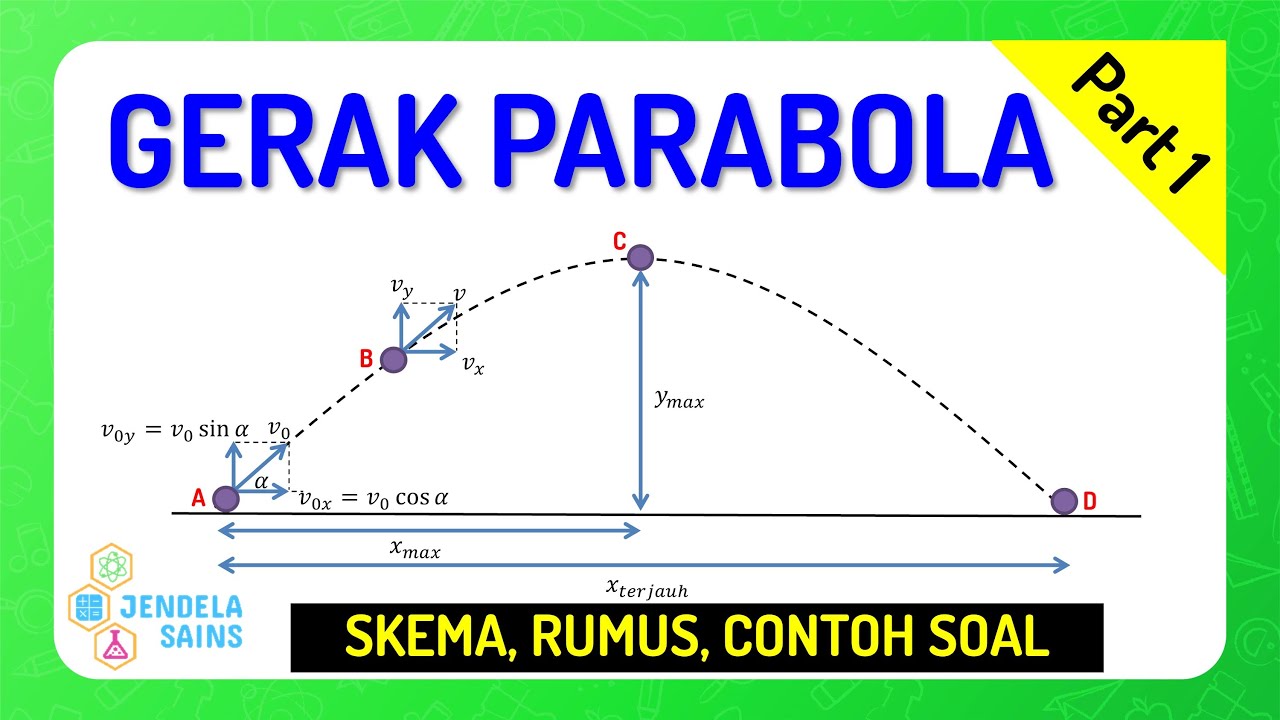
Gerak Parabola • Part 1: Konsep, Skema, dan Rumus Gerak Parabola
Gerak Parabola - Fisika Kelas 10 (Quipper Video)

GERAK PARABOLA
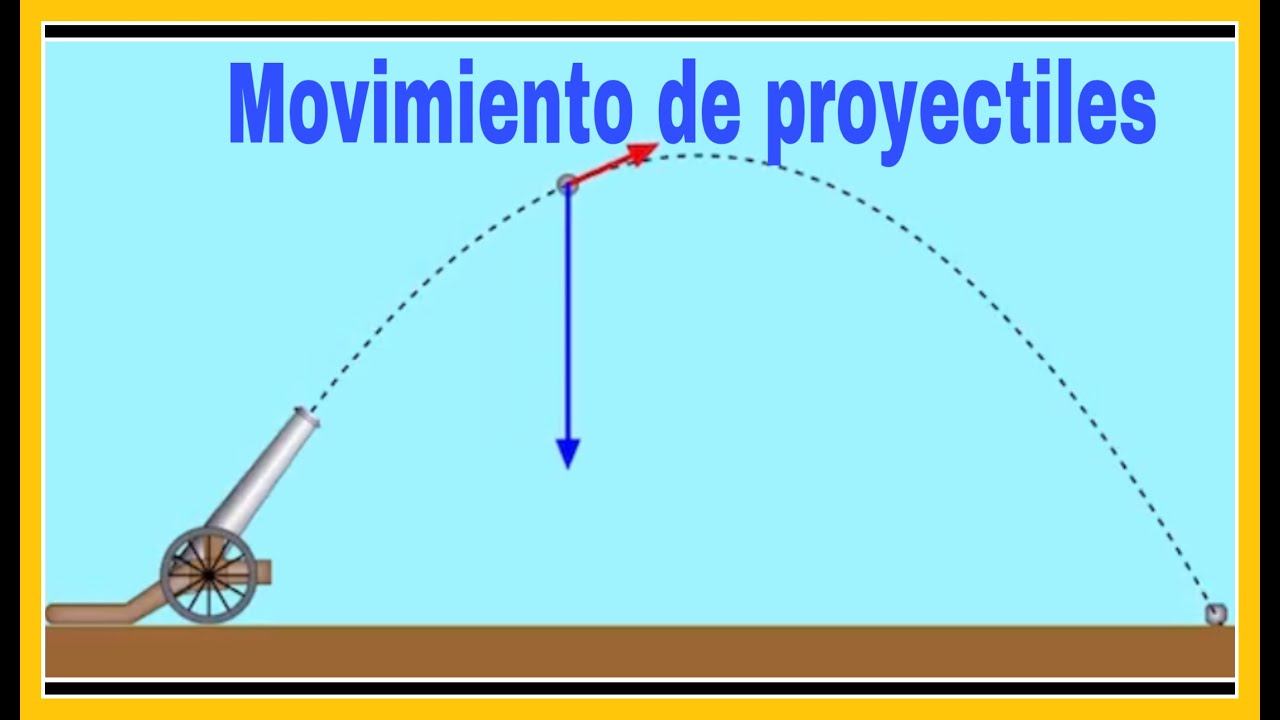
FISICA (CLASE 46) - MOVIMIENTO parabólico O MOVIMIENTO de proyectiles - MOVIMIENTO EN EL PLANO

Penerapan Turunan dalam kehidupan sehari-hari
5.0 / 5 (0 votes)
