Mann Whitney: Uji Non-Parametrik Komparasi Numerik Tidak Berpasangan
Summary
TLDRThis video explains the Mann-Whitney U test, a non-parametric statistical method used to compare two independent groups with non-normally distributed data. The tutorial guides viewers through the process in SPSS, from testing for normality to running the test and interpreting the results. It emphasizes how to handle data that doesn't meet normality assumptions and provides insights into interpreting the U statistic, p-value, and descriptive statistics. The video concludes by reminding viewers of the importance of selecting the right test and understanding potential errors like type II (false negative) when analyzing data.
Takeaways
- 😀 The Mann-Whitney U test is a non-parametric test used to compare two independent groups with non-normal data distributions.
- 😀 Unlike the independent t-test, which assumes normality, the Mann-Whitney U test does not require normally distributed data.
- 😀 The script uses an example comparing the antimicrobial effect of NaCl and a control group by measuring bacterial colony formation.
- 😀 The independent variable in this example is the type of substance (NaCl vs. control), while the dependent variable is the number of bacterial colonies (CFUs).
- 😀 Before applying the Mann-Whitney U test, normality of the data should be tested using descriptive statistics and normality tests like Shapiro-Wilk.
- 😀 If any group shows a non-normal distribution, the Mann-Whitney U test should be used instead of the t-test to analyze the data.
- 😀 In SPSS, the Mann-Whitney U test can be accessed by navigating to the 'Nonparametric Tests' menu and selecting 'Legacy Dialogs' -> '2 Independent Samples'.
- 😀 The results of the Mann-Whitney U test provide a p-value to determine whether there is a significant difference between the two groups (e.g., p > 0.05 indicates no significant difference).
- 😀 If the p-value is greater than 0.05, as in the example (p = 0.50), it suggests that there is no significant difference in the antimicrobial effect between NaCl and the control group.
- 😀 When presenting non-parametric data, it is recommended to use median values along with the minimum and maximum rather than means and standard deviations, especially if there are outliers.
- 😀 While statistical significance is important, it is also crucial to consider practical or substantive differences between groups, which might not always align with statistical findings.
Q & A
What is the Mann-Whitney test used for in this context?
-The Mann-Whitney test is a non-parametric test used to compare two independent groups with non-normal data distributions. It helps determine if there is a significant difference between the groups, such as comparing bacterial growth between a control group and a treatment group.
How is the Mann-Whitney test different from the independent t-test?
-The Mann-Whitney test is used for non-parametric data (data that doesn't follow a normal distribution), while the independent t-test is used when data is normally distributed. Both tests compare two independent groups, but the Mann-Whitney test doesn't assume normality in the data.
What does a p-value of 0.05 indicate in the Mann-Whitney test?
-A p-value of 0.05 indicates the threshold for statistical significance. If the p-value is less than 0.05, the difference between the groups is considered statistically significant. In this case, a p-value of 0.50 suggests no significant difference between the control and treatment groups.
What is the role of normality testing in selecting the appropriate statistical test?
-Normality testing helps determine whether data follows a normal distribution. If the data is normally distributed, an independent t-test is appropriate. If the data is not normally distributed, a non-parametric test like the Mann-Whitney test should be used.
What does 'descriptive statistics' in the context of normality testing involve?
-Descriptive statistics include measures such as mean, median, standard deviation, and range (minimum and maximum values). These statistics help summarize the data and provide insights into its distribution, which is essential for normality testing.
Why is it important to look at the minimum and maximum values in non-parametric testing?
-In non-parametric testing, the median and range (minimum and maximum values) are often more informative than mean and standard deviation because non-parametric data may contain outliers or have a skewed distribution, making mean and standard deviation less reliable.
What is the significance of having two groups, control and treatment, in this study?
-Having a control group and a treatment group allows for comparison between the groups. The control group serves as a baseline, and the treatment group helps assess the effect of the intervention (in this case, a substance like NaCl) on bacterial growth or other variables.
How does the Mann-Whitney test handle data with outliers?
-The Mann-Whitney test is robust to outliers because it does not rely on assumptions of normality. Instead of comparing means, it compares the ranks of the data, making it less sensitive to extreme values that might distort the results in parametric tests.
What might be the consequence of using an independent t-test when the data is not normally distributed?
-Using an independent t-test on non-normal data could lead to incorrect conclusions, as the test assumes the data is normally distributed. If the assumption is violated, the test may not accurately detect significant differences between groups, leading to potential Type I or Type II errors.
Why is it necessary to report both descriptive statistics and inferential statistics?
-Descriptive statistics summarize and describe the main features of a dataset, while inferential statistics (like the Mann-Whitney test) help make conclusions about the population based on the sample. Both are necessary for a complete analysis, as they provide a full understanding of the data's distribution and statistical significance.
Outlines

This section is available to paid users only. Please upgrade to access this part.
Upgrade NowMindmap

This section is available to paid users only. Please upgrade to access this part.
Upgrade NowKeywords

This section is available to paid users only. Please upgrade to access this part.
Upgrade NowHighlights

This section is available to paid users only. Please upgrade to access this part.
Upgrade NowTranscripts

This section is available to paid users only. Please upgrade to access this part.
Upgrade NowBrowse More Related Video

Cara Uji Beda Dua Kelompok dengan Jamovi | Independent Sample t-test dan Paired Sample t-test
What is the difference between parametric and nonparametric hypothesis testing?
Parametric and Nonparametric Tests

Common Statistical Tools: Preliminary Concepts
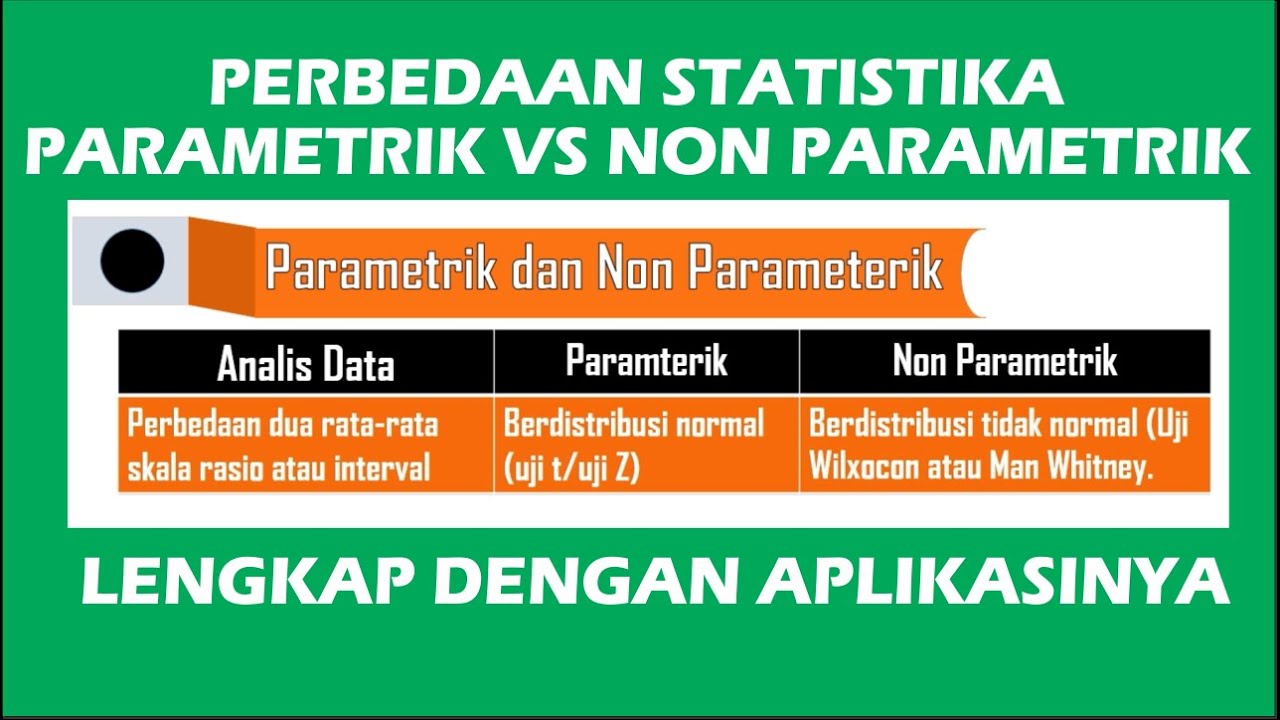
Perbedaan Statistika Parametrik dan Non Parametrik

Kruskal Wallis: Uji Non-Parametrik Komparasi Numerik Tidak Berpasangan
5.0 / 5 (0 votes)
