WORD FORMATION
Summary
TLDRIn this video, Coach Irene explores the fascinating process of word formation in English, highlighting nine essential techniques: affixation, compounding, conversion, clipping, blending, acronyms, back formation, reduplication, and borrowing. From adding prefixes and suffixes to create new words, to the playful combination of words like 'brunch' and 'smog,' Irene illustrates how these processes contribute to the dynamic nature of the language. The video also dives into the evolution of words through technological advancements and cultural shifts, making English one of the most diverse languages globally. Watch to learn how language continues to grow and adapt over time!
Takeaways
- 😀 Word formation is the process of creating new words from existing ones and is essential for language growth and evolution.
- 😀 Affixation involves adding prefixes or suffixes to a base word to change its meaning or grammatical function, e.g., 'unhappy' or 'teacher'.
- 😀 Compounding combines two or more words to form a new word, which can be closed, hyphenated, or open, e.g., 'notebook', 'mother-in-law', 'post office'.
- 😀 Conversion, or zero derivation, shifts a word to a different grammatical category without changing its form, e.g., 'Google' (noun → verb).
- 😀 Clipping shortens longer words without changing their meaning, including back clipping, fore clipping, and middle clipping, e.g., 'advertisement → ad', 'telephone → phone'.
- 😀 Blending fuses parts of two or more words to form a new word, often playful or casual, e.g., 'brunch', 'smog', 'vlog'.
- 😀 Acronyms and initialisms simplify complex phrases using initial letters, e.g., 'NASA' (acronym) and 'ATM' (initialism).
- 😀 Back-formation creates new words by removing a perceived affix from an existing word, e.g., 'burgle' from 'burglar'.
- 😀 Reduplication repeats whole or part of words for emphasis, playfulness, or expressiveness, e.g., 'bye-bye', 'chit-chat', 'tick-tock'.
- 😀 Borrowing integrates words from other languages into English, while coinage (neologism) creates entirely new words to reflect cultural, technological, or brand innovations, e.g., 'yoga', 'selfie', 'Google'.
Q & A
What is word formation and why is it important in language?
-Word formation is the process of creating new words from existing ones. It plays a key role in the growth and evolution of a language by helping it adapt and expand, particularly in English, which is dynamic and constantly evolving due to its flexible word formation rules.
What is affixation and how does it work?
-Affixation involves adding prefixes or suffixes to a base word to change its meaning or grammatical function. For example, adding 'un' to 'happy' creates 'unhappy' (a change in meaning), and adding 'er' to 'teach' creates 'teacher' (a change from verb to noun).
What are the three types of compounds in word formation?
-The three types of compounds are closed compounds (written as one word, e.g., 'notebook'), hyphenated compounds (linked by hyphens, e.g., 'mother-in-law'), and open compounds (written separately but function as a single unit, e.g., 'post office').
What is conversion or zero derivation in word formation?
-Conversion, also known as zero derivation or functional shift, is when a word is reassigned to a different grammatical category without changing its form. For example, 'Google' (a noun) becomes 'to Google' (a verb), or 'run' (a verb) becomes 'a run' (a noun).
How does clipping work in word formation?
-Clipping is the process of shortening a longer word without changing its meaning. There are three types of clipping: back clipping (e.g., 'advertisement' becomes 'ad'), fore clipping (e.g., 'telephone' becomes 'phone'), and middle clipping (e.g., 'influenza' becomes 'flu').
What is blending and how does it differ from affixation?
-Blending involves combining parts of two or more words to create a new one. For example, 'brunch' is formed by blending 'breakfast' and 'lunch.' Unlike affixation, which adds prefixes or suffixes, blending fuses portions of words together creatively.
What is the difference between acronyms and initialisms?
-Acronyms are formed from the initial letters of a phrase and are pronounced as a word (e.g., 'NASA' for 'National Aeronautics and Space Administration'). Initialisms are also formed from initial letters but are pronounced letter by letter (e.g., 'ATM' for 'Automated Teller Machine').
What is back formation in word formation?
-Back formation is a process where a new word is created by removing an affix from an existing word, often mistakenly thought to be part of the base word. For example, 'addict' (originally 'addictor') or 'editor' (from 'edit').
How does reduplication function in language?
-Reduplication is the repetition of a word or part of a word to create a new meaning or emphasis. For example, 'bye-bye' (full reduplication), 'chit-chat' (partial reduplication), or 'tick-tock' (ablaut reduplication). It is often used in informal or playful speech.
What is borrowing in word formation and how has it influenced English?
-Borrowing is the process of adopting words from other languages into English. For example, 'ballet' (French), 'yoga' (Sanskrit), and 'piano' (Italian). English has a vast number of loanwords, making it one of the most linguistically diverse languages.
What is coinage or neologism in language?
-Coinage, or neologism, refers to the creation of entirely new words that were not previously part of the language. These words often arise due to technological advancements, cultural changes, or branding, such as 'Google' (as a verb) or 'selfie' (a popular term from social media).
Outlines

This section is available to paid users only. Please upgrade to access this part.
Upgrade NowMindmap

This section is available to paid users only. Please upgrade to access this part.
Upgrade NowKeywords

This section is available to paid users only. Please upgrade to access this part.
Upgrade NowHighlights

This section is available to paid users only. Please upgrade to access this part.
Upgrade NowTranscripts

This section is available to paid users only. Please upgrade to access this part.
Upgrade NowBrowse More Related Video
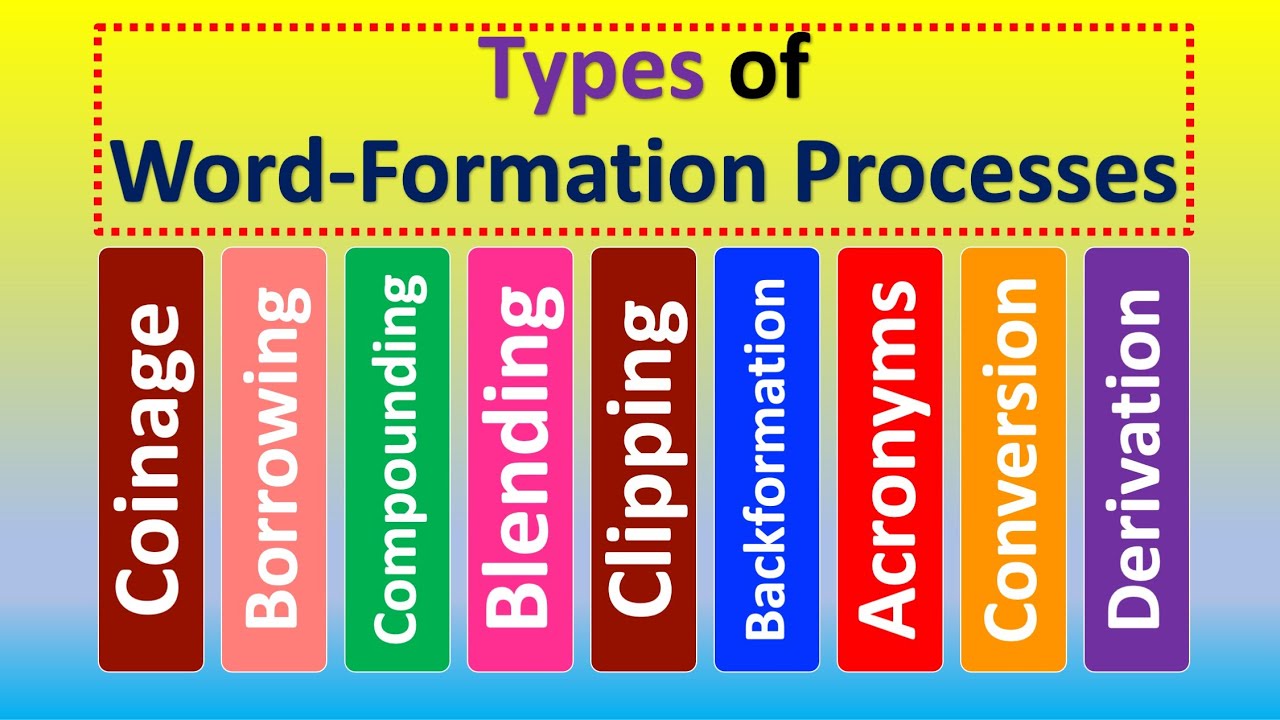
Types of Word-Formation Processes, Coinage, Borrowing, Compounding, Blending, Clipping, Acronyms etc
Morphology 101: Word-formation processes

Erin McKean: Go ahead, make up new words!

BAHAGIAN 1 : PROSES PEMBENTUKAN KATA

Tata Kata Bahasa Indonesia

Bahasa Indonesia Kelas XII Bab 2 Mempresentasikan Ide Kewirausahaan Pembelajaran 3
5.0 / 5 (0 votes)
