Logika Umum: Mengenal Argumen | Penalaran Umum | Alternatifa
Summary
TLDRIn this video, the speaker breaks down the components of an argument, focusing on the essential parts like the main conclusion, supporting evidence, and intermediate conclusions. The speaker explains how arguments can vary in complexity, from simple claims supported by evidence to more intricate structures involving background information and multiple conclusions. The importance of identifying these components is emphasized, as well as the role of rhetorical language in guiding the reader’s understanding. Practical examples help illustrate different argument types, making the concepts clearer for the audience.
Takeaways
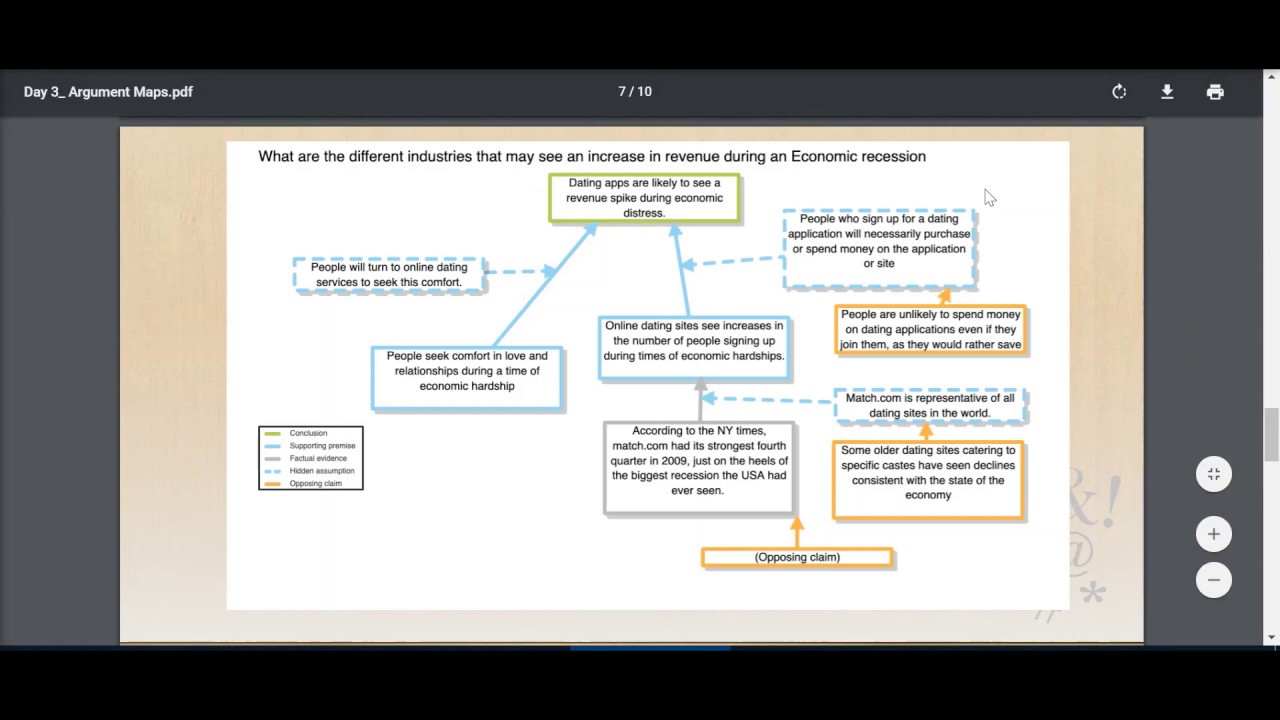
- 😀 An argument consists of a series of statements, with at least two main components: a conclusion (claim) and supporting evidence.
- 😀 The conclusion is the primary claim of the argument, which explains the information the argument is trying to convince the audience to accept.
- 😀 Supporting evidence provides factual information or reasons that help prove the truth of the conclusion, such as examples or data.
- 😀 There is no fixed order for the components of an argument. The conclusion can appear at the beginning, middle, or end of the argument.
- 😀 The simplest argument structure includes just a conclusion and one piece of supporting evidence.
- 😀 In more complex arguments, there may be intermediate conclusions, also known as sub-conclusions, which are derived from supporting evidence but are not the main conclusion.
- 😀 An example of an argument with a sub-conclusion: Sarah might accept a job offer because she has 10 years of experience, which leads to the sub-conclusion that she will pay back the loan she owes.
- 😀 In complex arguments, background information is often included to set the stage and provide context for the conclusion and supporting evidence.
- 😀 Background information is often used to make an argument more persuasive or to clarify the context, but it can sometimes obscure the main points if not carefully read.
- 😀 Identifying the main conclusion in an argument is not always straightforward. Words like 'therefore', 'thus', and 'because' can often indicate the conclusion or supporting evidence in an argument.
Q & A
What is an argument according to the script?
-An argument is a series of statements that consists of at least a conclusion and supporting evidence. The conclusion is the main claim to be accepted, while the supporting evidence provides reasons or information that justify that claim.
What is the role of a conclusion in an argument?
-The conclusion is the primary claim that the argument is trying to establish or persuade the reader to accept. It represents the main point that the supporting evidence is intended to justify.
What function does supporting evidence serve in an argument?
-Supporting evidence provides one or more reasons that justify the conclusion. It strengthens the credibility of the main claim by offering logical backing or factual information.
Does the conclusion always appear at the beginning of an argument?
-No, there is no fixed order for argument components. The conclusion may appear at the beginning, in the middle, or at the end of the argument.
What is the simplest structure of an argument described in the script?
-The simplest structure consists of one conclusion and one supporting piece of evidence. For example, 'Sarah might receive the job offer because she has 10 years of experience.'
How can we identify the conclusion and supporting evidence in a simple argument?
-We identify the conclusion as the statement being claimed (e.g., Sarah might receive the job offer) and the supporting evidence as the reason provided to justify it (e.g., because she has 10 years of experience). The claim is what we are asked to believe, and the evidence explains why we should believe it.
What is an intermediate conclusion?
-An intermediate conclusion, also called a sub-conclusion, is a statement that is supported by evidence but also serves as support for a further, main conclusion. It connects initial evidence to the final claim.
How does an argument with an intermediate conclusion differ from a simple argument?
-In a more complex argument, the initial evidence supports an intermediate conclusion, which then supports the main conclusion. This creates a multi-layered structure rather than a direct evidence-to-conclusion relationship.
What is background information in an argument?
-Background information provides contextual details that set the stage for the argument. It helps the reader understand the situation but does not directly function as the main supporting evidence or conclusion.
Why can background information be misleading in logical reasoning questions?
-Background information can distract readers from identifying the actual conclusion and supporting evidence. It may act as rhetorical embellishment and sometimes serves as a decoy to obscure the main logical structure.
Why is it important to read arguments with a specific purpose?
-Reading with a purpose helps readers focus on identifying the conclusion, supporting evidence, and other components accurately, preventing them from being distracted by irrelevant background details.
What are some common indicator words that signal a conclusion?
-Common conclusion indicators include phrases such as 'therefore,' 'thus,' 'in conclusion,' 'because of that,' 'as a result,' and similar expressions that signal a claim is being drawn.
What are some common indicator words that signal supporting evidence?
-Common evidence indicators include words and phrases like 'because,' 'since,' 'furthermore,' 'given that,' 'for,' and 'as shown by,' which introduce reasons supporting a conclusion.
Outlines

This section is available to paid users only. Please upgrade to access this part.
Upgrade NowMindmap

This section is available to paid users only. Please upgrade to access this part.
Upgrade NowKeywords

This section is available to paid users only. Please upgrade to access this part.
Upgrade NowHighlights

This section is available to paid users only. Please upgrade to access this part.
Upgrade NowTranscripts

This section is available to paid users only. Please upgrade to access this part.
Upgrade NowBrowse More Related Video

How I wrote 1st class essays at Cambridge University (how to write the best essay)

3. Cara Berpikir Kritis - Dasar Berpikir Kritis

Estrutura do texto dissertativo-argumentativo - Redação - Ensino Médio
Callido Argument Mapping Extension
Argumentative Essay || GRADE 10 || MELC-based VIDEO LESSON | QUARTER 3 | MODULE 1
Academic Essay Basics - Intro/Body/Conclusion
5.0 / 5 (0 votes)
