(LENGKAP) Cara mudah merasionalkan penyebut
Summary
TLDRThis video tutorial provides a step-by-step guide to rationalizing denominators in mathematical expressions, a key concept often taught in middle and high school. The presenter explains the process using various examples, such as simplifying expressions involving square roots and radicals. Viewers are walked through several problems, demonstrating how to multiply by conjugates and apply algebraic techniques to simplify complex fractions. The tutorial is presented in a clear, accessible manner, aiming to make the topic easier to understand for students at different levels. The video also encourages engagement through likes, comments, and sharing.
Takeaways
- 😀 Rationalizing denominators involves multiplying both the numerator and denominator by the conjugate of the denominator to eliminate square roots from the denominator.
- 😀 The process can be applied to simple fractions involving square roots, like '2 / (√5 + √5)' or more complex ones involving different square roots.
- 😀 Always remember to change the signs when multiplying by the conjugate of a binomial with square roots (e.g., change '+' to '-') to use the difference of squares.
- 😀 In fractions, you multiply the numerator by the conjugate’s numerator and the denominator by the conjugate’s denominator. The result will simplify after eliminating the square roots from the denominator.
- 😀 For example, when rationalizing '2 / (√5 + √5)', multiply the fraction by '(√5 - √5) / (√5 - √5)' to get a simplified form.
- 😀 The key mathematical rule when working with square roots is that multiplying two conjugates (such as '√a + √b' and '√a - √b') results in 'a - b'. This is crucial in eliminating the square root in the denominator.
- 😀 In some problems, such as '3 / (2√7)', the steps are simplified by directly applying the conjugate without complicating the process.
- 😀 Understanding the difference of squares is fundamental: multiplying a binomial with square roots by its conjugate (changing the sign) helps eliminate the square roots and simplify the expression.
- 😀 Always check for simplifications after rationalizing. In some cases, common factors can be canceled out or simplified further, leading to a cleaner answer.
- 😀 The tutorial demonstrates various examples to help clarify the process, showing that rationalizing a denominator is a systematic and easy-to-understand technique.
Q & A
What is the main topic of this video?
-The main topic of the video is about rationalizing the denominator, specifically focusing on how to rationalize denominators with square roots in fractions, typically taught in middle and high school mathematics.
What is the first example presented in the video?
-The first example involves rationalizing the denominator of the fraction 2/√5 + √5. The process includes multiplying both the numerator and the denominator by √5, resulting in 2√5 / 5.
How do you rationalize a denominator involving a binomial with square roots?
-When the denominator involves a binomial like √5 + √7, you multiply both the numerator and denominator by the conjugate of the denominator (√5 - √7). This simplifies the denominator by using the difference of squares formula, and the result is a rationalized denominator.
What mathematical concept is used when multiplying binomials with square roots?
-The difference of squares formula is used when multiplying binomials with square roots. For example, (a + b)(a - b) = a² - b².
In the example 3/2√7, what steps are taken to rationalize the denominator?
-To rationalize 3/2√7, the numerator and denominator are both multiplied by √7. This results in (3√7) / (2 * 7), which simplifies to 3√7 / 14.
What happens when you multiply a fraction by its conjugate?
-When you multiply a fraction by its conjugate, the terms in the denominator cancel out the square roots, resulting in a rational number. This is achieved by applying the difference of squares formula.
How is the expression 4/(3 + √5) simplified?
-To simplify 4/(3 + √5), you multiply both the numerator and denominator by the conjugate (3 - √5). This eliminates the square root from the denominator using the difference of squares formula, leading to a simplified expression.
In the example 2√3 / (2 + √2), how do you rationalize the denominator?
-To rationalize 2√3 / (2 + √2), you multiply both the numerator and denominator by the conjugate (2 - √2). The result is a rationalized denominator and a simplified expression.
Why does the sign change when using the conjugate of a binomial?
-The sign changes when using the conjugate of a binomial because the conjugate is the opposite of the original binomial (e.g., from (a + b) to (a - b)). This ensures that when multiplied, the cross terms cancel out, leaving only the difference of squares.
What are the benefits of rationalizing the denominator in math problems?
-Rationalizing the denominator simplifies mathematical expressions, making them easier to work with. It is particularly useful when performing further calculations or simplifying equations involving square roots.
Outlines

This section is available to paid users only. Please upgrade to access this part.
Upgrade NowMindmap

This section is available to paid users only. Please upgrade to access this part.
Upgrade NowKeywords

This section is available to paid users only. Please upgrade to access this part.
Upgrade NowHighlights

This section is available to paid users only. Please upgrade to access this part.
Upgrade NowTranscripts

This section is available to paid users only. Please upgrade to access this part.
Upgrade NowBrowse More Related Video

Bentuk Akar Matematika Kelas X Matematika Peminatan Paling mudah
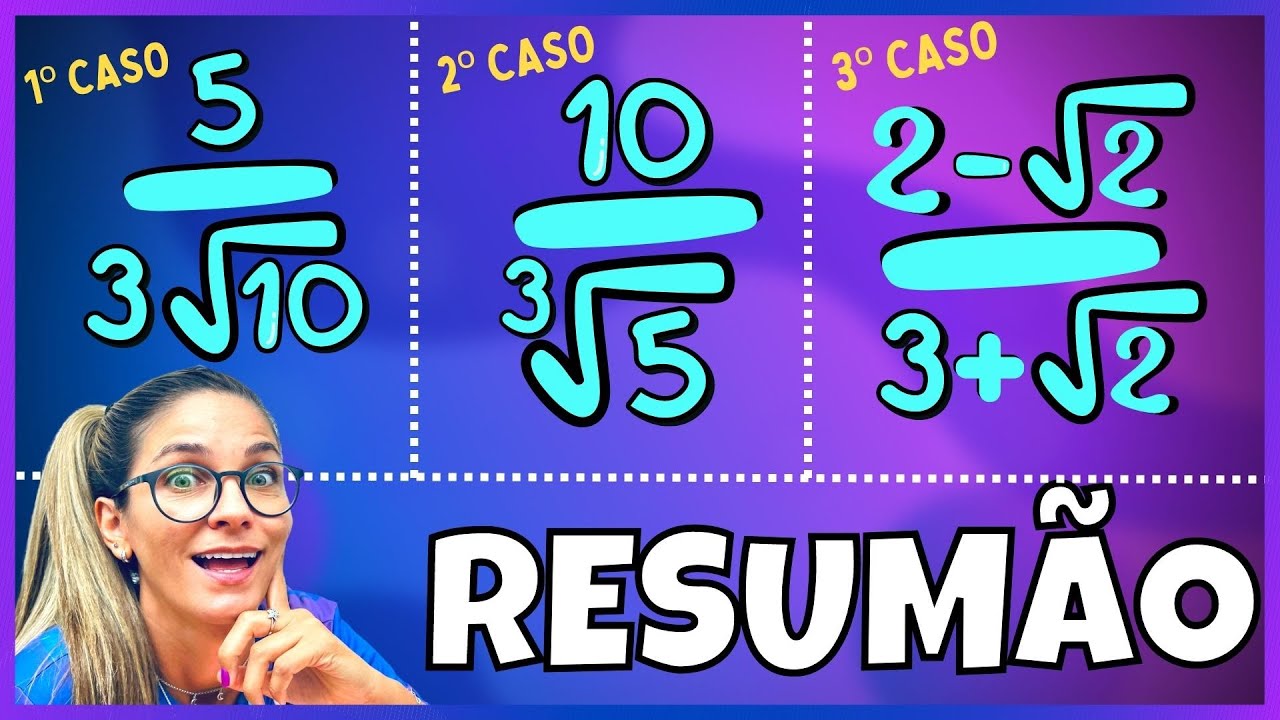
RACIONALIZAÇÃO DE DENOMINADORES RESUMÃO
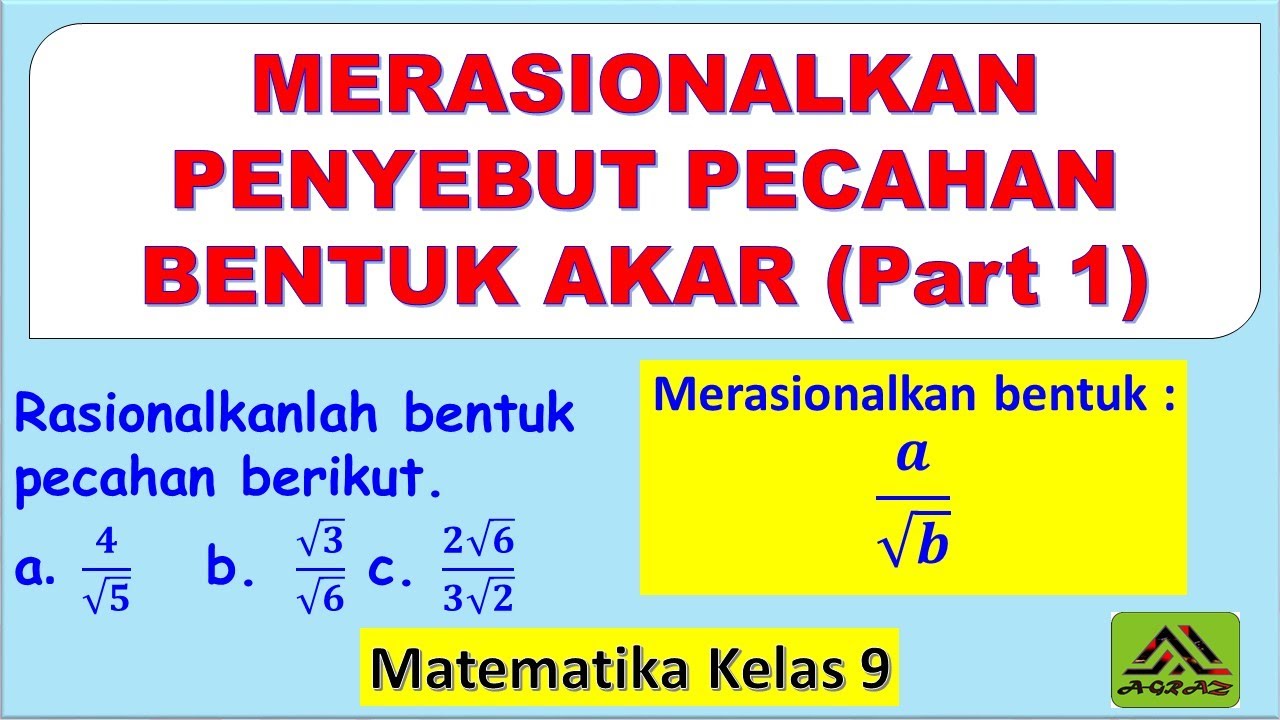
Merasionalkan Penyebut Pecahan Bentuk Akar (1) - Matematika Kelas 9
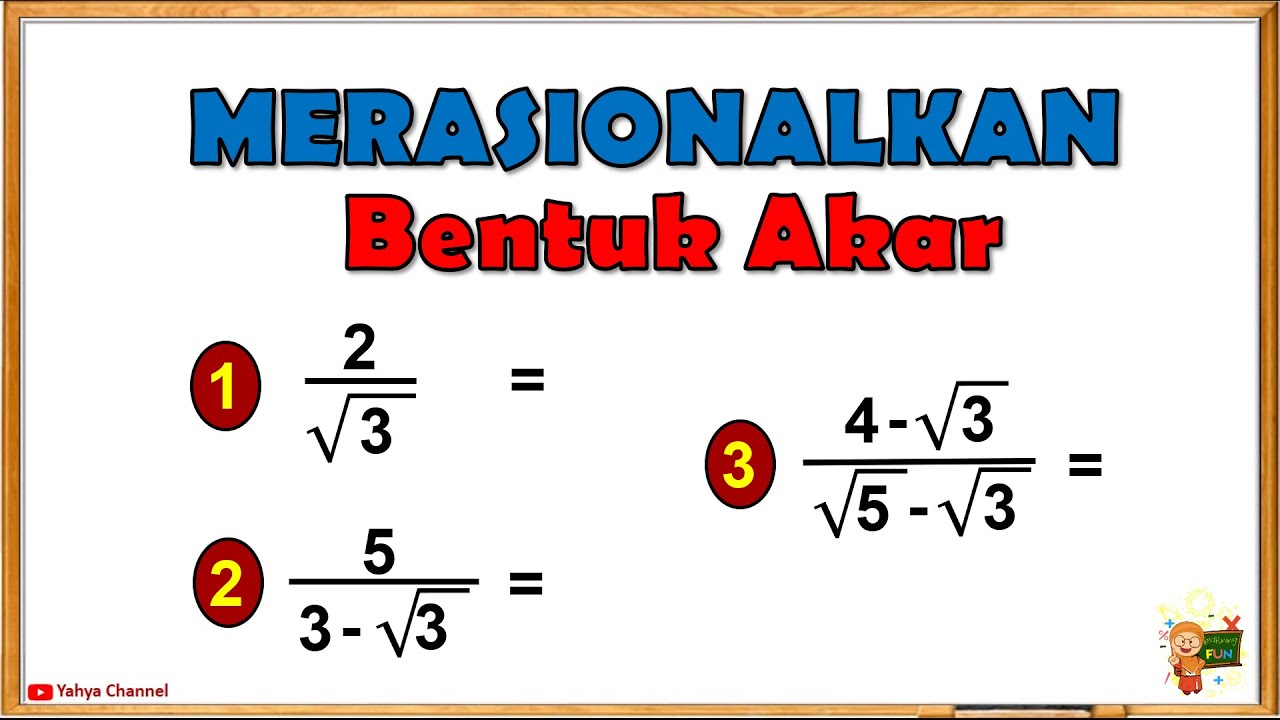
CARA MERASIONALKAN BENTUK AKAR

Turunan (Diferensial) Aturan berantai

Tips Mudah Menyederhanakan Bentuk Akar || Bab Bilangan Berpangkat (Part 2)
5.0 / 5 (0 votes)
