Acid and Base Definitions | Arrhenius, Bronsted-Lowry, and Lewis
Summary
TLDRIn this video, the instructor delves into the different definitions of acids and bases, explaining the three main perspectives: Arrhenius, Bronsted-Lowry, and Lewis. The Arrhenius definition focuses on acids donating protons and bases producing hydroxide ions in water. The Bronsted-Lowry definition shifts to proton donors and acceptors, applicable beyond water. Lastly, the Lewis definition explores acids and bases through the lens of electron pair donation and acceptance. The video emphasizes that these definitions provide different ways to understand acids and bases, with some compounds fitting into multiple categories.
Takeaways
- 😀 The video explains three different definitions of acids and bases: the Arrhenius, Bronsted-Lowry, and Lewis definitions.
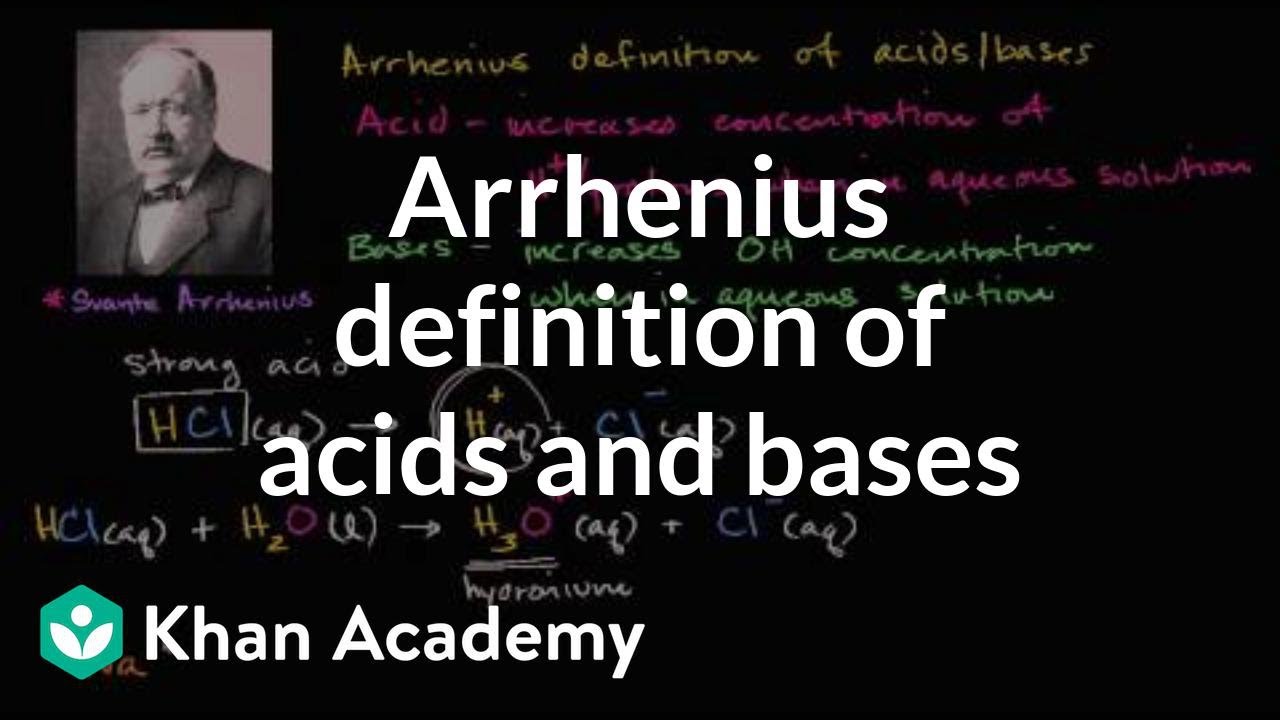
- 😀 The Arrhenius definition describes an acid as a molecule that donates a hydrogen ion (proton) when dissolved in water.
- 😀 An Arrhenius base is a molecule that produces a hydroxide ion when dissolved in water.
- 😀 The Bronsted-Lowry definition focuses on the transfer of hydrogen ions, where an acid is a proton donor and a base is a proton acceptor.
- 😀 Unlike the Arrhenius definition, the Bronsted-Lowry theory does not require the presence of water.
- 😀 The Lewis definition extends to organic chemistry and defines acids and bases based on electron pairs.
- 😀 A Lewis acid accepts a pair of electrons, while a Lewis base donates a pair of electrons.
- 😀 The three definitions offer different perspectives on acids and bases but can often overlap in certain cases.
- 😀 A compound can be classified as an Arrhenius, Bronsted-Lowry, and Lewis acid simultaneously.
- 😀 The video encourages viewers to explore further on the properties of acids and bases, referencing an additional video for deeper understanding.
Q & A
What is the Arrhenius definition of an acid?
-An Arrhenius acid is a molecule that donates a hydrogen ion (proton) when dissolved in water.
Why is a hydrogen ion referred to as a proton in the Arrhenius definition?
-A hydrogen ion is referred to as a proton because a typical hydrogen atom consists of only one proton and one electron. When the electron is removed, what remains is a proton.
What is the role of an Arrhenius base?
-An Arrhenius base is a molecule that produces a hydroxide ion (OH-) when dissolved in water.
How does the Bronsted-Lowry definition differ from the Arrhenius definition?
-The Bronsted-Lowry definition focuses on the proton transfer. An acid is a proton donor, while a base is a proton acceptor. This definition does not require the presence of water, unlike the Arrhenius definition.
Can a compound be both an Arrhenius acid and a Bronsted-Lowry acid?
-Yes, a compound can be both an Arrhenius acid and a Bronsted-Lowry acid, as long as it donates protons (hydrogen ions) in solution.
What does the Lewis definition of acids and bases focus on?
-The Lewis definition focuses on the behavior of electrons. A Lewis acid accepts a pair of electrons, while a Lewis base donates a pair of electrons.
How does the Lewis definition of acids and bases differ from the Arrhenius and Bronsted-Lowry definitions?
-The Lewis definition is more focused on electron interactions, whereas the Arrhenius and Bronsted-Lowry definitions are based on proton donation/acceptance. The Lewis definition also does not require water.
What is a key feature of the Lewis acid-base reaction?
-In a Lewis acid-base reaction, the acid accepts a pair of electrons, while the base donates a pair of electrons, forming a new bond.
Can a compound be classified as both a Lewis acid and a Bronsted-Lowry acid?
-Yes, a compound can be classified as both a Lewis acid and a Bronsted-Lowry acid, depending on whether it accepts electron pairs (Lewis) or donates protons (Bronsted-Lowry).
Are the Arrhenius, Bronsted-Lowry, and Lewis definitions of acids and bases mutually exclusive?
-No, these definitions are not mutually exclusive. A compound may fit multiple definitions. For example, a compound that donates a proton in water can also donate electron pairs, making it both an Arrhenius and a Lewis acid.
Outlines

This section is available to paid users only. Please upgrade to access this part.
Upgrade NowMindmap

This section is available to paid users only. Please upgrade to access this part.
Upgrade NowKeywords

This section is available to paid users only. Please upgrade to access this part.
Upgrade NowHighlights

This section is available to paid users only. Please upgrade to access this part.
Upgrade NowTranscripts

This section is available to paid users only. Please upgrade to access this part.
Upgrade Now




5.0 / 5 (0 votes)
