Soal soal TKA Matematika Jenjang SMP 2026 Materi Geometri dan Pengukuran | Part 3
Summary
TLDRThis educational video covers various geometry topics, specifically targeting SMP-level students. It explains concepts such as congruence, similarity, angle relationships, the Pythagorean theorem, and geometric transformations. Using clear examples, the video walks viewers through solving problems, such as determining angles in congruent triangles, calculating river width with similar triangles, and applying the Pythagorean theorem for real-world distance problems. The content is presented in an accessible manner, aiming to help students grasp key geometric principles and improve problem-solving skills.
Takeaways
- 😀 Geometry involves understanding concepts like congruence, similarity, and angles.
- 😀 When two triangles are congruent, corresponding angles and sides are equal.
- 😀 To calculate missing angles in congruent triangles, use the sum of angles in a triangle (180 degrees).
- 😀 Similar triangles have proportional sides, which can be used to find unknown lengths.
- 😀 The Pythagorean theorem is crucial for solving right-angled triangles, where the square of the hypotenuse equals the sum of the squares of the other two sides.
- 😀 The concept of opposite angles (vertically opposite) helps in solving angle-based problems.
- 😀 For real-world applications like measuring the width of a river, similar triangles can be used to find distances indirectly.
- 😀 The law of reflection in geometry involves reflecting points across specific lines to find new coordinates.
- 😀 Volume calculations for 3D shapes (like cones and cylinders) involve combining formulas for individual parts of the shape.
- 😀 Understanding geometric transformations like translation and reflection is essential for solving complex geometric problems.
Q & A
What is the first topic discussed in the video?
-The first topic discussed is congruency in triangles, specifically comparing two triangles, PQR and ABC, to identify congruent angles and sides.
How is the angle PQR determined in the congruent triangles problem?
-The angle PQR is determined by using the fact that in congruent triangles, corresponding angles are equal. The given angle BAC is 80°, and since the sides 12 and 15 enclose this angle, angle PQR is also 80°.
What is the method used to calculate the width of the river in the second example?
-The method used is based on similar triangles. By applying proportionality between corresponding sides of the triangles, the width of the river is calculated as 10 meters.
In the third problem, how are the angle relationships used to find angle A?
-The problem involves two lines intersecting, forming vertical and supplementary angles. By setting up an equation based on the relationship between the angles, the value of x is found to be 15°, and angle A is subsequently calculated as 15°.
What is the key concept used to solve the Pythagorean theorem question in the fourth example?
-The key concept is the Pythagorean theorem, which relates the sides of right triangles. In this case, the theorem is used to determine whether certain side lengths and statements about the quadrilateral PQRS are true.
How is the perimeter of quadrilateral PQRS calculated?
-The perimeter is calculated by adding the lengths of all four sides: PQ (9), QR (8), SR (17), and SP (12). The total perimeter is 46 cm.
What formula is used to calculate the area of quadrilateral PQRS?
-The area is calculated by adding the areas of two right triangles within the quadrilateral. The formula for the area of a right triangle is 1/2 * base * height. The total area of PQRS is found to be 114 cm².
In the problem about Rudi's cycling journey, how is the direct distance between Rudi's and Dimas' houses calculated?
-The direct distance is calculated using the Pythagorean theorem. The journey creates a right triangle, with the sides being 150 m (westward) and 80 m (southward). The direct distance (hypotenuse) is found to be 170 meters.
What is the significance of transformations in the sixth example involving point L?
-Transformations are used to first translate and then reflect the point L. The translation shifts point L to a new position, and the reflection is calculated using a formula for reflection over a vertical line (x = a). The value of 'a' is determined to be 1.
How is the volume of the combined shape of a cone and a cylinder determined in the final example?
-The volume of the combined shape is the sum of the volume of the cone and the volume of the cylinder. The formula for the volume of a cone is 1/3 * π * r² * h, and for the cylinder, it is π * r² * h. After the shape is flipped, the volume of water remains the same, but only the cylinder's volume is relevant, leading to a height of 6 cm.
Outlines

This section is available to paid users only. Please upgrade to access this part.
Upgrade NowMindmap

This section is available to paid users only. Please upgrade to access this part.
Upgrade NowKeywords

This section is available to paid users only. Please upgrade to access this part.
Upgrade NowHighlights

This section is available to paid users only. Please upgrade to access this part.
Upgrade NowTranscripts

This section is available to paid users only. Please upgrade to access this part.
Upgrade NowBrowse More Related Video

BAHAS SOAL ASLI TKA MATEMATIKA SMP 2026 | Mantappu Academy

PART#01: BAHASAN SOAL TRYOUT-3 TKA NUMERASI (MATEMATIKA) SMP 2026
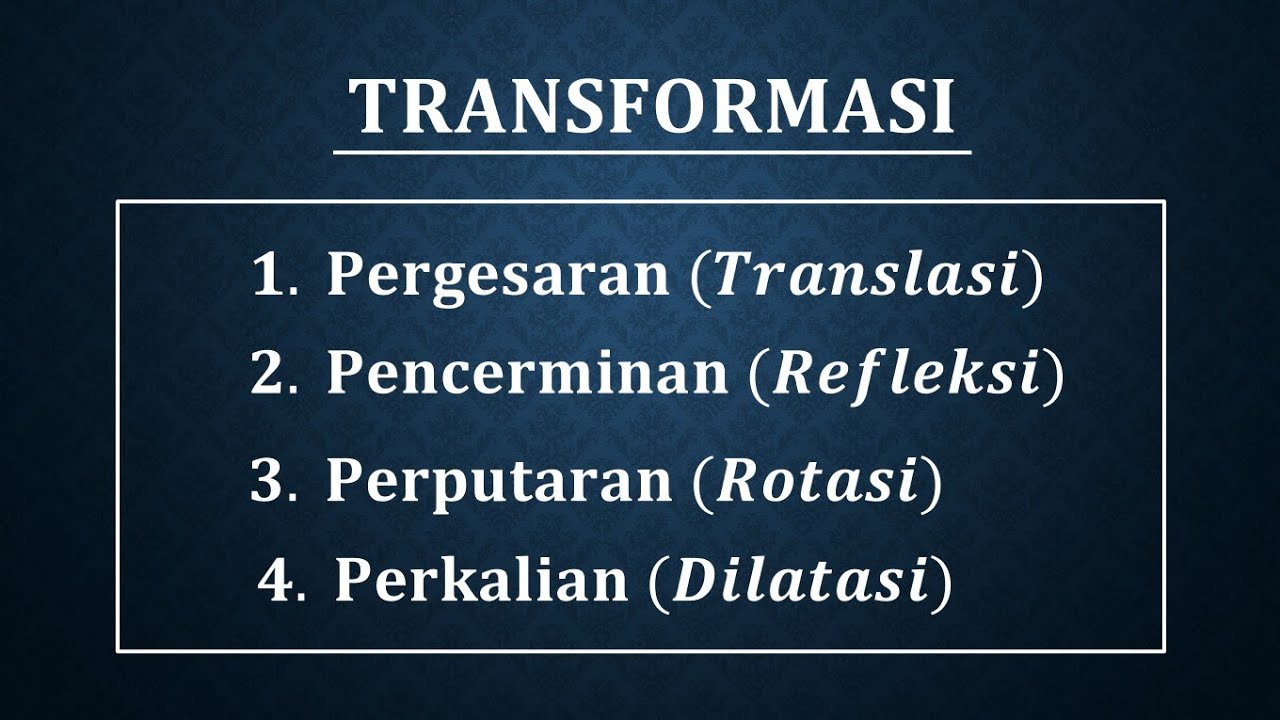
TRANFORMASI Pergeseran(Translasi), Pencerminan(Refleksi), Perputaran(Rotasi) dan Perkalian(Dilatasi)
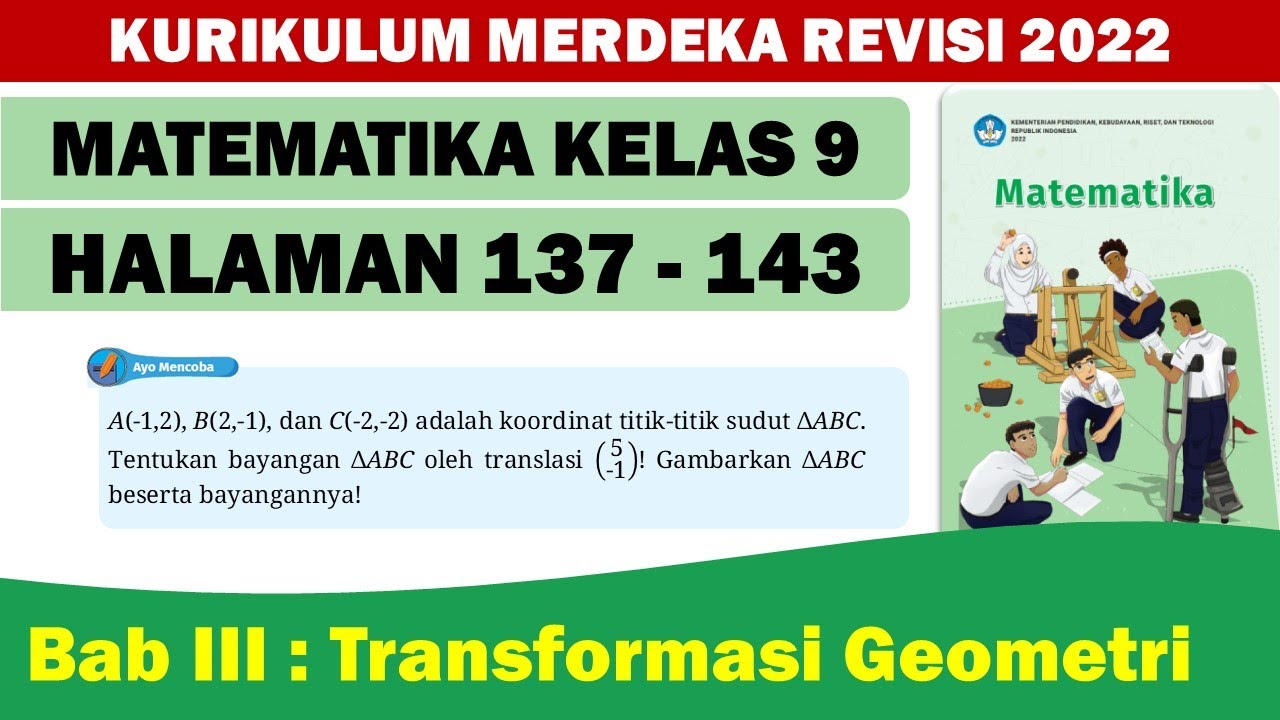
MATEMATIKA KELAS 9 HALAMAN 137-143 KURIKULUM MERDEKA EDISI 2022
Kekongruenan dan Kesebangunan [Part 2] - Kekongruenan Dua Segitiga

UNBK BAHASA INDONESIA SMP/MTS LENGKAP DENGAN PEMBAHASAN 2020 #BELAJARDIRUMAH
5.0 / 5 (0 votes)
