Ringkasan Idgham Mutamatsilain, Idgham Mutajanisain, Idgham Mutaqaribain
Summary
TLDRThis video tutorial covers the concept of 'Idgham' in Tajwid, focusing on its classification based on the articulation points (makhraj) and characteristics (sifat) of the Arabic letters. The script explains the three types of Idgham: Idgham Mutamatsilain, where letters with the same makhraj and sifat are merged; Idgham Mutajanisain, where letters have the same makhraj but different sifat; and Idgham Mutaqaribain, where the letters' makhraj and sifat are close but distinct. Examples from the Quran are provided for each type, helping viewers betterunderstandproperrecitationtechniques.
Takeaways
- 😀 Idgham is a technique in Tajwid where two Arabic letters are merged when recited.
- 😀 There are three main types of Idgham based on the characteristics (makhraj and sifat) of the letters: Idgham Mutamatsilain, Idgham Mutajanisain, and Idgham Mutaqaribain.
- 😀 Idgham Mutamatsilain occurs when two letters have the same makhraj and sifat, such as when the letter 'ba' with sukun is followed by 'ba' with harakat. These letters merge, and the first is not pronounced.
- 😀 Idgham Mutajanisain occurs when two letters have the same makhraj but different sifat. For example, the letter 'dal' (with sukun) followed by 'ta' (with harakat). The first letter is not pronounced, and the second letter is emphasized.
- 😀 Idgham Mutaqaribain happens when two letters are close in both their makhraj and sifat. For instance, 'lam' (with sukun) followed by 'ra' (with harakat). These letters are pronounced together smoothly, blending into one sound.
- 😀 The principle of Idgham Mutamatsilain helps achieve fluidity in recitation by merging identical letters without repeating sounds.
- 😀 Idgham Mutajanisain is more commonly found in the Qur'an, with specific examples like 'dal' followed by 'ta' or 'zai' followed by 'ra'. These types of combinations are usually not pronounced separately.
- 😀 Idgham Mutaqaribain, although less frequent, occurs when letters with closely related articulation points meet, such as 'lam' and 'ra'. This is also blended together in recitation.
- 😀 In all Idgham cases, the letter with sukun (no harakat) is typically omitted and merged into the following letter, ensuring smoother flow in Tajwid.
- 😀 The proper understanding of these three types of Idgham is crucial for accurate and fluid Quranic recitation, enhancing both pronunciation and memorization.
Q & A
What are the three types of Idgham discussed in the script?
-The three types of Idgham discussed are Idgham Mutamatsilain, Idgham Mutajanisain, and Idgham Mutaqaribain.
What does 'Idgham Mutamatsilain' refer to?
-'Idgham Mutamatsilain' refers to the merging of two letters that share the same makhraj (articulation point) and sifat (quality). The example given is the merging of the letter 'ba' with a 'ba' that has a harakat.
Can you provide an example of 'Idgham Mutamatsilain'?
-An example of Idgham Mutamatsilain is when the letter 'ba' with a sukun (no vowel) meets another 'ba' with a harakat (vowel). In this case, the first 'ba' is merged into the second 'ba'.
What is the key characteristic of 'Idgham Mutajanisain'?
-'Idgham Mutajanisain' involves two letters that have the same makhraj but different sifat. An example is the merging of the letter 'dal' with the letter 'ta', which have the same articulation point but different qualities.
Which letters are commonly involved in 'Idgham Mutajanisain'?
-Common pairs involved in Idgham Mutajanisain include 'dal' with 'ta', 'za' with 'da', 'ta' with 'ka', and 'ba' with 'mi'. These letters share the same makhraj but differ in their sifat.
What is the difference between 'Idgham Mutamatsilain' and 'Idgham Mutajanisain'?
-The key difference is that Idgham Mutamatsilain involves letters that are identical in both makhraj and sifat, while Idgham Mutajanisain involves letters that share the same makhraj but differ in sifat.
Can you provide an example of 'Idgham Mutajanisain'?
-An example of Idgham Mutajanisain is when the letter 'dal' (with sukun) meets the letter 'ta' (with harakat). In this case, the first letter ('dal') is not pronounced separately but merged into the second letter ('ta').
What does 'Idgham Mutaqaribain' refer to?
-'Idgham Mutaqaribain' refers to the merging of two letters that have a close makhraj and sifat, but are not exactly the same. The example given is the merging of 'lam' with 'ra', where both letters have similar articulation points and qualities.
Can you explain the process of reading 'Idgham Mutaqaribain' with an example?
-When two letters such as 'lam' with sukun and 'ra' with harakat meet, the first letter ('lam') is not pronounced separately but merged directly with the second letter ('ra'). This is because both letters share a similar makhraj and sifat.
What happens when a letter with a sukun meets a letter with a harakat in the context of Idgham?
-When a letter with sukun meets a letter with harakat in Idgham, the first letter is merged into the second one, meaning it is not pronounced separately, and they are read together smoothly as a single sound.
Outlines

This section is available to paid users only. Please upgrade to access this part.
Upgrade NowMindmap

This section is available to paid users only. Please upgrade to access this part.
Upgrade NowKeywords

This section is available to paid users only. Please upgrade to access this part.
Upgrade NowHighlights

This section is available to paid users only. Please upgrade to access this part.
Upgrade NowTranscripts

This section is available to paid users only. Please upgrade to access this part.
Upgrade NowBrowse More Related Video
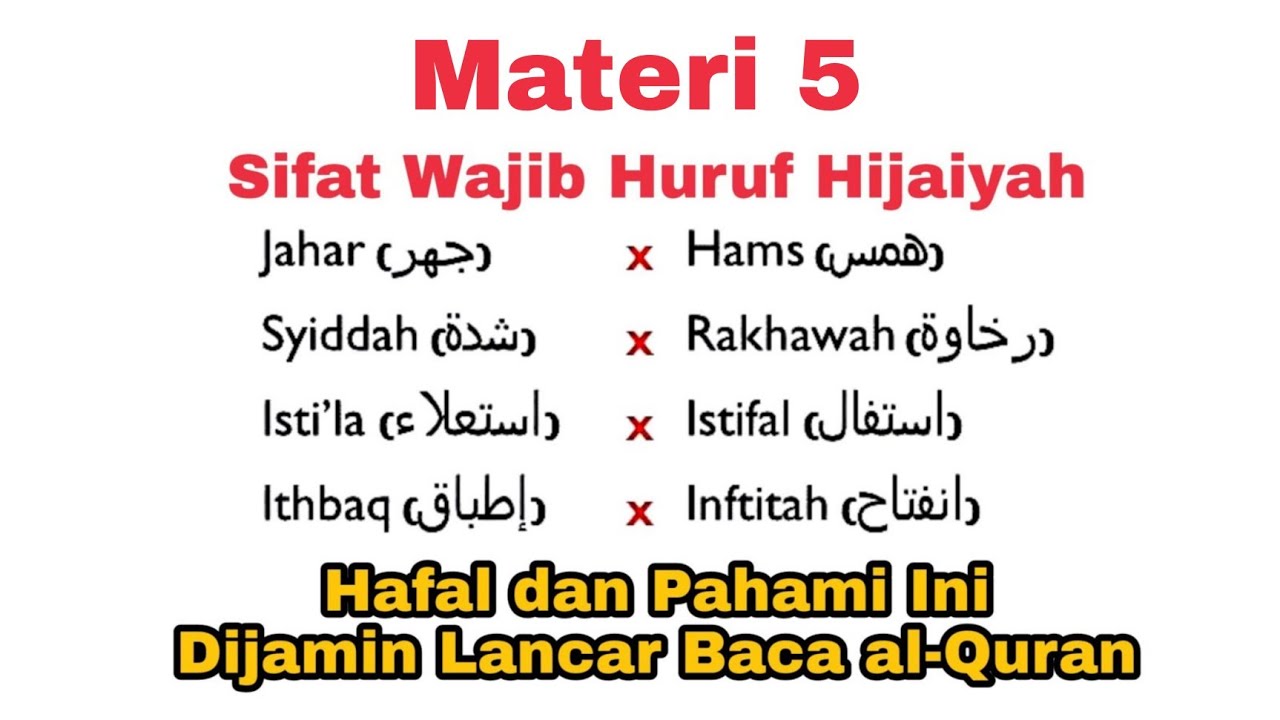
Materi 5. Pahami Sifat Wajib Huruf Hijaiyah (Sifat Berlawanan), Tajwid Ringkas Untuk Pemula
Tahsin Tilawah Al-Quran (TawaQu) : Bab Vokal dan Harakat Bag. 01

Penjelasan MUDAH huruf ء dan هـ | Makhaarij 2 | Arabic101Bahasa

Bedakan Segera Idgham Kamil & Idgham Naqish, Pahami Ini Agar Bacaan Lancar, Lengkap Contoh + Praktek

Belajar Makhorijul Huruf ( Makhroj Al Jauf ) Bagian 1 Mudah dan Ringkas .

Episode 1. Makharijul Huruf (Materi al-Halq/Huruf Tenggorokan) | Tajwid Pemula
5.0 / 5 (0 votes)
