MMW - Chapter 3 - Problem Solving and Reasoning (Part 1)
Summary
TLDRThis chapter focuses on problem-solving and reasoning, introducing two key types of reasoning: inductive and deductive. Inductive reasoning involves making generalizations from specific observations, while deductive reasoning derives specific conclusions from general principles. The video explains these concepts with examples, such as determining whether statements about dolphins, cats, or driving conditions are based on inductive or deductive reasoning. It also covers related concepts like intuition, mathematical proof, and certainty, showing how these mental processes guide our decision-making and help us reach logical conclusions.
Takeaways
- 😀 Inductive reasoning involves making generalizations from specific observations or instances. It moves from specific to general.
- 😀 Deductive reasoning involves drawing specific conclusions based on general principles or facts. It moves from general to specific.
- 😀 Inductive reasoning conclusions are not always valid, as they are based on observations that may not represent the whole picture.
- 😀 Deductive reasoning conclusions are always valid and based on previously known facts, making them certain and true.
- 😀 Intuition is the ability to understand something instinctively, without needing conscious reasoning or evidence.
- 😀 Mathematical proof is an argument that convinces others that a statement is true, often involving justification or logical reasoning.
- 😀 Certainty refers to an outcome or conclusion that is beyond doubt, achieved through reasoning and evidence.
- 😀 An example of inductive reasoning: all dolphins are mammals, all mammals have kidneys, so all dolphins must have kidneys.
- 😀 An example of deductive reasoning: all cats have a keen sense of smell, Fluffy is a cat, so Fluffy must have a keen sense of smell.
- 😀 Intuition, proof, and certainty are interconnected: intuition leads to an instinctive understanding, proof justifies it, and certainty removes all doubt about the conclusion.
Q & A
What is inductive reasoning?
-Inductive reasoning is the process of making generalized decisions based on repeated specific observations or instances. It moves from specific to general, such as concluding that all grandfathers are bald just because two grandfathers observed are bald.
How does deductive reasoning differ from inductive reasoning?
-Deductive reasoning involves drawing specific conclusions based on general premises. It moves from general to specific, such as concluding that 'Archie is kind' because 'all humans are kind' and 'Archie is a human.' Deductive reasoning is more certain and valid compared to inductive reasoning.
Why are conclusions in inductive reasoning not always valid?
-Conclusions in inductive reasoning are based on observations and generalizations, but these generalizations might not always be true. For example, just because two grandfathers are bald doesn't mean all grandfathers are bald.
What is the role of theory in deductive reasoning?
-Deductive reasoning relies on theory or known facts to draw specific conclusions. It uses previously established information to arrive at conclusions that are certain and true, like stating 'Archie is kind' because 'all humans are kind.'
Can you provide an example of inductive reasoning?
-Yes. An example of inductive reasoning is: 'Every windstorm in this area comes from the north. I can see a big cloud of dust in the distance, so a new windstorm is coming from the north.' This is based on repeated observations but may not always be accurate.
What makes deductive reasoning reliable?
-Deductive reasoning is reliable because it is based on established facts or theories. The conclusions drawn from general premises in deductive reasoning are logically valid and certain, such as concluding that 'fluffy has a keen sense of smell' because 'all cats have a keen sense of smell.'
What is intuition and how does it relate to problem-solving?
-Intuition is the ability to understand or know something instinctively, without the need for conscious reasoning or evidence. In problem-solving, intuition allows you to arrive at answers quickly based on prior knowledge or instinctive understanding, such as immediately knowing a square has four sides.
What is mathematical proof and how does it relate to reasoning?
-Mathematical proof is a logical argument that convinces others of the truth of a statement. It involves using established facts and reasoning to justify conclusions. In problem-solving, mathematical proof helps substantiate answers by providing clear and structured evidence.
What is the difference between certainty and intuition?
-Certainty is the state of being sure that a conclusion is correct, with no doubt. Intuition, on the other hand, is an instinctive understanding that does not require reasoning or proof. While intuition can help guide initial decisions, certainty is achieved after reasoning or proof establishes the truth of a conclusion.
How does inductive reasoning contribute to forming hypotheses?
-Inductive reasoning helps form hypotheses by observing specific instances and drawing generalized conclusions. For example, by observing that all observed swans are white, one might hypothesize that all swans are white, even though further evidence is needed to confirm this.
Outlines

This section is available to paid users only. Please upgrade to access this part.
Upgrade NowMindmap

This section is available to paid users only. Please upgrade to access this part.
Upgrade NowKeywords

This section is available to paid users only. Please upgrade to access this part.
Upgrade NowHighlights

This section is available to paid users only. Please upgrade to access this part.
Upgrade NowTranscripts

This section is available to paid users only. Please upgrade to access this part.
Upgrade NowBrowse More Related Video

PROBLEM SOLVING: INDUCTIVE AND DEDUCTIVE REASONING || MATHEMATICS IN THE MODERN WORLD

cognition

Critical Thinking #3: Types of Arguments

Problem Solving and Reasoning
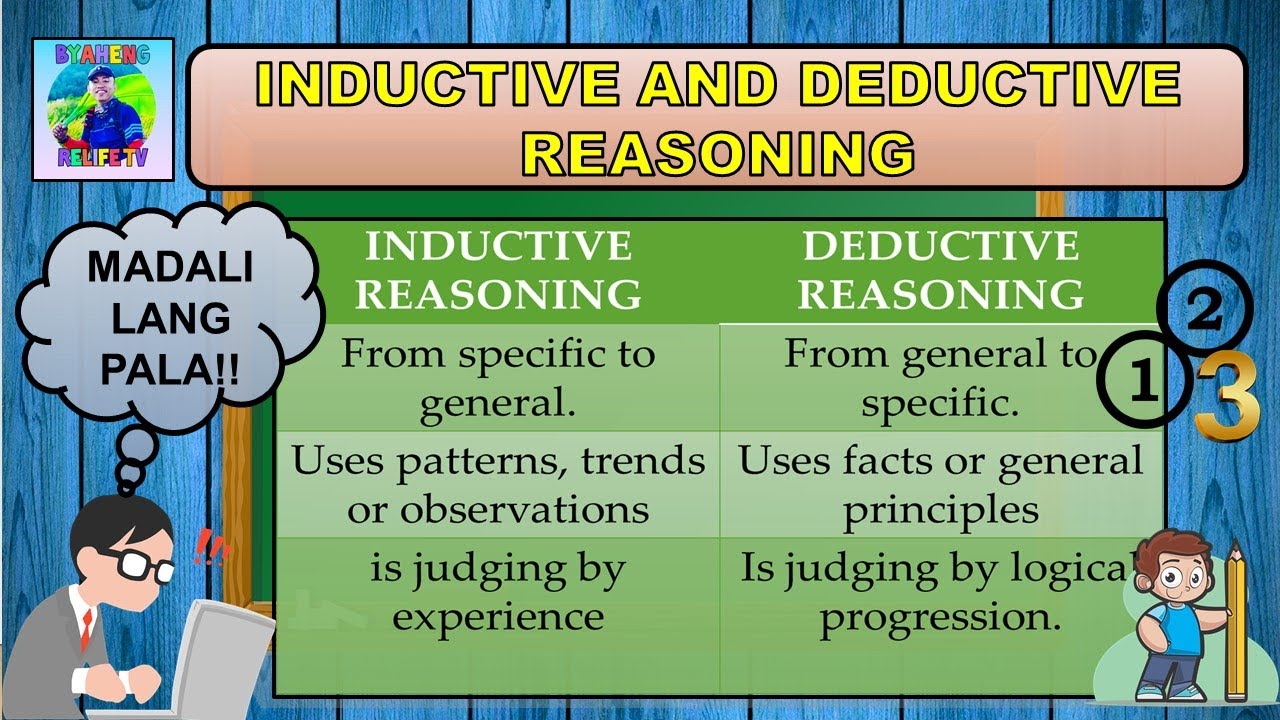
Inductive and Deductive Reasoning (Tagalog)

Thinking Skillfully: Induction vs. Deduction, ULTIMATE tools from the Scientific Method & Philosophy
5.0 / 5 (0 votes)
