How to Integrate Fourier Integrals | Complex Variables
Summary
TLDRIn this video, the instructor discusses how to compute improper integrals arising from Fourier analysis, particularly focusing on integrals involving sine and cosine terms. The process involves converting these integrals into contour integrals, using complex variables and the residue theorem. The video provides a detailed example to solve the integral of cosine x over x² + α², using techniques like Jordan's lemma, Euler's formula, and the residue theorem. The explanation emphasizes the importance of handling complex variables carefully to evaluate Fourier integrals over the real line.
Takeaways
- 😀 Improper integrals from Fourier analysis involve integrals of the form ∫ from -∞ to ∞ of f(x) * sin(ax) dx or f(x) * cos(ax) dx, where 'a' is a positive real number.
- 😀 For negative 'a', the sine and cosine terms can still be handled by factoring out the negative sign, simplifying the analysis.
- 😀 The approach to solving improper integrals is similar to contour integration used for rational functions, but with specific adjustments for sine and cosine terms.
- 😀 Replacing sine and cosine functions with their complex exponential equivalents (e^(i a z)) is crucial for managing the moduli of the integrals and preventing issues with large values as the radius increases.
- 😀 The modulus of e^(i a z) avoids the exponential growth that occurs when using sine and cosine directly, since the growth is counteracted in the complex plane.
- 😀 The technique involves transforming the problem into a contour integral over the complex plane, breaking it into a line segment and a semicircular arc.
- 😀 Jordan's lemma is applied to ensure that the integral over the semicircular arc approaches zero as the radius of the arc increases.
- 😀 The residue theorem is used to calculate the contour integral, which simplifies the evaluation of the improper integral by finding the residues at the poles of the integrand.
- 😀 To ensure proper handling of the complex integrals, the function being integrated must be a rational function with specific conditions, such as no real zeros in the denominator and a higher degree in the denominator.
- 😀 In the example problem, the integral of cos(x) / (x^2 + α^2) is solved using these techniques, resulting in the final result of π * e^(-α) / α for the improper integral.
- 😀 The final result of the contour integral is interpreted by taking either the real or imaginary part of the complex value depending on whether the original integral involves a cosine or sine function.
Q & A
What are the types of improper integrals discussed in the video?
-The video discusses improper integrals of the form: the integral from negative infinity to infinity of f(x) times sine(ax) dx and the integral from negative infinity to infinity of f(x) times cosine(ax) dx, where 'a' is a positive real number.
Why can't we simply replace 'x' with 'z' in Fourier integrals as we did with rational functions?
-We can't directly replace 'x' with 'z' in Fourier integrals because the sine and cosine terms depend on the exponential of 'y' (the imaginary part of 'z'). As 'y' grows large, these terms become prohibitively large, making this approach unfeasible for the Fourier integrals.
What is the advantage of using the exponential form of sine and cosine in Fourier integrals?
-By replacing sine and cosine with the exponential form, we nullify the problematic exponential growth (e^ay) that occurs when integrating over a semicircular arc, thus making the integral more manageable.
What are the conditions for the function f(z) to be suitable for applying the contour integral technique?
-The function f(z) must be a rational function (the ratio of two polynomials), where the degree of the denominator is higher than that of the numerator. The polynomials should have real coefficients, and the denominator should have no real zeros, with at least one zero in the upper half-plane.
How do we break up the contour integral over a semicircular section in the complex plane?
-The contour integral is broken into two parts: one over the line segment from -R to R on the real axis, and another over the semicircular arc (C_R). The integral over the entire contour C is the sum of these two integrals.
What is the role of Jordan's Lemma in evaluating contour integrals?
-Jordan's Lemma is used to show that the integral over the semicircular arc vanishes as the radius (R) approaches infinity. This is crucial for evaluating the contour integral, as it allows us to ignore the contribution from the arc and focus only on the line segment integral.
Why do we need to evaluate the residue of the function at the pole z = iα?
-We evaluate the residue at z = iα because this is the only pole within the upper half-plane that contributes to the contour integral, as per the residue theorem. This residue helps us compute the value of the contour integral.
What does the residue theorem tell us about the contour integral?
-The residue theorem states that the contour integral around a closed curve is equal to 2πi times the sum of the residues at the poles enclosed by the curve. In this case, the integral over the contour C can be evaluated by calculating the residue at the pole z = iα.
What is the final step after evaluating the contour integral for the Fourier integral?
-The final step is to take the real part of the result if you are computing a cosine integral or the imaginary part if you are computing a sine integral. This is based on Euler's formula, where the exponential of a complex number can be expressed as a combination of sine and cosine functions.
What is the solution to the example problem involving the integral of cos(x) / (x^2 + α^2) from negative infinity to infinity?
-The integral of cos(x) / (x^2 + α^2) from negative infinity to infinity is π * e^(-α) / α. This result is obtained by applying the residue theorem and Jordan's Lemma as described in the steps of the solution process.
Outlines

This section is available to paid users only. Please upgrade to access this part.
Upgrade NowMindmap

This section is available to paid users only. Please upgrade to access this part.
Upgrade NowKeywords

This section is available to paid users only. Please upgrade to access this part.
Upgrade NowHighlights

This section is available to paid users only. Please upgrade to access this part.
Upgrade NowTranscripts

This section is available to paid users only. Please upgrade to access this part.
Upgrade NowBrowse More Related Video

Wallis' Formula (Part 1) by J.V.Viola

Integral Trigonometri
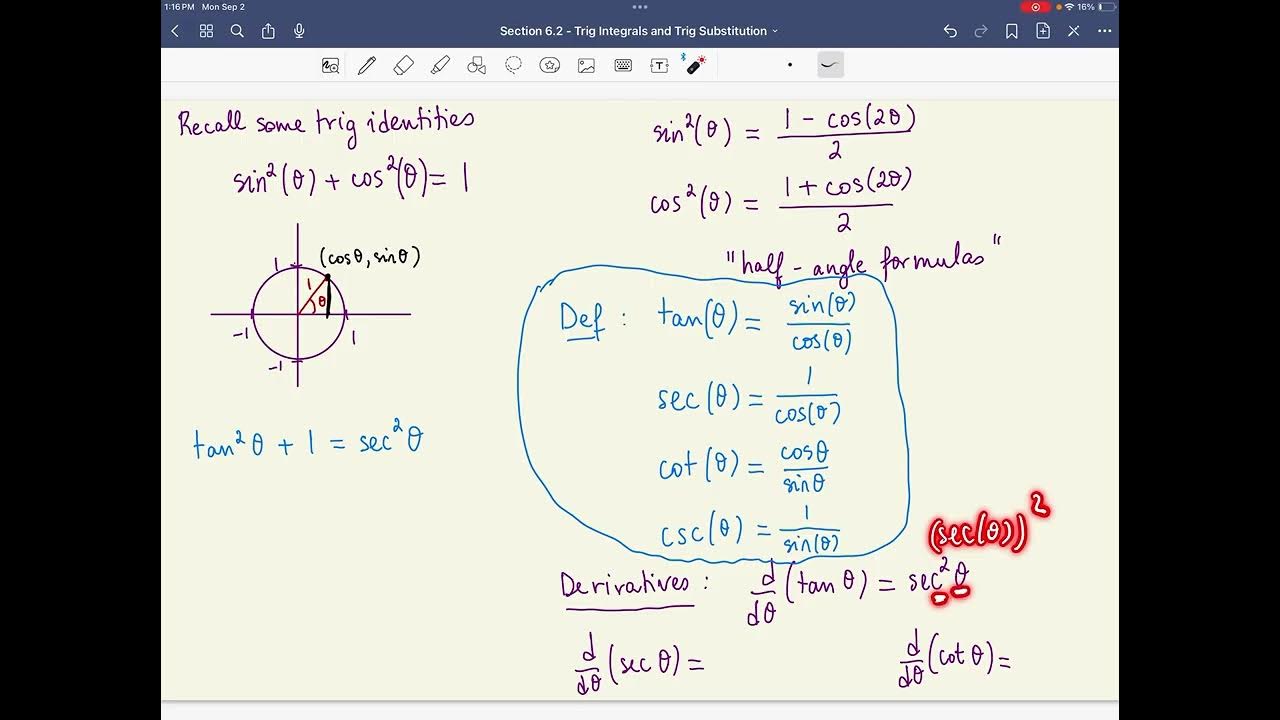
Section 6.2 - Trig integrals and substitution - Part 1

✅INTEGRALES trigonométricas con POTENCIAS [𝙚𝙣 4 𝙋𝙖𝙨𝙤𝙨 😎🫵💯 ] Cálculo Integral

KALKULUS INTEGRAL - INTEGRAL TAK WAJAR
Integral Trigonometri Dasar, Substitusi & Menggunakan Identitas Trigonometri (Integral Part 6)
5.0 / 5 (0 votes)
