Suhu, Kalor, dan Pemuaian | IPA Kelas 7 Bab 3 Kurikulum Merdeka - Lengkap
Summary
TLDRMisinta, a friendly presenter, teaches Grade 7 science about temperature, heat, and expansion. The lesson defines temperature versus heat, introduces thermometers and units (Celsius, Fahrenheit, Kelvin) and demonstrates conversions (e.g., 100°C = 373.15 K). It explains specific heat and the heat formula Q = m·c·ΔT, then explores heat transfer by conduction, convection, and radiation with everyday examples like pans, sea breezes, and sunlight. The video finishes with thermal expansion—linear, area, and volumetric—covering coefficients, formulas, and real-world cases like train tracks and cables. Viewers are invited to request practice problems, comment, and subscribe.
Takeaways
- 😀 Heat can be measured using temperature, which indicates the degree of heat or cold of a substance.
- 😀 Temperature is measured with a thermometer, and common units include Celsius, Fahrenheit, Reamer, and Kelvin.
- 😀 The temperature conversion formula between Celsius and Kelvin is: K = C + 273.15.
- 😀 Heat is energy that moves due to temperature differences, while temperature is the degree of heat.
- 😀 Specific heat is the amount of heat energy required to raise the temperature of 1 kg of a substance by 1 Kelvin.
- 😀 Heat can be measured in Joules (J) or Kilocalories (kcal), with each substance having its own specific heat value.
- 😀 The formula to calculate heat is Q = m × C × ΔT, where Q is heat, m is mass, C is specific heat, and ΔT is temperature change.
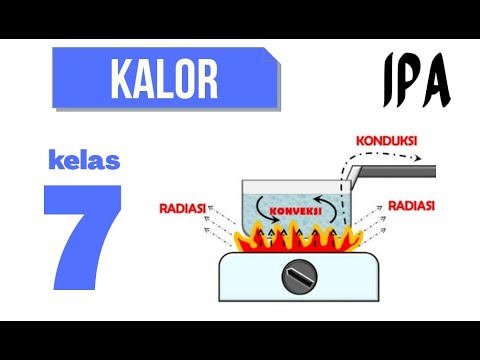
- 😀 Heat transfers occur through three main methods: conduction, convection, and radiation.
- 😀 Conduction is the transfer of heat through a solid intermediary, where the intermediary itself does not move.
- 😀 Convection involves the transfer of heat through the flow of a liquid or gas, with the intermediary substance moving.
- 😀 Radiation transfers heat without an intermediary substance and can also include light, like how heat from the sun reaches Earth.
- 😀 Expansion and shrinkage of objects occur due to heat, where expansion is the increase in size, and shrinkage is the decrease in size.
- 😀 The formula for length expansion is: l = l0 × (1 + α × ΔT), where α is the coefficient of length expansion, and ΔT is the temperature change.
Q & A
What is the main topic of the lesson?
-The main topic of the lesson is about temperature, heat, and expansion, focusing on how heat is measured, transferred, and how it affects different substances.
How is temperature defined in the lesson?
-Temperature is defined as the degree of heat or cold of a substance. It helps quantify how hot or cold something is, but it cannot directly express the exact amount of heat, which is why a thermometer is used.
What are the different units of temperature mentioned in the lesson?
-The units of temperature discussed in the lesson are Celsius, Fahrenheit, Reamur, and Kelvin, each with different fixed points for temperature measurement.
How do you convert Celsius to Kelvin?
-To convert Celsius to Kelvin, you add 273.15 to the Celsius temperature. For example, 100 degrees Celsius is equivalent to 373.15 Kelvin.
What is the difference between temperature and heat?
-Temperature refers to the degree of heat, and it is a quantitative measure. Heat, on the other hand, is a form of energy that flows due to temperature differences and cannot be measured directly in a numerical sense.
What is specific heat and how is it used in calculations?
-Specific heat is the amount of heat energy required to raise the temperature of 1 kilogram of a substance by 1 Kelvin. It varies depending on the material and is used in the formula Q = m * C * ΔT to calculate heat absorbed or released by a substance.
What are the three methods of heat transfer explained in the lesson?
-The three methods of heat transfer are conduction (heat transfer through a solid), convection (heat transfer through a moving fluid like air or water), and radiation (heat transfer through electromagnetic waves, usually accompanied by light).
Can you explain conduction with an example?
-Conduction is the transfer of heat through a solid without movement of the substance. An example is a pan lid becoming hot while cooking; the heat from the bottom of the pan is transferred to the lid.
How does convection differ from conduction?
-Convection involves the movement of a fluid (liquid or gas) to transfer heat. In contrast, conduction occurs in solids where heat is transferred without the movement of the substance itself. An example of convection is water boiling, where hot water rises and cooler water sinks.
What is radiation and how does it transfer heat?
-Radiation is the transfer of heat through electromagnetic waves without the need for an intermediary substance. An example is the warmth felt from the sun's rays or from a campfire, where heat is transferred through the air.
What is thermal expansion, and how does it affect materials?
-Thermal expansion is the increase in size of an object when it is heated. Materials can expand in length, area, or volume depending on the type of expansion. For example, train tracks expand when heated during the day, and metal objects lengthen when exposed to heat.
How can you calculate the expansion of a material based on temperature change?
-The expansion of a material can be calculated using formulas that consider the initial size, coefficient of expansion, and the temperature change. For example, the formula for length expansion is l = l0 * (1 + α * ΔT), where α is the coefficient of length expansion, and ΔT is the temperature change.
Outlines

This section is available to paid users only. Please upgrade to access this part.
Upgrade NowMindmap

This section is available to paid users only. Please upgrade to access this part.
Upgrade NowKeywords

This section is available to paid users only. Please upgrade to access this part.
Upgrade NowHighlights

This section is available to paid users only. Please upgrade to access this part.
Upgrade NowTranscripts

This section is available to paid users only. Please upgrade to access this part.
Upgrade NowBrowse More Related Video
SUHU, KALOR, DAN PEMUAIAN: IPA SMP KELAS 7

Bab 3 Suhu, Kalor, dan Pemuaian #1 (SUHU) | IPA SMP Kelas 7 | Sekolah Penggerak

BAB 3 Suhu, Kalor dan Pemuaian IPA kelas 7 kurikulum merdeka #ipakelas7

BAB 3 Suhu, Kalor dan Pemuaian || SUHU – IPA Kelas 7 Kurikulum Merdeka

KALOR | Suhu dan Kalor - Fisika Kelas 11

Calor Específico |Termodinámica| Ejercicio - Salvador FI
5.0 / 5 (0 votes)
