Fungsi #Part 12 // Jenis-jenis Fungsi // Fungsi Irasional // Grafik , Domain, Kodomain, Range
Summary
TLDRThis video explains irrational functions, focusing on their general form, conditions for definition, and how to graph them. Key concepts include domain and range requirements, such as ensuring expressions inside square roots are non-negative. The script covers step-by-step instructions for drawing the graph of irrational functions, finding domain values, and determining the points of intersection with axes. Through several examples, the video highlights important characteristics like injectivity, surjectivity, and bijectivity, providing a comprehensive understanding of irrational functions in real number domains.
Takeaways
- 😀 Irrational functions have a general form of f(x) = √(g(x) + c), where g(x) is the expression inside the square root.
- 😀 For an irrational function to be defined in real numbers, the expression inside the square root must be greater than or equal to zero.
- 😀 If the expression inside the square root is negative, the function has no real value and cannot be defined in the real number system.
- 😀 A key characteristic of irrational functions is that they must contain a variable inside the square root to be classified as such.
- 😀 Functions like f(x) = √(3) + x², where the term inside the square root is constant, are not considered irrational functions.
- 😀 The graph of an irrational function typically resembles a half parabola.
- 😀 To graph an irrational function, follow these steps: 1) Determine the domain, 2) Find the initial point, 3) Find x and y intercepts, 4) Identify auxiliary points, 5) Draw the graph.
- 😀 For the function f(x) = √(2x + 1), the domain is x ≥ -1/2, meaning the values of x must satisfy the condition that 2x + 1 ≥ 0.
- 😀 To determine the y-intercept, substitute x = 0 into the function and solve for y. For example, in f(x) = √(2x + 1), substituting x = 0 gives y = 1.
- 😀 The range of an irrational function is always y ≥ 0, since the square root of a non-negative number is always non-negative.
- 😀 Rational functions can sometimes be inverted if they are bijective, meaning they are both injective (one-to-one) and surjective (onto).
Q & A
What is the general form of an irrational function?
-The general form of an irrational function is typically expressed as f(x) = √(g(x) + C) or sometimes f(x) = √(g(x)), where g(x) represents a function and C is a constant.
What condition must the value inside the square root meet for an irrational function to be valid?
-The value inside the square root, denoted as g(x), must be greater than or equal to zero. This is because square roots of negative numbers are not defined within the real number system.
What makes a function irrational, based on the content of the script?
-A function is considered irrational if it involves a square root and the expression inside the square root contains a variable. If the square root contains only a constant, it is not an irrational function.
Can you provide an example of an irrational function?
-Yes, f(x) = √(2x + 3) is an example of an irrational function, as the square root contains the variable x.
Why does an irrational function require the value inside the square root to be non-negative?
-An irrational function requires the value inside the square root to be non-negative because square roots of negative numbers are not defined in the real number system. For example, √(-1) does not exist in real numbers, but it is defined in complex numbers as the imaginary unit 'i'.
What are the steps to graph an irrational function?
-The steps to graph an irrational function are as follows: 1) Determine the domain of the function, 2) Find the starting point of the graph, 3) Identify the x- and y-intercepts, 4) Calculate additional points, and 5) Plot the graph and connect the points to form the curve.
How do you find the domain of an irrational function?
-To find the domain of an irrational function, you need to solve the inequality where the expression inside the square root is greater than or equal to zero. This ensures that the square root is defined for all values in the domain.
What does the term 'bijective function' mean in the context of irrational functions?
-A bijective function is both injective (one-to-one) and surjective (onto). In the context of irrational functions, it means that the function passes the horizontal line test (injective) and that every possible output value is reached (surjective), making it possible to find an inverse function.
What is the domain and range of the function f(x) = √(2x + 1)?
-For the function f(x) = √(2x + 1), the domain is x ≥ -1/2, as 2x + 1 must be greater than or equal to zero. The range is y ≥ 0 because the square root function outputs only non-negative values.
How would you graph the function y = √(4 - x + 1)?
-To graph y = √(4 - x + 1), first determine the domain by solving 4 - x + 1 ≥ 0, which simplifies to x ≤ 5. The domain is x ≤ 5. Then, find the starting point by substituting x = 5 into the function, yielding y = 1. Plot the graph and mark the points as you move along the curve.
Outlines

This section is available to paid users only. Please upgrade to access this part.
Upgrade NowMindmap

This section is available to paid users only. Please upgrade to access this part.
Upgrade NowKeywords

This section is available to paid users only. Please upgrade to access this part.
Upgrade NowHighlights

This section is available to paid users only. Please upgrade to access this part.
Upgrade NowTranscripts

This section is available to paid users only. Please upgrade to access this part.
Upgrade NowBrowse More Related Video
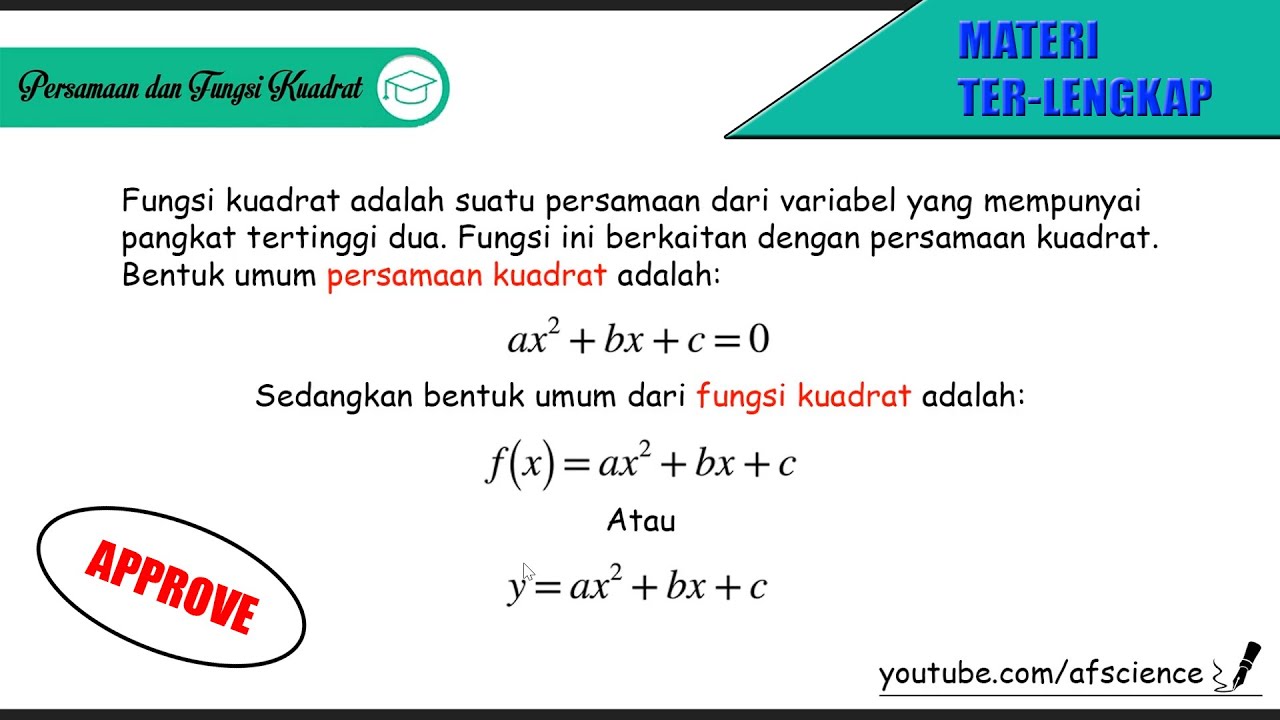
Persamaan dan Fungsi Kuadrat (Materi LENGKAP)

FUNÇÃO DO 2º GRAU: DEFINIÇÃO E GRÁFICO
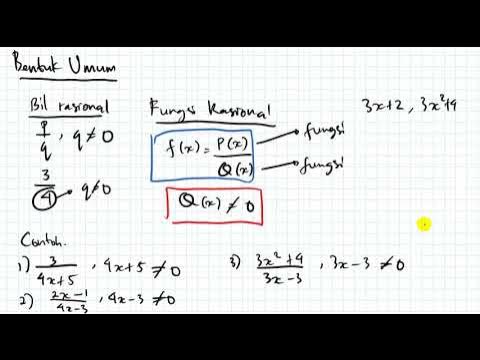
Fungsi Rasional kelas XI Matematika Tingkat Lanjut (Kurikulum Merdeka)

Persamaan Irasional - (pengenalan)
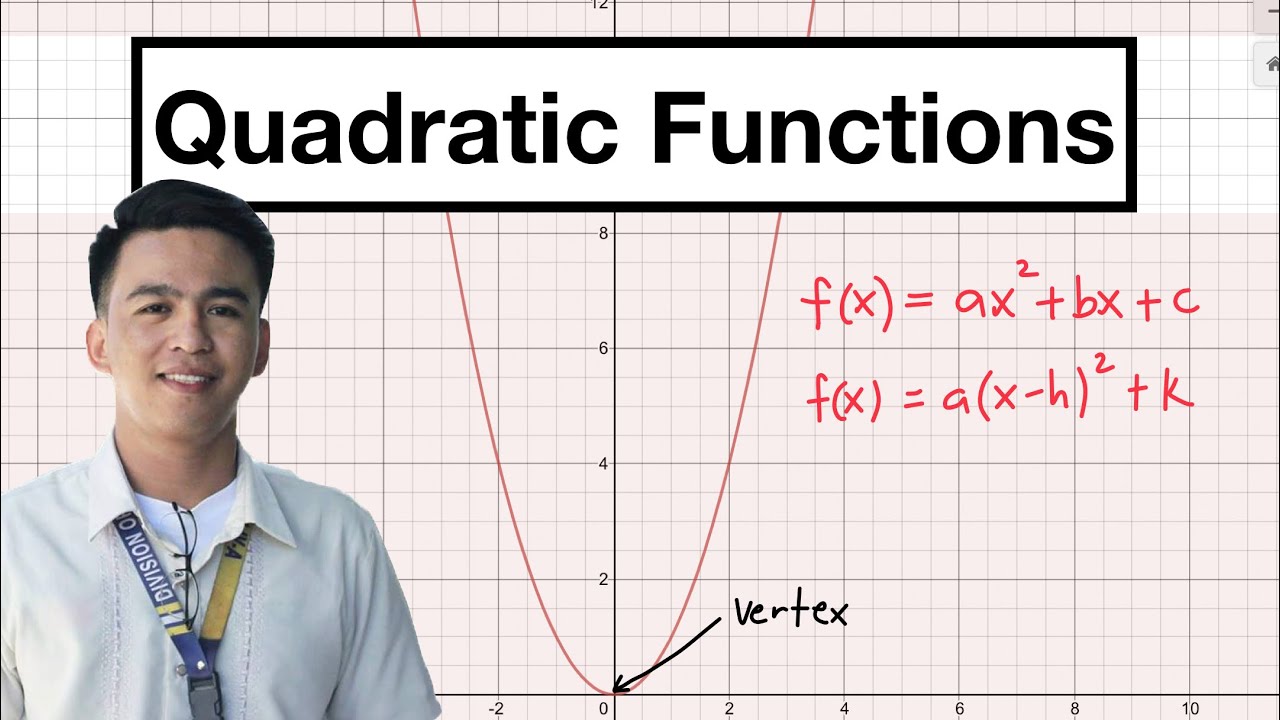
Introduction to Quadratic Function | Examples of Quadratic Function

Matematika Kelas 9 : Fungsi Kuadrat (Part 1 : Bentuk umum dan grafik fungsi kuadrat)
5.0 / 5 (0 votes)
