How do Hash Indexes work? | Systems Design Interview: 0 to 1 with Google Software Engineer
Summary
TLDRIn this video, Jordan, a self-proclaimed expert in backend development, dives into the concept of hash indexes in databases. He explains how hash maps and hash functions provide fast, O(1) reads and writes, making them ideal for quick lookups. However, he also highlights the limitations, such as memory constraints, non-durability (leading to data loss on system crashes), and the inability to perform range queries efficiently. Jordan concludes that while hash indexes are great for small datasets requiring fast access, they aren't suitable for larger datasets or complex queries, making it important to consider trade-offs when choosing an index type.
Takeaways
- 😀 Hash indexes are built on hash maps, allowing for O(1) constant time reads and writes.
- 😀 A hash function transforms keys (e.g., 'Jordan') into a numeric value, which is used to quickly access data in memory or on disk.
- 😀 One key benefit of hash indexes is their ability to retrieve or update data in constant time, making them highly efficient for specific lookups.
- 😀 Hash maps are not ideal for handling range queries, such as selecting data between two values, because they require checking all possible values in the range.
- 😀 Hash indexes require all keys to fit into memory (RAM), which can be expensive and limits scalability as data grows.
- 😀 Hash indexes are stored in memory for fast performance, but this means data can be lost if the system crashes because RAM is non-durable.
- 😀 To ensure durability, databases using hash indexes employ a write-ahead log (WAL), which logs changes to disk before they are applied in memory.
- 😀 A write-ahead log allows the system to recover data in case of a crash by replaying the changes stored in the log.
- 😀 While hash indexes are fast for lookups and writes, they don't support efficient range queries, making them less suitable for certain types of queries.
- 😀 In databases, the choice of index type (hash, tree, etc.) depends on use cases. Hash indexes are best for small datasets and simple key-based lookups but not for complex queries or large data sets.
Q & A
What is a hash index in the context of databases?
-A hash index is a type of database index that uses a hash map data structure to quickly look up values based on a key. The key is processed by a hash function, which returns a value that determines the index location in the array where the data is stored. This allows for constant-time (O(1)) lookups and updates.
How does a hash function work in a hash map?
-A hash function takes an input (e.g., a string like 'Jordan') and transforms it into a numeric value (the hash code). This hash code is then used to determine the index in the array where the corresponding value will be stored. The same input will always generate the same output, which ensures consistency in the hash map.
What are the advantages of using a hash index in a database?
-The main advantages of hash indexes are that they allow for constant-time (O(1)) lookups and updates, making data retrieval very fast. They are also stored in memory, which provides faster access compared to disk storage.
What are the major drawbacks of using hash indexes?
-The major drawbacks of hash indexes are that they are not suitable for range queries (e.g., retrieving all records within a specific range of values), they are memory-intensive, and they lack durability since they are stored in volatile memory (RAM). If the system crashes, data in memory is lost unless a write-ahead log is used.
Why can't hash indexes be used for range queries?
-Hash indexes cannot efficiently perform range queries because they store data in a way that doesn't maintain any order. To perform a range query, the database would need to check every possible key in the hash index, resulting in O(n) time complexity, which is inefficient for large datasets.
What is the purpose of the write-ahead log in relation to hash indexes?
-The write-ahead log (WAL) is used to ensure durability for hash indexes. Since hash indexes are stored in volatile memory, the WAL records all write operations to the database. If the system crashes, the WAL allows the database to recover the hash index by replaying the recorded changes.
What is the trade-off between using hash indexes and other types of indexes like B-trees?
-Hash indexes offer O(1) time complexity for lookups and updates but cannot handle range queries efficiently. On the other hand, B-trees support efficient range queries but have O(log n) time complexity for lookups and updates. The trade-off comes down to whether fast lookups or efficient range queries are more important for a given use case.
How do collisions occur in a hash map, and how are they handled?
-Collisions occur when two different keys produce the same hash value. They are typically handled in two ways: chaining, where each index in the hash table points to a linked list of elements, or probing, where the system searches for the next available index in the table.
Why are hash indexes considered to be memory-intensive?
-Hash indexes are memory-intensive because they store all keys and their corresponding values in memory (RAM). Since memory is limited and more expensive than disk storage, this means that only a small amount of data can be indexed using hash indexes, especially in systems with limited RAM.
What happens if a hash index needs to be rebuilt after a system crash?
-If a system crashes, the hash index can be rebuilt by replaying the changes recorded in the write-ahead log (WAL). The WAL stores a sequence of write operations, and by replaying these operations, the hash index can be repopulated and restored to its previous state.
Outlines

This section is available to paid users only. Please upgrade to access this part.
Upgrade NowMindmap

This section is available to paid users only. Please upgrade to access this part.
Upgrade NowKeywords

This section is available to paid users only. Please upgrade to access this part.
Upgrade NowHighlights

This section is available to paid users only. Please upgrade to access this part.
Upgrade NowTranscripts

This section is available to paid users only. Please upgrade to access this part.
Upgrade NowBrowse More Related Video

Google SWE teaches systems design | EP1: Database Design

DB Indexing in System Design Interviews - B-tree, Geospatial, Inverted Index, and more!
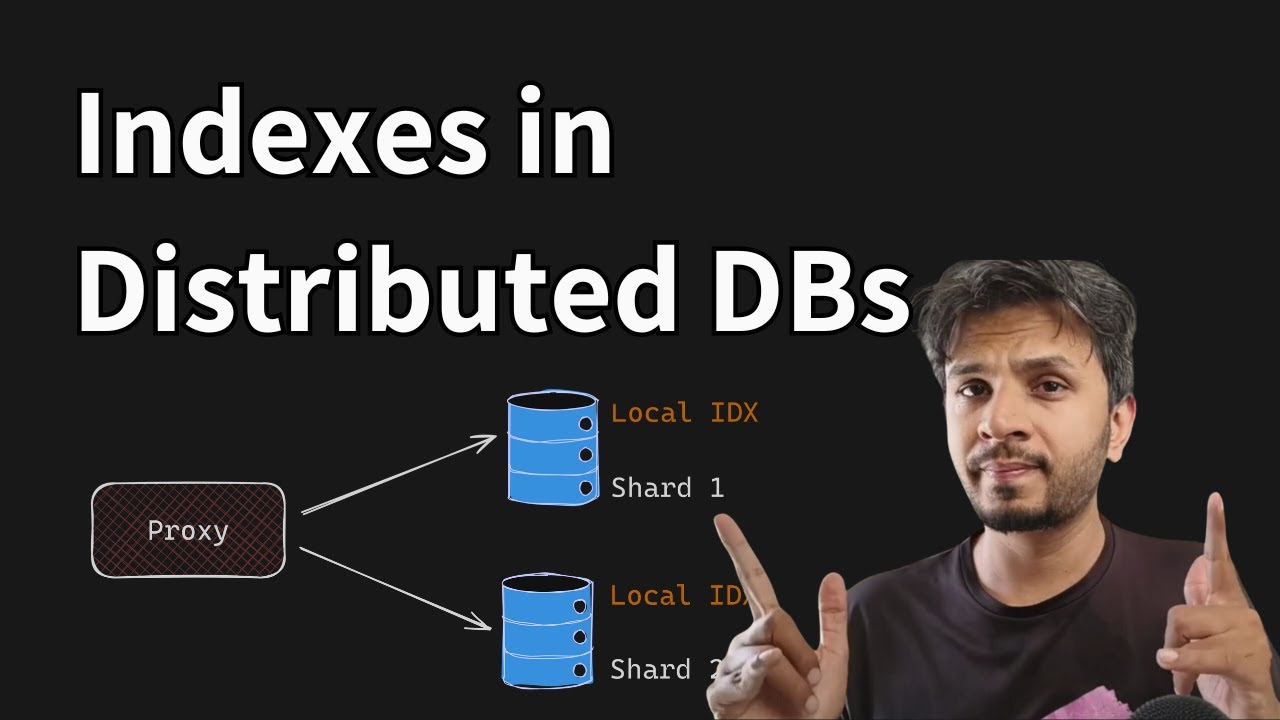
How indexes work in Distributed Databases, their trade-offs, and challenges

Database Indexes: What do they do? | Systems Design Interview: 0 to 1 with Google Software Engineer

Chapter 3.1 - Append only log and hash indexes (Storage and retrieval)

Backend web development - a complete overview
5.0 / 5 (0 votes)
