Materi Ringkas Fisika - Gelombang || SMA Kelas XI
Summary
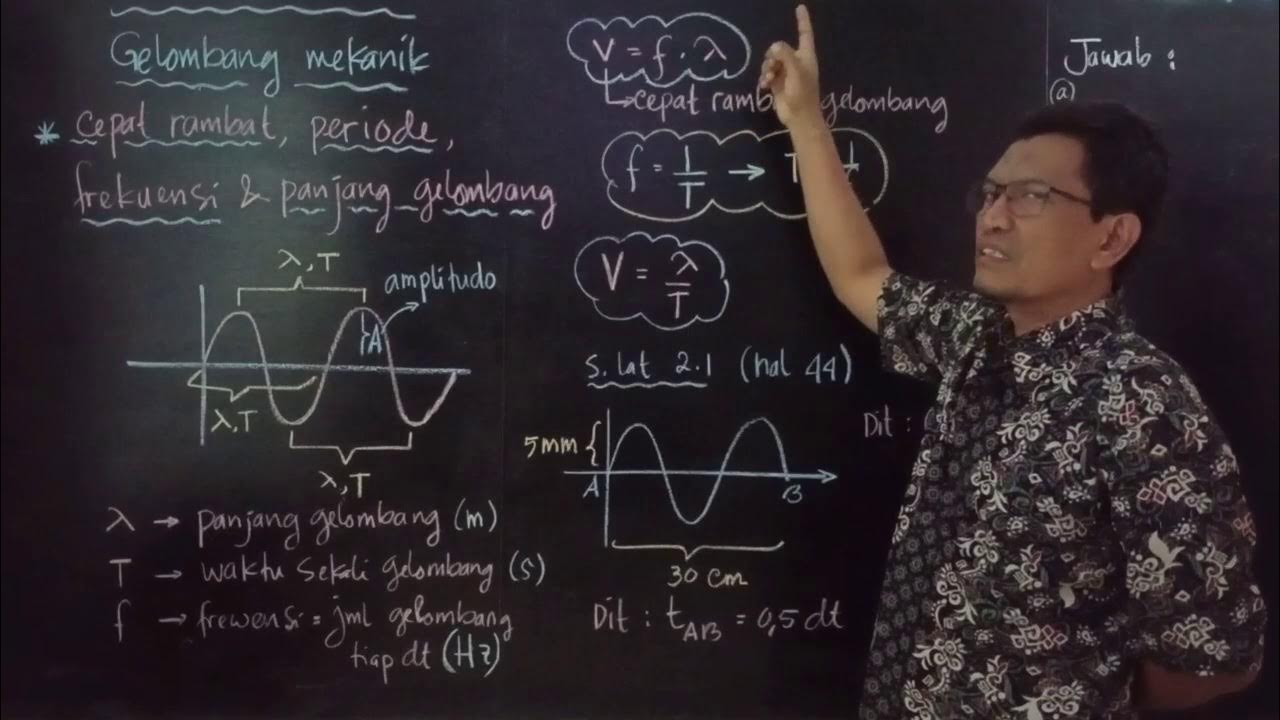
TLDRThis lesson explores the concept of waves, their types, and properties. It discusses both longitudinal and transverse waves, including examples like sound waves and light waves. The video also explains wave characteristics such as frequency, amplitude, and wave speed, along with formulas to calculate them. Additionally, it introduces mechanical and electromagnetic waves, highlighting their differences in terms of medium requirements. The lesson wraps up with an example problem on calculating wave frequency, period, wavelength, and wave speed, encouraging viewers to practice solving similar problems.
Takeaways
- 🌊 Waves are vibrations that propagate energy without transferring matter, commonly observed in water, strings, radio, and light.
- 🛶 Objects like boats on water waves do not move forward but only oscillate following the wave's motion.
- ↔️ There are two main types of waves based on vibration direction: longitudinal (vibration parallel to wave propagation, e.g., sound waves) and transverse (vibration perpendicular to wave propagation, e.g., light and string waves).
- 📏 Waves can also be categorized by amplitude: traveling waves (constant amplitude across points) and stationary or standing waves (amplitude varies, e.g., plucked guitar string).
- ⚙️ Based on the medium, waves are divided into mechanical waves (require a medium like solid, liquid, gas) and electromagnetic waves (do not require a medium, e.g., sunlight).
- 📐 Wavelength (λ) is the distance covered by one complete wave cycle: one crest to the next for transverse waves, or one compression to the next for longitudinal waves.
- ⏱️ Wave frequency (f) is the number of waves passing a point per second, calculated as f = 1/period or f = number of waves / time.
- ⏳ Wave period (T) is the time required for one wave cycle to pass a point, with the relationship T = 1/f.
- 📊 Amplitude is the maximum displacement of a wave from its equilibrium position.
- ⚡ Wave speed (v) is the distance a wave travels per unit of time, calculated as v = wavelength × frequency.
Q & A
What is a wave in physics?
-A wave is a vibration that travels through a medium without transferring material. Instead, it carries energy from one place to another.
What are the two main types of waves based on the direction of vibration?
-The two main types are longitudinal waves, where the vibration is parallel to the wave's direction of travel, and transverse waves, where the vibration is perpendicular to the direction of travel.
Can you provide an example of a longitudinal wave?
-An example of a longitudinal wave is sound, where the air particles vibrate parallel to the direction of the sound wave's movement.
What is a transverse wave? Can you give an example?
-A transverse wave is a wave where the vibration is perpendicular to the direction of travel. An example is a wave on a rope or light waves.
What is the difference between a traveling wave and a stationary wave?
-A traveling wave maintains a constant amplitude at every point along its path, while a stationary wave has varying amplitudes, with points that remain stationary called nodes, and points with maximum displacement called antinodes.
What are mechanical waves, and what do they require to travel?
-Mechanical waves are waves that require a medium (solid, liquid, or gas) to propagate. Examples include sound waves, water waves, and waves on a rope.
What are electromagnetic waves, and do they require a medium to travel?
-Electromagnetic waves are waves that do not require a medium to propagate. They can travel through a vacuum, like light waves from the Sun traveling through space.
What is the definition of wavelength?
-Wavelength is the distance traveled by one complete wave cycle. For transverse waves, it’s the distance between two consecutive peaks or troughs, while for longitudinal waves, it’s the distance between two consecutive compressions or rarefactions.
How is the frequency of a wave defined?
-The frequency of a wave is defined as the number of complete wave cycles that pass a given point per second.
What is the relationship between wave speed, wavelength, and frequency?
-The wave speed (v) is equal to the product of the wavelength (λ) and frequency (f). This can be expressed as the formula v = λ * f.
Outlines

Этот раздел доступен только подписчикам платных тарифов. Пожалуйста, перейдите на платный тариф для доступа.
Перейти на платный тарифMindmap

Этот раздел доступен только подписчикам платных тарифов. Пожалуйста, перейдите на платный тариф для доступа.
Перейти на платный тарифKeywords

Этот раздел доступен только подписчикам платных тарифов. Пожалуйста, перейдите на платный тариф для доступа.
Перейти на платный тарифHighlights

Этот раздел доступен только подписчикам платных тарифов. Пожалуйста, перейдите на платный тариф для доступа.
Перейти на платный тарифTranscripts

Этот раздел доступен только подписчикам платных тарифов. Пожалуйста, перейдите на платный тариф для доступа.
Перейти на платный тарифПосмотреть больше похожих видео





5.0 / 5 (0 votes)

