Topic 9.1 & 9.2 Strat Ozone Dep
Summary
TLDRThis AP Environmental Science video explores stratospheric ozone, distinguishing it from harmful ground-level ozone. It explains how ozone forms naturally in the stratosphere through UV interactions and protects life from harmful UV rays. The lesson covers the causes of ozone depletion, focusing on CFCs and their catalytic chlorine atoms, with an emphasis on Antarctic thinning during spring due to ice crystal reactions. The video highlights the successful global response through the Montreal Protocol, which phased out CFCs, while noting the environmental trade-offs of their replacements, HCFCs and HFCs, as greenhouse gases. Overall, it presents ozone depletion as both a scientific and policy success story.
Takeaways
- 🌞 Stratospheric ozone is beneficial because it protects life on Earth from harmful UV rays, while tropospheric ozone is harmful to humans and plants.
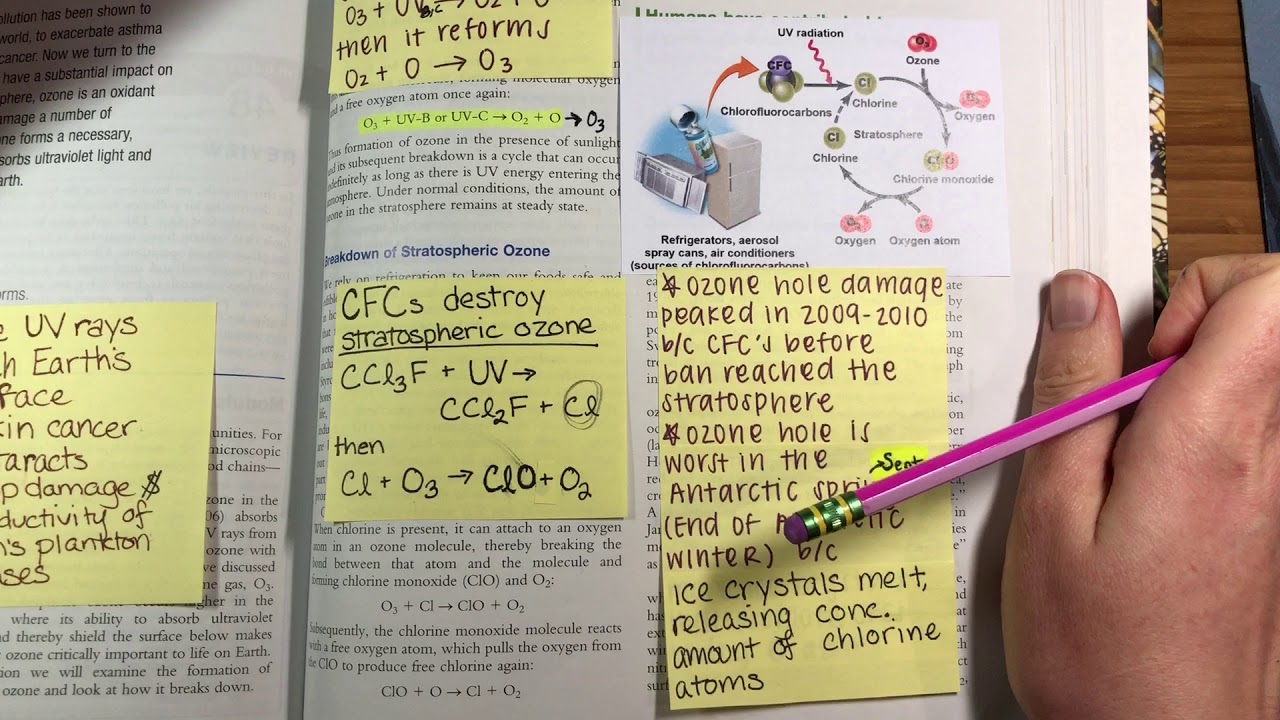
- 🧪 Ozone (O₃) forms in the stratosphere when UV light splits O₂ molecules into free oxygen atoms, which then recombine with O₂ to form ozone.
- ☀️ Stratospheric ozone blocks UVA, UVB, and UVC rays, all of which can cause skin cancer, cataracts, and crop damage.
- ⚠️ Stratospheric ozone depletion, often called the 'ozone hole,' is actually a thinning of the ozone layer, primarily caused by CFCs (chlorofluorocarbons).
- 🧊 Antarctica experiences the most severe ozone depletion due to its cold stratosphere and high concentrations of ice crystals, which accelerate ozone breakdown.
- 📅 Peak ozone depletion in Antarctica occurs during the Antarctic spring (September) because ice crystals accumulate during the winter.
- 🔬 A single chlorine atom from CFCs can destroy up to 100,000 ozone molecules, demonstrating the potency of CFCs in ozone depletion.
- 🌍 The Montreal Protocol was an international treaty that successfully phased out CFC production, leading to recovery of the ozone layer over time.
- -
- ♻️ Replacements for CFCs, such as HCFCs and HFCs, reduced ozone depletion but introduced new issues as potent greenhouse gases.
- 📉 Graphs show a global decline in CFC concentrations, confirming the success of international regulation in protecting the ozone layer.
- 💊 Broadspectrum sunscreen is recommended because it protects against both UVA and UVB rays, which are responsible for skin damage and cancer.
Q & A
What is the difference between ozone in the troposphere and the stratosphere?
-Ozone in the troposphere is harmful to humans and plants, contributing to lung damage, asthma, and photochemical smog. Ozone in the stratosphere is beneficial because it blocks harmful UV radiation from reaching Earth's surface.
How is ozone formed in the stratosphere?
-Ozone forms when UV rays break apart O2 molecules into free oxygen atoms, which then combine with other O2 molecules to create O3. This cycle of formation and breakdown continues naturally.
Why is the ozone layer important for human health?
-It protects against harmful UV radiation, which can cause skin cancer, cataracts, and other eye damage. It also helps reduce environmental damage like crop and plant harm.
What are chlorofluorocarbons (CFCs) and why are they harmful?
-CFCs are chemicals once used in refrigeration, air conditioning, and spray cans. Chlorine atoms from CFCs break down ozone molecules in the stratosphere, leading to ozone depletion.
How many ozone molecules can a single chlorine atom destroy?
-A single chlorine atom can destroy approximately 100,000 ozone molecules in the stratosphere.
Why is ozone depletion most severe over Antarctica?
-Antarctica has a colder stratosphere and high concentrations of ice crystals that catalyze ozone destruction. This effect is strongest during the Antarctic spring, at the end of winter when ice crystals are most abundant.
What is the Montreal Protocol and its significance?
-The Montreal Protocol is an international treaty aimed at reducing CFC production by 50% by 2000. It successfully helped restore the ozone layer and is considered one of the greatest environmental success stories.
What are HCFCs and HFCs, and why are they important in this context?
-HCFCs and HFCs were introduced as replacements for CFCs to prevent ozone depletion. However, they are potent greenhouse gases, which can contribute to global warming.
What types of UV radiation does the ozone layer help block, and which require additional protection?
-The ozone layer blocks most UVC and some UVB radiation. UVA radiation is less blocked, so people need broad-spectrum sunscreen to protect against UVA and UVB.
How long did it take for the ozone layer to begin recovering after the CFC ban?
-It took approximately 25 years for CFCs emitted before the ban to reach the stratosphere and for the ozone depletion process to slow, allowing the ozone layer to gradually recover.
What environmental and health problems can result from increased UV radiation due to ozone depletion?
-Increased UV radiation can lead to higher rates of skin cancer, cataracts, eye damage, and crop or plant damage.
Outlines

Этот раздел доступен только подписчикам платных тарифов. Пожалуйста, перейдите на платный тариф для доступа.
Перейти на платный тарифMindmap

Этот раздел доступен только подписчикам платных тарифов. Пожалуйста, перейдите на платный тариф для доступа.
Перейти на платный тарифKeywords

Этот раздел доступен только подписчикам платных тарифов. Пожалуйста, перейдите на платный тариф для доступа.
Перейти на платный тарифHighlights

Этот раздел доступен только подписчикам платных тарифов. Пожалуйста, перейдите на платный тариф для доступа.
Перейти на платный тарифTranscripts

Этот раздел доступен только подписчикам платных тарифов. Пожалуйста, перейдите на платный тариф для доступа.
Перейти на платный тарифПосмотреть больше похожих видео
Ch 15 mod 49 sticky notes ced

Stratospheric Ozone
What Is The Ozone Layer? | Ozone Layer Depletion | Dr Binocs Show |Kids Learning Video|Peekaboo Kidz

The Antarctic Ozone Hole -- From Discovery to Recovery, a Scientific Journey

Causes of ozone layer depletion | Ozone layer depletion | what is ozone hole

What Is The Ozone Layer? | Ozone Layer Depletion | Class 12 Biology | Extraclass.com
5.0 / 5 (0 votes)

