BAHASA JAWA KELAS 8 - WEWATEKANE TEMBANG MACAPAT
Summary
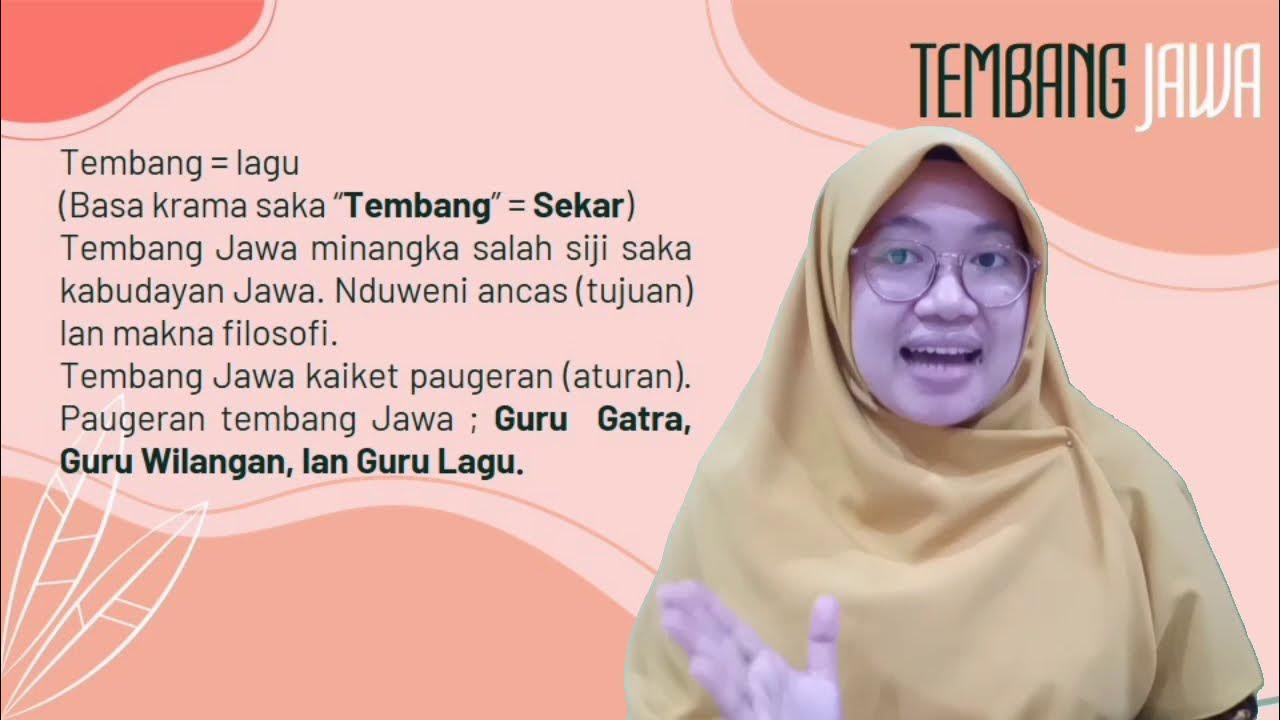
TLDRThis video is an engaging Bahasa Jawa lesson for eighth-grade students, focusing on the traditional Javanese poetry form called Tembang Macapat. The instructor introduces the types of Tembang Macapat, explaining their characteristics, moral messages, and appropriate usage. Through lively examples, students learn the themes of love, patience, wisdom, and life lessons embedded in different Tembang, such as Mijil, Sinom, Kinanthi, Asmorondono, Dhandhanggulo, Gambuh, Maskumambang, Durma, Pangkur, Megatruh, and Pucung. The lesson emphasizes both oral and written comprehension, encouraging students to prepare their materials, follow along attentively, and absorb practical and spiritual knowledge for both worldly and moral development.
Takeaways
- 😀 The lesson begins with a greeting in Arabic and Javanese, invoking peace and blessings for all students.
- 😀 The class focuses on Javanese language for 8th-grade students, specifically studying Tembang Macapat.
- 😀 Students are instructed to prepare writing tools and take notes during the lesson for important material.
- 😀 The learning objectives include understanding the structure, linguistic elements, and moral messages of Tembang Macapat both orally and in writing.
- 😀 Students are also tasked with transforming Tembang Macapat texts into practical exercises (referred to as 'tab perusak').
- 😀 The teacher introduces 11 types of Tembang Macapat, highlighting initial letters and using colors for easier identification.
- 😀 Each Tembang type has a specific theme or moral lesson, ranging from advice and patience to love, courage, and reflection.
- 😀 Examples are given for each Tembang type, connecting traditional poetic content with daily life and moral teachings.
- 😀 Music is occasionally used to support the teaching of Tembang Macapat, enhancing engagement and understanding.
- 😀 The lesson concludes with a recap, prayers for beneficial knowledge, gratitude, and farewell messages to the students.
Q & A
What is the main topic discussed in the transcript?
-The main topic discussed is *tembang macapat*, a traditional Javanese poetry form. The script also briefly includes prayers and guidance for students to prepare for their lessons.
What is the purpose of *tembang macapat* in Javanese culture?
-*Tembang macapat* serves as a poetic and musical form used for storytelling, imparting wisdom, and providing moral lessons through various types of poems.
How are the *tembang macapat* categorized?
-The *tembang macapat* is categorized into eleven types, including Mijil, Ki, Sinom, Asmorondono, Dhandhanggulo, Danbo, Maskumambang, Durmo, Pangkur, Megatruh, and Pucung.
What does the prayer at the beginning of the script represent?
-The prayer at the beginning is a form of invocation for divine blessings, asking for knowledge, understanding, and guidance from God for the students and the lesson.
What is the significance of each *tembang macapat* type?
-Each type of *tembang macapat* serves a specific purpose: for example, Mijil is used for opening, Sinom for patience, Dhandhanggulo for gentleness, and Pucung for closure or resolution.
What is the role of *pitutur* (advice) in the *tembang macapat*?
-*Pitutur* or advice is an integral part of *tembang macapat*, with many of the poems being used to impart life lessons, moral guidance, and reflections on human experiences, such as love and suffering.
Why is *tembang macapat* considered a form of moral teaching?
-*Tembang macapat* conveys ethical values and life lessons through poetic expressions. For example, the *Sinom* type promotes patience, while the *Dandang Gulo* focuses on being gentle and soft-hearted.
How does the script integrate traditional Javanese culture and education?
-The script integrates traditional Javanese culture by focusing on *tembang macapat* as a method of cultural transmission, using it to teach students not only language but also Javanese ethics and social values.
What does the term *wewatekane* refer to in the context of the *tembang macapat*?
-*Wewatekane* refers to the characteristics or qualities that each type of *tembang macapat* embodies, such as patience in *Sinom* or gentleness in *Dandang Gulo*.
What role does *music* play in the *tembang macapat* performance?
-Music is central to *tembang macapat*, as it helps to convey the emotional tone and rhythm of the poem. It is performed in a musical style that enhances the poetic messages, such as the sorrow in *Maskumambang* or the joy in *Pangkur*.
Outlines

Этот раздел доступен только подписчикам платных тарифов. Пожалуйста, перейдите на платный тариф для доступа.
Перейти на платный тарифMindmap

Этот раздел доступен только подписчикам платных тарифов. Пожалуйста, перейдите на платный тариф для доступа.
Перейти на платный тарифKeywords

Этот раздел доступен только подписчикам платных тарифов. Пожалуйста, перейдите на платный тариф для доступа.
Перейти на платный тарифHighlights

Этот раздел доступен только подписчикам платных тарифов. Пожалуйста, перейдите на платный тариф для доступа.
Перейти на платный тарифTranscripts

Этот раздел доступен только подписчикам платных тарифов. Пожалуйста, перейдите на платный тариф для доступа.
Перейти на платный тарифПосмотреть больше похожих видео


5.0 / 5 (0 votes)

