Pengantar Statistika I
Summary
TLDRIn this introductory video on 'MAS2 001 Probability and Statistics', Junita Amalia explains the basics of statistics, highlighting the distinction between 'statistik' (statistics) and 'statistika' (the study of statistics). The video emphasizes the importance of statistics in daily life, covering its applications in business, industry, and computing. Key concepts include types of data (qualitative vs. quantitative), measurement scales, populations vs. samples, and various sampling methods. The video encourages students to engage with tasks involving data examples and sampling methods to deepen their understanding of statistical principles.
Takeaways
- 😀 Statistika is a science focused on collecting, analyzing, and interpreting data to make decisions, while Statistik refers to the measurement of data (e.g., average, standard deviation).
- 😀 Statistika is crucial in daily life for interpreting diverse data, such as the varying heights of students in a class, to make informed decisions.
- 😀 Descriptive statistics involves organizing and presenting data, while inferential statistics makes conclusions about a population based on a sample.
- 😀 Data must be objective, representative, relevant, updated, and have minimal error to be considered good.
- 😀 Data is categorized into primary data (collected directly) and secondary data (taken from existing sources).
- 😀 Data types are classified into qualitative (descriptive qualities) and quantitative (numerical measurements). Quantitative data can be discrete (whole numbers) or continuous (decimals).
- 😀 Measurement scales include nominal (categorical), ordinal (ranked categories), interval (measurable difference without true zero), and ratio (measurable difference with true zero).
- 😀 Population refers to the entire group, and a sample is a subset of the population. A sample must represent the population for reliable results.
- 😀 Random sampling ensures that every member of the population has an equal chance of selection, whereas non-random sampling does not guarantee equal chances for all members.
- 😀 Four key sampling methods are discussed: Random Sampling (simple, stratified, cluster), and Non-Random Sampling (purposive, quota, snowball).
- 😀 The survey procedure involves defining the survey’s purpose, identifying the population, selecting a sample, collecting data, analyzing results, and drawing conclusions.
Q & A
What is the difference between 'statistik' and 'statistika'?
-'Statistik' refers to numerical measures of data, such as averages or percentages, whereas 'statistika' is the scientific discipline that focuses on the collection, analysis, interpretation, and presentation of data for decision-making.
Why is statistika important in daily life?
-Statistika is crucial because it helps in analyzing diverse data in various fields, making informed decisions, and drawing meaningful conclusions from complex datasets, such as the height variations of students in a class.
What are the two main types of statistics discussed in the script?
-The two main types of statistics are 'descriptive statistics', which involves summarizing and presenting data, and 'inferential statistics', which is used to make predictions or conclusions about a population based on sample data.
What are qualitative and quantitative data, and how do they differ?
-Qualitative data relates to qualities or characteristics (e.g., colors, opinions), while quantitative data deals with numerical values (e.g., height, weight). The key difference is that qualitative data cannot be measured numerically, whereas quantitative data can.
Can you explain the four measurement scales mentioned in the script?
-The four measurement scales are: 1) Nominal: Categories with no specific order (e.g., gender). 2) Ordinal: Categories with a defined order (e.g., educational levels). 3) Interval: Ordered data with equal intervals but no true zero (e.g., temperature in Celsius). 4) Ratio: Ordered data with equal intervals and a true zero (e.g., height, weight).
What is the significance of using a representative sample in statistics?
-A representative sample reflects the characteristics of the larger population, ensuring that conclusions drawn from the sample are valid and can be generalized to the entire population.
What are the benefits of using sampling methods in surveys?
-Sampling methods reduce costs and time compared to studying the entire population, increase accuracy and efficiency, and allow for broader coverage while ensuring the data collected is representative of the population.
What is the difference between random sampling and non-random sampling?
-In random sampling, each member of the population has an equal chance of being selected, ensuring a representative sample. In non-random sampling, the sample is chosen based on specific criteria, but not all population members have an equal chance of selection.
Can you list and explain the types of random sampling mentioned in the script?
-The types of random sampling are: 1) Simple Random Sampling: Every individual has an equal chance of being selected. 2) Stratified Random Sampling: The population is divided into subgroups, and samples are drawn from each subgroup. 3) Cluster Random Sampling: The population is divided into clusters, and entire clusters are selected for the sample.
What is a purposive sampling method, and how is it different from quota or snowball sampling?
-Purposive sampling involves selecting individuals based on specific characteristics relevant to the study. Quota sampling involves selecting a specific number of individuals from various subgroups, while snowball sampling starts with a small group and uses referrals from initial participants to expand the sample.
Outlines

Этот раздел доступен только подписчикам платных тарифов. Пожалуйста, перейдите на платный тариф для доступа.
Перейти на платный тарифMindmap

Этот раздел доступен только подписчикам платных тарифов. Пожалуйста, перейдите на платный тариф для доступа.
Перейти на платный тарифKeywords

Этот раздел доступен только подписчикам платных тарифов. Пожалуйста, перейдите на платный тариф для доступа.
Перейти на платный тарифHighlights

Этот раздел доступен только подписчикам платных тарифов. Пожалуйста, перейдите на платный тариф для доступа.
Перейти на платный тарифTranscripts

Этот раздел доступен только подписчикам платных тарифов. Пожалуйста, перейдите на платный тариф для доступа.
Перейти на платный тарифПосмотреть больше похожих видео

KULIAH STATISTIKA (1) - KONSEP DASAR STATISTIKA
STATISTIKA Part 1- Pengenalan dan Manfaat Mempelajari Statistika

Pendahuluan Statistika - Pertemuan 1

KUPAS TUNTAS: Apakah Perbedaan Statistik Inferensial dengan Statistik Deskriptif ?

What is the difference between Descriptive Statistics and Inferential Statistics?
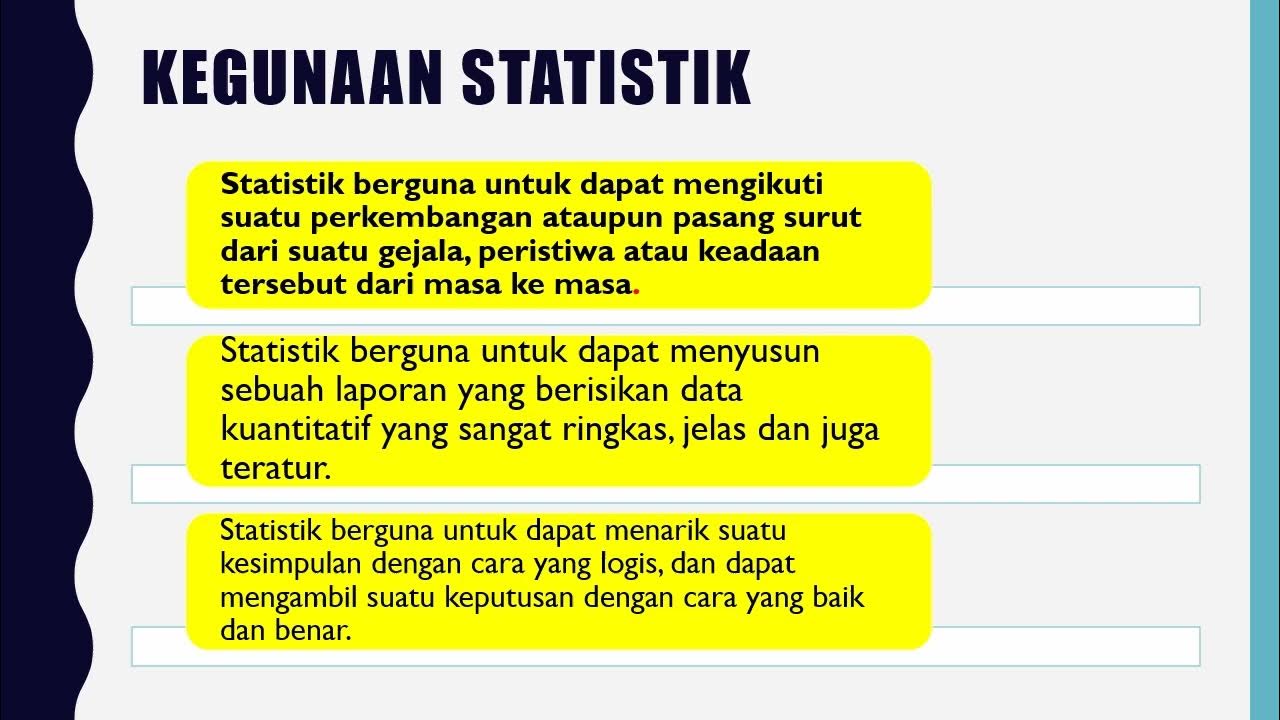
pengantar statistika
5.0 / 5 (0 votes)

