Tests for cations for IGCSE and O Level Chemistry
Summary
TLDRThis experiment tests for various cations (Al, Ca, Zn, Pb, Na, Cu²⁺, Fe²⁺, Fe³⁺, Cr³⁺) using sodium hydroxide and ammonia. The reactions are observed with different results: white precipitates form for most cations, with sodium not producing any precipitate. Adding excess sodium hydroxide or ammonia causes varying changes in the precipitates, such as dissolving or remaining unchanged. Specific tests also detect copper, iron, and chromium with distinctive colors for their precipitates. An additional test for ammonium ions is performed, showing ammonia gas production when heated with sodium hydroxide.
Takeaways
- 😀 The experiment tests for various cations using sodium hydroxide and ammonia solutions.
- 😀 The cations tested include aluminum, calcium, zinc, lead, sodium, copper(II), iron(II), iron(III), chromium(III), and ammonium.
- 😀 Sodium hydroxide reacts with the cations to form precipitates, with some dissolving in excess sodium hydroxide.
- 😀 Aluminum, zinc, and lead form white precipitates with sodium hydroxide, but only aluminum and zinc dissolve in excess sodium hydroxide.
- 😀 Calcium produces a white precipitate with sodium hydroxide, but it does not dissolve in excess sodium hydroxide.
- 😀 Sodium does not form a precipitate with sodium hydroxide.
- 😀 Ammonia produces a white precipitate with aluminum, zinc, and lead ions, but not with calcium or sodium ions.
- 😀 Excess ammonia dissolves the white precipitate formed by aluminum and zinc ions, but not by lead ions.
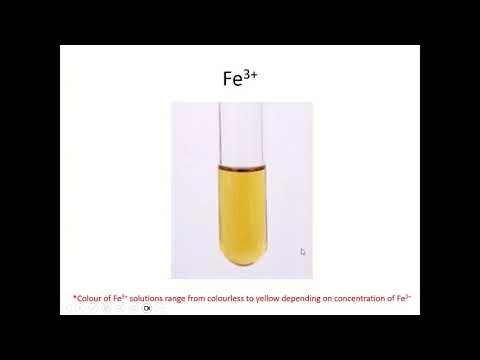
- 😀 Copper(II), iron(II), iron(III), and chromium(III) form distinct precipitates with sodium hydroxide: blue, green, reddish-brown, and green, respectively.
- 😀 Ammonium ions are confirmed by the production of ammonia gas when heated with sodium hydroxide, indicated by the turning of red litmus paper to blue.
Q & A
What is the purpose of Experiment 18.2?
-The purpose of Experiment 18.2 is to test for the presence of various cations using sodium hydroxide (NaOH) and ammonia (NH₃), observing the formation or dissolution of precipitates to identify different ions.
Which cations were tested in this experiment?
-The cations tested in this experiment were aluminum (Al³⁺), calcium (Ca²⁺), zinc (Zn²⁺), lead (Pb²⁺), sodium (Na⁺), copper (Cu²⁺), iron (Fe²⁺, Fe³⁺), and chromium (Cr³⁺).
What was the result when sodium hydroxide was added to aluminum ions (Al³⁺)?
-When sodium hydroxide was added to aluminum ions, a white precipitate of aluminum hydroxide (Al(OH)₃) formed.
How did the excess sodium hydroxide affect the precipitate formed with aluminum ions?
-The excess sodium hydroxide dissolved the white precipitate of aluminum hydroxide, resulting in a colorless solution.
What was the result when ammonia was added to the zinc ion solution?
-When ammonia was added to the zinc ion solution, a white precipitate of zinc hydroxide (Zn(OH)₂) formed.
How did excess ammonia affect the precipitate formed with zinc ions?
-The white precipitate of zinc hydroxide dissolved in excess ammonia, forming a colorless solution.
What was observed when ammonia was added to calcium ions (Ca²⁺)?
-When ammonia was added to calcium ions, no precipitate was formed, indicating no reaction.
What was the reaction when sodium hydroxide was added to copper(II) ions (Cu²⁺)?
-When sodium hydroxide was added to copper(II) ions, a blue precipitate of copper hydroxide (Cu(OH)₂) formed.
What happened when excess sodium hydroxide was added to chromium(III) ions (Cr³⁺)?
-When excess sodium hydroxide was added to chromium(III) ions, the green precipitate dissolved to form a green solution.
What test was used to confirm the presence of ammonium ions (NH₄⁺) in the experiment?
-To confirm the presence of ammonium ions, sodium hydroxide was added to ammonium salts, and the mixture was gently heated. The ammonia gas produced turned red litmus paper blue, indicating the presence of ammonium ions.
Outlines

Этот раздел доступен только подписчикам платных тарифов. Пожалуйста, перейдите на платный тариф для доступа.
Перейти на платный тарифMindmap

Этот раздел доступен только подписчикам платных тарифов. Пожалуйста, перейдите на платный тариф для доступа.
Перейти на платный тарифKeywords

Этот раздел доступен только подписчикам платных тарифов. Пожалуйста, перейдите на платный тариф для доступа.
Перейти на платный тарифHighlights

Этот раздел доступен только подписчикам платных тарифов. Пожалуйста, перейдите на платный тариф для доступа.
Перейти на платный тарифTranscripts

Этот раздел доступен только подписчикам платных тарифов. Пожалуйста, перейдите на платный тариф для доступа.
Перейти на платный тарифПосмотреть больше похожих видео
9701 Chemistry Paper 3 Qualitative Analysis - Part 1 Coloured Cations

UNSUR HARA MAKRO DAN MIKRO LENGKAP : NITROGEN, FOSFAT, KALIUM, BORON, KALSIUM, SULFUR, ZINK, SILIKA
konfigurasi elektron

O-Level Chemistry | 16 | Qualitative Analysis [1/3]

GCSE Chemistry Revision "Required Practical 4: Temperature Changes"

Double Displacement Reactions
5.0 / 5 (0 votes)

