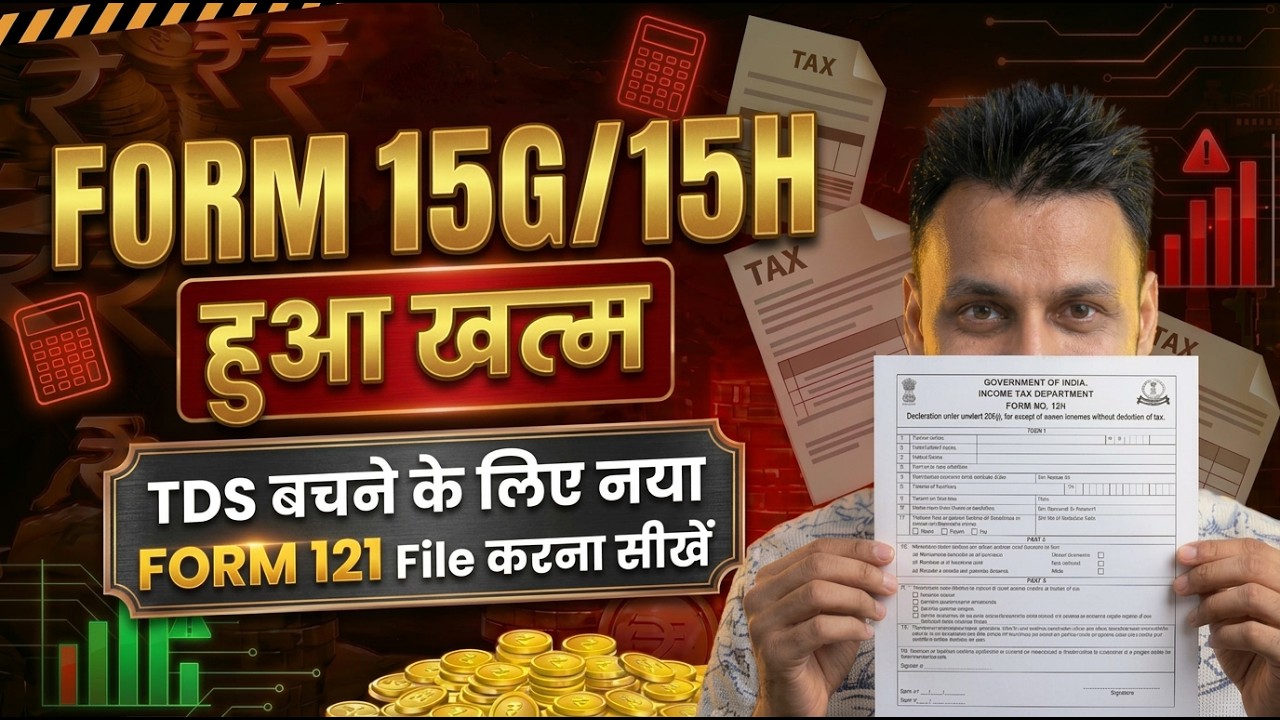
Important Update ! Form 15G / 15H Removed from 1 April 2026 | New TDS form and Rules Explained |
Summary
TLDRThis video explains key updates to India’s Income Tax Act, focusing on the changes to Forms 15G and 15H, which will be replaced by the new Form 121 starting April 2026. The video details how individuals and senior citizens can avoid TDS deductions on interest income from fixed deposits by filing these forms. It also covers the upcoming amendments in Budget 2026, including how demat account holders can streamline filing by submitting a single Form 121 through their depository. The video is a must-watch for taxpayers looking to understand these important tax form changes.
Takeaways
- 😀 The Income Tax Act 2025 and Income Tax Rules 2026 come into effect from April 1, 2026, replacing Forms 15G and 15H with the new Form 121.
- 😀 TDS (Tax Deducted at Source) is applied on fixed deposit interest exceeding ₹10,000 per year for non-senior citizens and ₹1 lakh for senior citizens.
- 😀 Filing Forms 15G (for non-senior citizens) and 15H (for senior citizens) allows individuals to receive full interest without TDS deduction, provided income limits are met.
- 😀 Non-senior citizens can use these forms if their total estimated income in a financial year is up to ₹4 lakh, while senior citizens can use them up to ₹12 lakh.
- 😀 Declarations must be filed every financial year in April, and false declarations can lead to penalties and prosecution.
- 😀 The basic exemption limit is ₹4 lakh for FY 2026-27, meaning individuals with income below this do not need to pay tax or file ITR.
- 😀 Section 87A of the old act (now Section 156 in 2025 Act) provides tax relief for individuals whose taxable income is within slab rates, excluding capital gains taxed at special rates.
- 😀 From April 1, 2026, Form 121 consolidates 15G and 15H, allowing both senior and non-senior citizens to file a single form for all eligible income sources.
- 😀 For securities held in demat accounts, a single Form 121 filed with the depository (NSDL/CDSL) will cover all relevant companies, effective from April 1, 2027.
- 😀 Fixed deposit TDS cannot be managed through the depository; a separate Form 121 must be filed with each bank to avoid deduction.
- 😀 Form 121 also applies to dividend income, interest from bonds, debentures, and mutual fund units, ensuring TDS is avoided for eligible individuals.
Q & A
What is the Income Tax Act 2025, and when will it become applicable?
-The Income Tax Act 2025 will become applicable from April 1, 2026. It introduces new rules and changes to the taxation system, including modifications to the forms used for tax declarations.
What are Forms 15G and 15H, and how do they help taxpayers?
-Forms 15G and 15H are used by individuals to avoid the deduction of TDS (Tax Deducted at Source) on fixed deposit interest. Form 15G is for individuals below 60 years of age with an income up to ₹4 lakh, while Form 15H is for senior citizens (aged 60 years and above) with an income up to ₹12 lakh.
What changes are coming in April 2026 regarding Forms 15G and 15H?
-From April 1, 2026, Forms 15G and 15H will no longer exist. A new form, Form 121, will replace them. This form will apply to both senior and non-senior citizens, and individuals will need to file it with the bank to avoid TDS on fixed deposit interest.
Who can file Form 15G?
-Form 15G can be filed by individuals under 60 years of age, whose estimated total income for the financial year is up to ₹4 lakh. This form helps avoid TDS deductions on fixed deposit interest.
Who is eligible to file Form 15H?
-Form 15H can be filed by senior citizens (aged 60 years and above) whose total estimated income for the year is up to ₹12 lakh. It helps senior citizens avoid TDS deductions on interest income from fixed deposits.
Can I file Form 15G or 15H for more than one year?
-No, Forms 15G and 15H must be filed every year. They are valid only for the respective financial year and must be filed again the following year if the eligibility criteria remain the same.
What happens if I don't file Form 15G or 15H?
-If you do not file Form 15G or 15H, the bank will deduct TDS at the rate of 10% on your fixed deposit interest income if it exceeds ₹1 lakh, and you will have to claim a refund by filing your Income Tax Return (ITR).
What is the new Form 121, and how does it work?
-Form 121 is the new tax declaration form that will replace Forms 15G and 15H starting from April 2026. Taxpayers, whether senior or non-senior citizens, will need to file this form to avoid TDS deductions on fixed deposit interest and other income sources like dividends and interest from bonds or mutual funds.
What are the benefits of Section 87A in the Income Tax Act?
-Section 87A of the Income Tax Act provides relief to individuals by reducing their taxable income to zero if their total taxable income is up to ₹1 lakh. This section waives the tax amount that would otherwise be payable.
How does the new tax regime affect Form 15G and 15H filings?
-Under the new tax regime, if your total income is up to ₹4 lakh, you don't have to pay any tax, and you also don't need to file an ITR. By filing Form 15G or 15H, you can avoid TDS deductions and avoid the hassle of claiming a refund through ITR.
Outlines

このセクションは有料ユーザー限定です。 アクセスするには、アップグレードをお願いします。
今すぐアップグレードMindmap

このセクションは有料ユーザー限定です。 アクセスするには、アップグレードをお願いします。
今すぐアップグレードKeywords

このセクションは有料ユーザー限定です。 アクセスするには、アップグレードをお願いします。
今すぐアップグレードHighlights

このセクションは有料ユーザー限定です。 アクセスするには、アップグレードをお願いします。
今すぐアップグレードTranscripts

このセクションは有料ユーザー限定です。 アクセスするには、アップグレードをお願いします。
今すぐアップグレード関連動画をさらに表示
Form 15G/15H removed | How to file new form 121 to save TDS on interest from bank FD

All about the New Income Tax Bill 2025 | Personal Finance | Tax slabs | New tax regime

👉 1 April 2026 से लागू बड़े बदलाव | Income Tax, GST, Banking, Cash, UPI सब बदल गया!

Direct Tax Code 2025 replacing Income Tax Act, 1961 | DTC 2025 | CA Raj K Agrawal

Stepwise Form 121 Filing with all FAQ | Form 15G/15H removed

Income Tax खत्म हो गया । What is Direct Tax Code | Direct Tax Code 2025 | Direct Tax Code 2025 |
5.0 / 5 (0 votes)

