Stepwise Form 121 Filing with all FAQ | Form 15G/15H removed
Summary
TLDRThis video explains the process of filing Form 121 to save TDS on Fixed Deposit (FD) interest under the new Income Tax rules effective from April 2026. It covers the eligibility criteria for both senior and non-senior citizens, detailing how to fill out the form, key conditions, and the steps involved in submitting it at the bank. The video also highlights important points such as the exemption limit for non-senior citizens and the consequences of incorrect form submission. A helpful guide for those looking to file their taxes and save TDS efficiently.
Takeaways
- 😀 Form 121 replaces Forms 15G and 15H for preventing TDS on interest and certain other incomes.
- 😀 Senior citizens (≥60 years) are eligible if total tax on total income is zero.
- 😀 Non-senior citizens (<60 years) must meet two conditions: tax must be zero and total interest income must be below the basic exemption limit (₹4,00,000 in the new regime).
- 😀 Only interest income needs to be considered when comparing against the basic exemption limit for non-senior citizens.
- 😀 Eligibility must be carefully checked before filing to avoid penalties or prosecution.
- 😀 Part A of Form 121 is filled by the taxpayer with personal details, PAN, income information, and declaration of eligibility.
- 😀 Part B is submitted by the bank, which verifies the form, generates a UIN (Unique Identification Number), and uploads it to the TDS portal within one month.
- 😀 A duplicate of the submitted form should be kept by the taxpayer as a record.
- 😀 Common cases for filing include FD interest, PF withdrawals, insurance payouts, dividends, and rent from specified persons.
- 😀 Incorrect or false declarations in Form 121 can lead to penalties, so careful attention to the conditions is necessary.
Q & A
What is Form 121 and why was it introduced?
-Form 121 is a new declaration form introduced to replace Forms 15G and 15H for claiming non-deduction of TDS on interest income and specified incomes. It standardizes the process for both senior and non-senior citizens.
Who is eligible to submit Form 121?
-Eligibility depends on age and income: Senior citizens (60+) are eligible if their total tax is zero. Non-senior citizens (below 60) must meet two conditions: their total tax must be zero, and total interest income must be below the basic exemption limit (₹4 lakh in the new regime).
How does the eligibility criteria differ for senior and non-senior citizens?
-For senior citizens, only total tax being zero is checked, while for non-senior citizens, both zero tax and interest income below the exemption limit are required.
What types of income are covered under Form 121?
-Form 121 covers interest income from FDs, savings accounts, mutual funds, post office schemes, PF, LIC payouts, rent from specified persons, and dividends from domestic companies.
How is interest income considered for non-senior citizens?
-Only total interest income is compared to the basic exemption limit. If it exceeds the limit (₹4 lakh in the new regime), Form 121 cannot be submitted.
What are the key steps for filling Part A of Form 121?
-Part A requires the taxpayer to fill in personal details (name, PAN, address, contact), tax year, senior citizen status, nature and estimate of income, and past ITR details. The form must be signed, dated, and include the location.
What happens after Part A is submitted to the bank?
-The bank verifies the information in Part B, generates a Unique Identification Number (UIN), uploads details to the TDS portal, and ensures TDS is not deducted for eligible incomes.
What penalties apply for providing false information in Form 121?
-Providing false information can lead to prosecution and penalties. It is crucial that all eligibility criteria are correctly met before submission.
How does the bank handle Form 121 after submission?
-The bank processes the submitted Part B, generates the UIN, retains one copy for records, submits the other to the TDS portal within a month, and ensures quarterly reporting to the IT department.
Can Form 121 be used for multiple types of interest income?
-Yes, the form can include multiple eligible sources of interest income, as long as the combined income meets the eligibility criteria for tax non-deduction.
Is there any online submission option for Form 121?
-Currently, Form 121 is primarily submitted offline through banks, but online submission may be supported in the future through net banking or mobile banking interfaces.
What is the main reason taxpayers fail in submitting Form 121 correctly?
-The most common issue is misunderstanding eligibility, especially for non-senior citizens regarding the interest income threshold and ensuring the total tax on income is zero.
Outlines

This section is available to paid users only. Please upgrade to access this part.
Upgrade NowMindmap

This section is available to paid users only. Please upgrade to access this part.
Upgrade NowKeywords

This section is available to paid users only. Please upgrade to access this part.
Upgrade NowHighlights

This section is available to paid users only. Please upgrade to access this part.
Upgrade NowTranscripts

This section is available to paid users only. Please upgrade to access this part.
Upgrade NowBrowse More Related Video
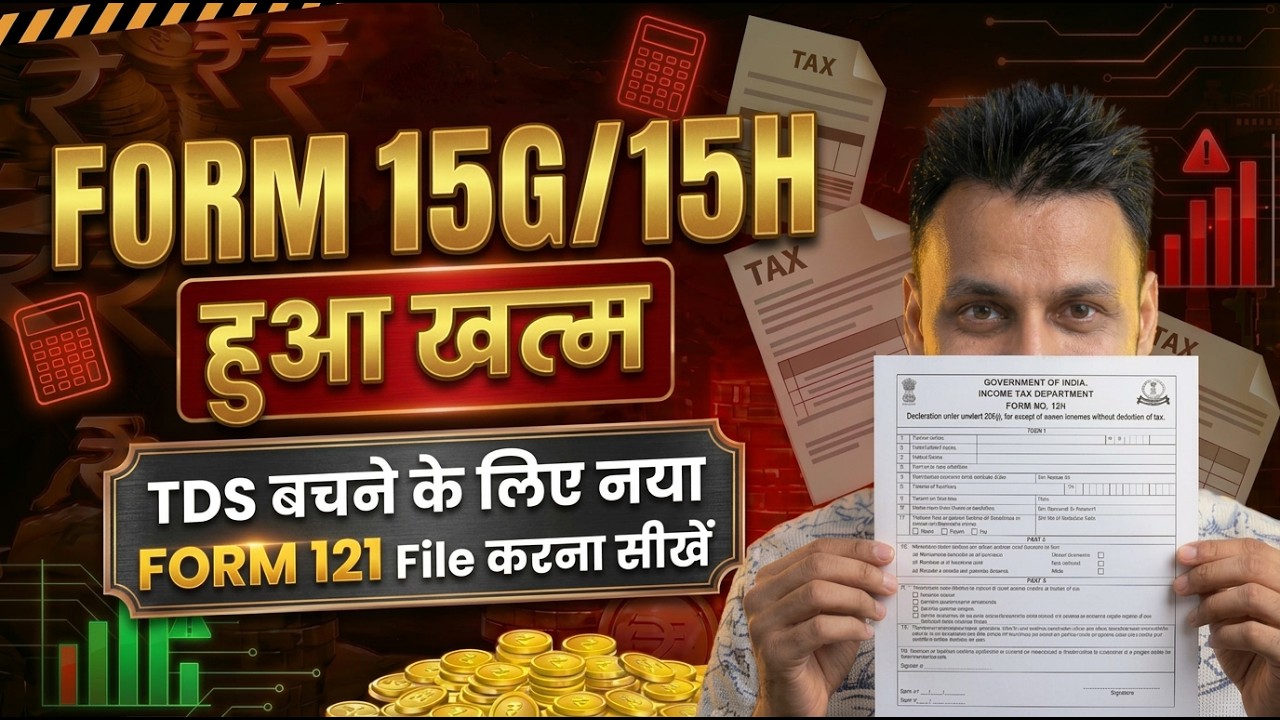
Form 15G/15H removed | How to file new form 121 to save TDS on interest from bank FD

Important Update ! Form 15G / 15H Removed from 1 April 2026 | New TDS form and Rules Explained |
Form 26QB TDS Online | How to File Form 26QB TDS Return Online | 26QB Online Payment Process

आज LIVE करके दिखाया TDS Payment | LIVE TDS Payment 🔴 April 2026 | How to Pay TDS Online (Live)
60, 70, 75, 80 उम्र वालों की हुई मौज 1 April 2026 से | Senior citizens Rights 2026 | Senior Citizens

Form 10IEA Filing for AY 2024-25
5.0 / 5 (0 votes)
