Memahami Makna Diagram Kesetimbangan Kimia
Summary
TLDRThis tutorial explains how to understand chemical equilibrium diagrams. It begins by defining key terms such as reactants, products, and equilibrium reactions. The video details how concentration curves for reactants and products evolve over time, illustrating how equilibrium is reached when concentrations stabilize. It explores the equilibrium constant (Kc), explaining its significance: Kc > 1 indicates more products than reactants, Kc < 1 indicates more reactants, and Kc = 1 signals balanced concentrations. The tutorial also demonstrates how to interpret and simulate Kc values using sample data, providing a practical approach to analyzing chemical reactions and diagrams effectively for high school chemistry learners.
Takeaways
- 😀 Chemical equilibrium involves a balance between the forward reaction (reactants to products) and the reverse reaction (products to reactants).
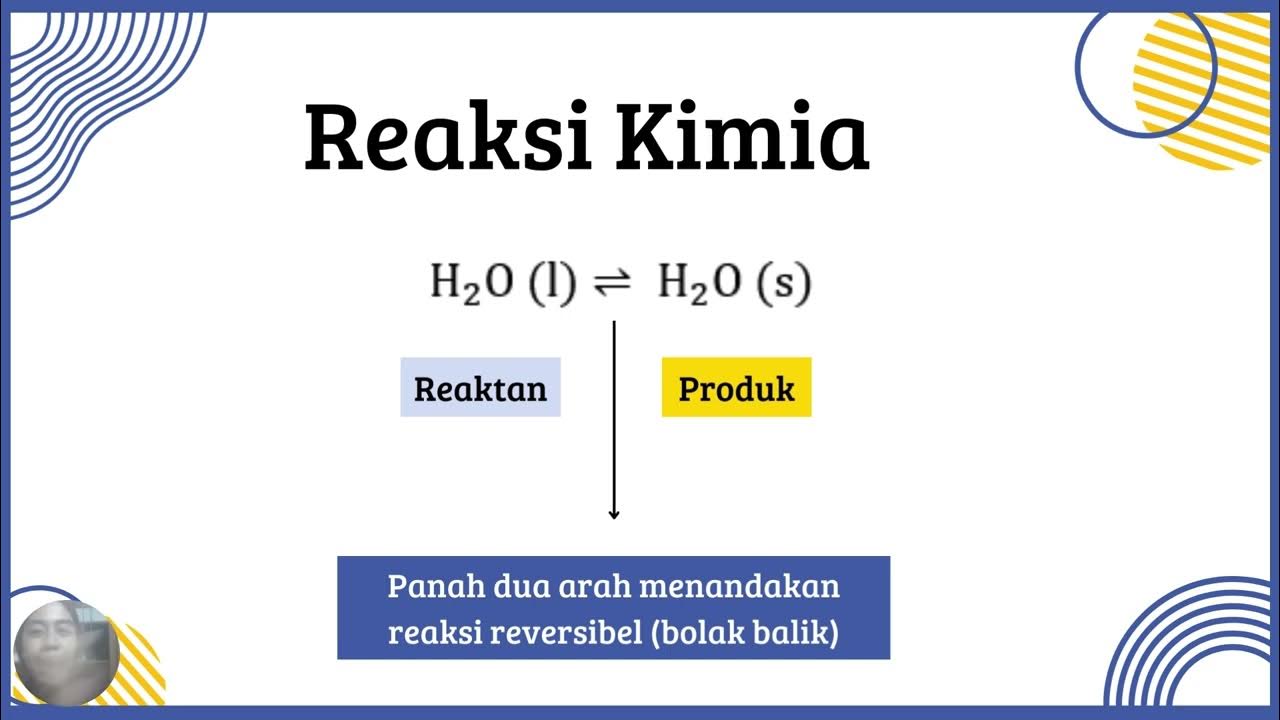
- 😀 Reactants are species on the left side of the equilibrium arrow, while products are on the right side.
- 😀 Equilibrium reactions are often represented using a double-headed arrow pointing both ways.
- 😀 The equilibrium constant (Kc) quantifies the ratio of product concentrations to reactant concentrations, raised to their stoichiometric coefficients.
- 😀 When Kc > 1, the reaction favors product formation; when Kc < 1, reactants are favored; and when Kc ≈ 1, reactants and products are roughly equal.
- 😀 Concentration vs. time graphs show reactants decreasing and products increasing until both reach a constant value at equilibrium.
- 😀 Reactant curves start high and decline, while product curves start low and rise until stabilization.
- 😀 Simulations using numerical values help illustrate how initial concentrations and stoichiometry affect Kc and the equilibrium state.
- 😀 Observing the position of curves on a graph gives an approximate idea of whether Kc is greater than, less than, or equal to 1.
- 😀 Care must be taken when interpreting Kc from graphs alone, as the stoichiometry of the reaction can significantly influence the calculated values.
- 😀 Practical understanding of equilibrium involves combining graphical analysis, Kc calculations, and stoichiometric considerations for accurate conclusions.
Q & A
What is the difference between a reactant and a product in a chemical equilibrium reaction?
-Reactants (preaksi) are the chemical species present on the left side of the equilibrium arrow, while products (hasil reaksi) are on the right side. Reactants are consumed to form products, and at equilibrium, their concentrations stabilize.
How is a chemical equilibrium represented in a reaction equation?
-Chemical equilibrium is represented by a double-headed arrow (⇌) indicating that the reaction proceeds in both forward and reverse directions until the rates of formation of products and reactants are equal.
How is the equilibrium constant (K_C) calculated?
-The equilibrium constant K_C is calculated using the formula: K_C = [products]^coefficient / [reactants]^coefficient, where the concentrations of each species are raised to the power of their stoichiometric coefficients.
What does it indicate if K_C is greater than 1?
-If K_C > 1, it indicates that the concentration of products is higher than the concentration of reactants at equilibrium, meaning the reaction favors product formation.
What does it indicate if K_C is less than 1?
-If K_C < 1, it indicates that the concentration of reactants is higher than that of products at equilibrium, meaning the reaction favors the reactants.
How can you interpret reactant and product concentration curves in a graph over time?
-A reactant curve starts high and decreases to a constant value, while a product curve starts low and increases to a constant value. The point where both curves stabilize represents the equilibrium state.
Can you always determine the relative concentrations of reactants and products solely from the K_C value?
-No. While K_C gives a general indication, the actual concentrations depend on the stoichiometry of the reaction. Precise concentrations require calculations using the specific reaction coefficients.
Why might simulation with numerical values be necessary when analyzing equilibrium graphs?
-Simulation is needed because the graphs often do not provide absolute concentration values. Using estimated or scaled numbers allows calculation of K_C and verification of which reaction alternatives match the observed trends.
What happens to the reaction rates of reactants and products as equilibrium is approached?
-As equilibrium is approached, the rate of decrease of reactants slows until it becomes constant, while the rate of product formation slows until it also becomes constant. At equilibrium, the rates of forward and reverse reactions are equal.
How does the stoichiometry of a reaction affect the value of K_C?
-The stoichiometry affects how the concentrations of reactants and products are raised to their respective powers in the K_C calculation. Different stoichiometric coefficients can result in different K_C values even if the equilibrium concentrations are similar.
What visual clue on a concentration vs. time graph suggests that products dominate the reaction?
-If the product curve (usually shown in green) is above the reactant curve (usually shown in red) when both stabilize, it suggests that the products have a higher concentration, indicating K_C > 1.
What visual clue on a graph suggests that reactants dominate the reaction?
-If the reactant curve is above the product curve when equilibrium is reached, it suggests the reactants have a higher concentration, indicating K_C < 1.
Outlines

このセクションは有料ユーザー限定です。 アクセスするには、アップグレードをお願いします。
今すぐアップグレードMindmap

このセクションは有料ユーザー限定です。 アクセスするには、アップグレードをお願いします。
今すぐアップグレードKeywords

このセクションは有料ユーザー限定です。 アクセスするには、アップグレードをお願いします。
今すぐアップグレードHighlights

このセクションは有料ユーザー限定です。 アクセスするには、アップグレードをお願いします。
今すぐアップグレードTranscripts

このセクションは有料ユーザー限定です。 アクセスするには、アップグレードをお願いします。
今すぐアップグレード



5.0 / 5 (0 votes)

