Thermochemistry: Heat and Work
Summary
TLDRThis video explores the fundamental concepts of heat and work in thermodynamics, explaining how energy is transferred and transformed between systems. It distinguishes heat as random molecular motion driven by temperature differences, and work as organized, directional energy transfer. The video illustrates these principles with practical examples like rubbing hands, engine combustion, gas expansion, and piston movements. Key concepts such as the first law of thermodynamics, sign conventions for heat (Q) and work (W), and calculating internal energy (ΔU) are thoroughly discussed. The examples guide viewers in understanding when energy is absorbed, released, or transformed, making abstract thermodynamic principles tangible and relatable.
Takeaways
- 😀 Heat and work are two primary forms of energy that can be observed in various systems and their interactions.
- 😀 Heat is associated with random molecular motion, while work involves organized, directional energy transfer.
- 😀 The flow of heat always moves from areas of higher temperature to lower temperature.
- 😀 Heat can be converted into work (e.g., combustion in an engine), and work can be converted into heat (e.g., rubbing hands together).
- 😀 The First Law of Thermodynamics states that energy cannot be created or destroyed, only transferred or transformed.
- 😀 The sign of heat (Q) indicates whether energy is being absorbed (positive) or released (negative) by a system.
- 😀 Work (W) can be positive or negative, depending on whether energy is being added to the system or taken away from it.
- 😀 Positive Q (endothermic) means the system absorbs heat, increasing molecular motion, while negative Q (exothermic) means the system releases heat.
- 😀 Positive W means work is done by the system, such as a gas expanding in a piston, while negative W means work is done on the system, such as compressing gas.
- 😀 The internal energy of a system (ΔU) is the sum of heat (Q) and work (W) transferred to or from the system, indicating whether energy is stored or spent.
- 😀 Practical examples, such as gas expanding in a piston or the evaporation of sweat, demonstrate how heat and work can be quantified and their signs determined based on the system's behavior.
Q & A
What is the main difference between heat and work in thermodynamics?
-Heat is energy transferred due to temperature differences and involves random, disordered molecular motion, while work is energy transferred through organized, directional motion.
How can heat and work be interchangeable?
-Heat and work can be converted into each other. For example, rubbing hands (work) generates heat, and heat from fuel combustion in a car engine can perform mechanical work.
According to the first law of thermodynamics, how is the change in internal energy calculated?
-The change in internal energy (ΔU) of a system is calculated by adding the heat (Q) absorbed by the system and the work (W) done on the system: ΔU = Q + W.
What does a positive Q indicate in a thermodynamic process?
-A positive Q indicates that the system absorbs heat, meaning it is an endothermic process.
What does a negative W indicate in the context of gas expansion?
-A negative W indicates that the system is doing work on the surroundings, such as when a gas expands and pushes against external pressure.
Why are gases often used to demonstrate work and heat interactions?
-Gases are used because their volume changes are easy to observe, unlike liquids and solids, and these changes clearly indicate whether work is done on or by the system.
What happens to the internal energy if a gas absorbs 450 J of heat and does 600 J of work by expanding?
-The internal energy decreases because ΔU = Q + W = 450 + (-600) = -150 J, meaning the system spent more energy than it stored.
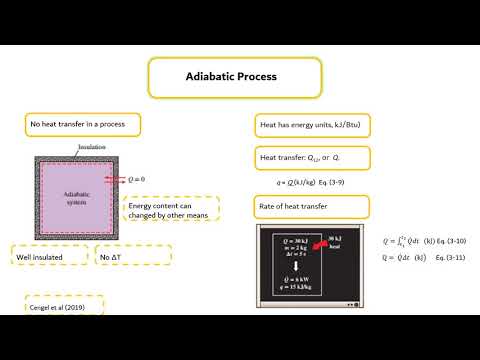
In the example of piston pulled up, why is W negative and Q zero?
-W is negative because the gas expands, doing work on the surroundings, and Q is zero because there is no heat transfer mentioned in the scenario.
How do you determine whether heat or work is positive or negative in a given situation?
-Heat is positive if absorbed and negative if released. Work is positive if done on the system and negative if the system does work on the surroundings.
What is the effect on molecules when a substance absorbs heat?
-When a substance absorbs heat, the kinetic energy of its molecules increases, causing faster molecular motion and, for example, phase changes such as melting or boiling.
What does zero work (0 W) signify in a thermodynamic process?
-Zero work means no mechanical energy transfer occurs in the system, such as when there is no expansion or compression of gases.
Why is the sign convention important in thermodynamics?
-The sign convention indicates the direction of energy transfer, helping determine whether the system is gaining or losing energy through heat or work, which is crucial for calculating internal energy.
Outlines

このセクションは有料ユーザー限定です。 アクセスするには、アップグレードをお願いします。
今すぐアップグレードMindmap

このセクションは有料ユーザー限定です。 アクセスするには、アップグレードをお願いします。
今すぐアップグレードKeywords

このセクションは有料ユーザー限定です。 アクセスするには、アップグレードをお願いします。
今すぐアップグレードHighlights

このセクションは有料ユーザー限定です。 アクセスするには、アップグレードをお願いします。
今すぐアップグレードTranscripts

このセクションは有料ユーザー限定です。 アクセスするには、アップグレードをお願いします。
今すぐアップグレード




5.0 / 5 (0 votes)

