COURS FLE: Donner un ordre/Un conseil/Exprimer une interdiction
Summary
TLDRThis video lesson explains how to use the imperative in French to give orders, offer advice, or express prohibitions. Using the context of a global virus outbreak, it demonstrates how authorities might instruct people to wear masks, maintain social distance, and follow safety rules. The lesson covers affirmative and negative forms, singular and plural commands, and special cases with reflexive and irregular verbs. It also introduces alternative ways to give advice and express prohibitions, making the grammar practical and relevant. With clear examples, viewers learn not only the rules but also how to apply them in real-life situations for safety and etiquette.
Takeaways
- 😀 The imperative mood is used to give orders, advice, and recommendations.
- 😀 In the imperative, the verb is conjugated in the form of a command, like 'Porte un masque' (Wear a mask).
- 😀 The plural or formal form of the imperative uses the verb in the second person plural: 'Portez un masque' (Wear a mask).
- 😀 In the negative form, the verb is surrounded by 'ne...pas': 'Ne porte pas de masque' (Don't wear a mask).
- 😀 Reflexive verbs change the reflexive pronoun in the imperative: 'Lave-toi les mains' (Wash your hands).
- 😀 For plural or formal 'you' with reflexive verbs: 'Lavez-vous les mains' (Wash your hands).
- 😀 The imperative is also used to express prohibitions, e.g., 'Il est interdit de fumer' (It is forbidden to smoke).
- 😀 Expressions like 'Je te conseille de...' (I advise you to...) or 'Je te recommande de...' (I recommend you to...) are used for giving advice.
- 😀 For recommendations, you can say: 'Si j’étais à ta place, je ferais attention' (If I were in your place, I would be careful).
- 😀 Irregular verbs in the imperative (like 'être' and 'avoir') have unique forms, e.g., 'Sois' (be), 'Aie' (have).
- 😀 The imperative is used in the context of health and safety guidelines, such as wearing masks and maintaining social distance to prevent virus spread.
Q & A
What is the primary purpose of using the imperative mood in French?
-The imperative mood is used to give orders, advice, recommendations, or to express prohibitions. It helps convey commands or suggestions directly.
How do you form the imperative for the verb 'porter' (to wear) in French?
-In the imperative, 'porter' is conjugated as 'porte' when addressing a single person informally (tu) and 'portez' when addressing a group or formally (vous).
How do you form the negative of the imperative in French?
-The negative imperative is formed by placing 'ne' and 'pas' around the verb. For example, 'Ne porte pas de masque' (Don't wear a mask).
What is the form of the reflexive verb 'se laver' in the negative imperative?
-In the negative imperative for reflexive verbs like 'se laver' (to wash oneself), the reflexive pronoun changes depending on the subject. For 'tu,' it becomes 'ne te lave pas' (Don't wash yourself).
How do you conjugate a second group verb like 'choisir' (to choose) in the imperative?
-For second group verbs like 'choisir,' you conjugate them as 'choisis' (tu form), 'choisissons' (nous form), and 'choisissez' (vous form).
What should you say if you want to give advice to someone in French?
-To give advice, you can use phrases like 'Je te conseille de' (I advise you to) or 'Je te recommande de' (I recommend you to). For example, 'Je te conseille de rester à la maison' (I advise you to stay home).
What phrase is used in French to express a prohibition?
-To express a prohibition, you can use phrases such as 'Il est interdit de' (It is forbidden to), 'Il n'est pas permis de' (It is not allowed to), or 'Il est défendu de' (It is prohibited to).
How does the conjugation change when using the plural form or formal 'vous' in the imperative?
-When using 'vous' (plural or formal), the verb takes the 'vous' form of the imperative. For example, 'Portez un masque' (Wear a mask, plural/formal).
Why is there an 's' added to the 'tu' form of the imperative for some verbs?
-For some verbs in the 'tu' form of the imperative (first group verbs), an 's' is added for pronunciation reasons, such as 'Manges' becoming 'Mange' (Eat) for informal singular, but 'Mangez' remains for plural/formal.
How does the imperative change for reflexive verbs like 'se promener' (to walk)?
-For reflexive verbs, the reflexive pronoun changes based on the subject. For example, 'Ne te promène pas' (Don't walk around - tu form), 'Ne nous promenons pas' (Don't walk around - nous form), and 'Ne vous promenez pas' (Don't walk around - vous form).
Outlines

このセクションは有料ユーザー限定です。 アクセスするには、アップグレードをお願いします。
今すぐアップグレードMindmap

このセクションは有料ユーザー限定です。 アクセスするには、アップグレードをお願いします。
今すぐアップグレードKeywords

このセクションは有料ユーザー限定です。 アクセスするには、アップグレードをお願いします。
今すぐアップグレードHighlights

このセクションは有料ユーザー限定です。 アクセスするには、アップグレードをお願いします。
今すぐアップグレードTranscripts

このセクションは有料ユーザー限定です。 アクセスするには、アップグレードをお願いします。
今すぐアップグレード関連動画をさらに表示

MATERI IMPERATIVE SENTENCE - KALIMAT PERINTAH (COMMAND AND PROHIBITION)
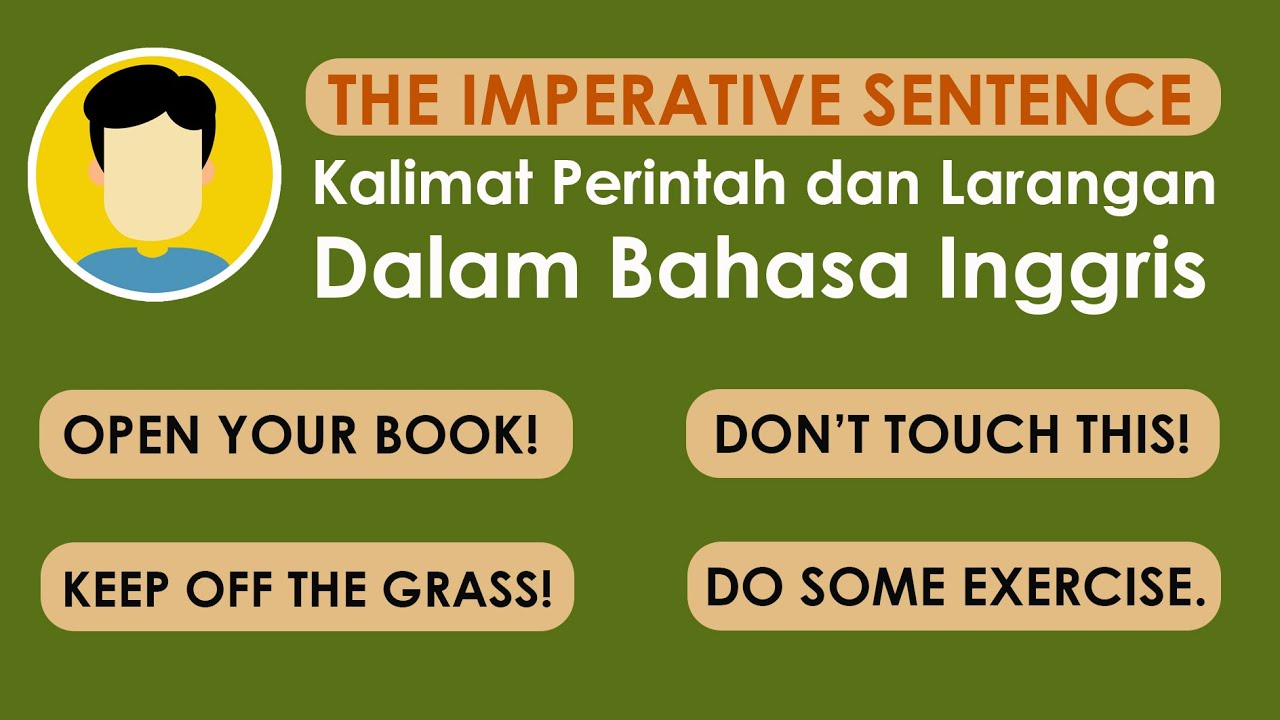
The Imperative Sentence | Kalimat Perintah & Larangan dalam Bahasa Inggris | Belajar Bagasa Inggris

A1 English Grammar Imperatives

The Imperative - Give Orders and Commands - English Grammar

l'impératif présent

Imperative Sentence : Cara Membuat Kalimat Perintah dalam Bahasa Inggris
5.0 / 5 (0 votes)

