Tebongkar! Rahasia Cepat Memahami Kinematika Gerak dengan jelas dan detail! (Seri Fisika Dasar)
Summary
TLDRThis video introduces the fundamentals of kinematics, the branch of physics that studies motion without considering its causes. It explains one-dimensional motion, including uniform motion and uniformly accelerated motion, as well as two-dimensional motion, such as projectile and circular motion. The video also covers vertical motion under gravity, highlighting free fall and the role of constant acceleration. Presented in a conversational style with everyday examples, it emphasizes understanding motion concepts before tackling complex scenarios. Ideal for students, the video encourages learning through clear explanations, practical illustrations, and a focus on core principles of motion in physics.
Takeaways
- 😀 Kinematics is the branch of physics that studies the motion of objects without considering the forces causing that motion.
- 😀 There are two main types of motion studied in kinematics: one-dimensional motion and two-dimensional motion.
- 😀 One-dimensional motion occurs along a single axis, such as a car moving forward or backward on a straight road.
- 😀 In uniformly accelerated motion (GLBB), the object moves with a constant acceleration, and the distance covered can be calculated using specific formulas.
- 😀 In uniform linear motion (GLB), the velocity of the object remains constant, meaning the object moves at a steady speed.
- 😀 Acceleration in motion can either be constant (uniform acceleration) or variable, depending on the situation.
- 😀 Free fall is a type of vertical motion where objects fall under the influence of gravity without initial velocity or resistance.
- 😀 In projectile motion (parabolic motion), an object moves in a curved trajectory, influenced by both horizontal and vertical motion components.
- 😀 Circular motion occurs when an object moves along a circular path, and it can be uniform (constant angular velocity) or non-uniform (changing speed).
- 😀 Relative motion refers to how the speed or acceleration of an object appears differently depending on the observer's frame of reference.
Q & A
What is Kinematics?
-Kinematics is the branch of physics that deals with the motion of objects, without considering the forces causing that motion. It focuses on describing the movement, including the velocity and acceleration of the object.
What is the main difference between Kinematics and Dynamics?
-Kinematics focuses on describing motion (position, velocity, acceleration), whereas Dynamics deals with the forces that cause motion and how they interact with the objects.
What are the two types of motion discussed in the video?
-The video discusses two types of motion: 1D (one-dimensional) motion, where objects move along a single axis (e.g., a car moving on a straight road), and 2D (two-dimensional) motion, which involves motion in two directions (e.g., projectile motion).
What does 'uniform motion' mean in the context of the video?
-Uniform motion, also called 'uniform linear motion,' refers to the motion of an object where its velocity remains constant. This means there is no change in speed or direction.
What does 'Uniformly Accelerated Motion (GLBB)' mean?
-Uniformly Accelerated Motion (GLBB) refers to motion in which the object experiences a constant acceleration. In this case, the speed of the object increases or decreases at a steady rate.
What is the significance of the equations for uniformly accelerated motion?
-The equations for uniformly accelerated motion allow us to calculate the object's final velocity, displacement, and time, assuming constant acceleration. These equations are essential for solving problems in kinematics.
What is the difference between free fall motion and other types of vertical motion?
-Free fall motion occurs when an object falls under the influence of gravity alone, without any initial velocity or external forces. In contrast, vertical motion can also involve initial velocity or forces acting on the object, such as when an object is thrown upwards.
What is the relationship between velocity and time in uniformly accelerated motion?
-In uniformly accelerated motion, the velocity of an object changes linearly with time. This means that the object’s speed increases or decreases at a constant rate over time.
What is projectile motion?
-Projectile motion refers to the motion of an object that is thrown into the air and moves along a curved trajectory under the influence of gravity. The object’s motion is influenced by both horizontal and vertical components.
What does 'relative motion' mean in physics?
-Relative motion refers to the motion of an object as observed from a particular frame of reference. The object’s velocity can appear different depending on the observer’s own motion or position.
Outlines

このセクションは有料ユーザー限定です。 アクセスするには、アップグレードをお願いします。
今すぐアップグレードMindmap

このセクションは有料ユーザー限定です。 アクセスするには、アップグレードをお願いします。
今すぐアップグレードKeywords

このセクションは有料ユーザー限定です。 アクセスするには、アップグレードをお願いします。
今すぐアップグレードHighlights

このセクションは有料ユーザー限定です。 アクセスするには、アップグレードをお願いします。
今すぐアップグレードTranscripts

このセクションは有料ユーザー限定です。 アクセスするには、アップグレードをお願いします。
今すぐアップグレード関連動画をさらに表示

Aula 01 - Cinemática - Conceitos Iniciais
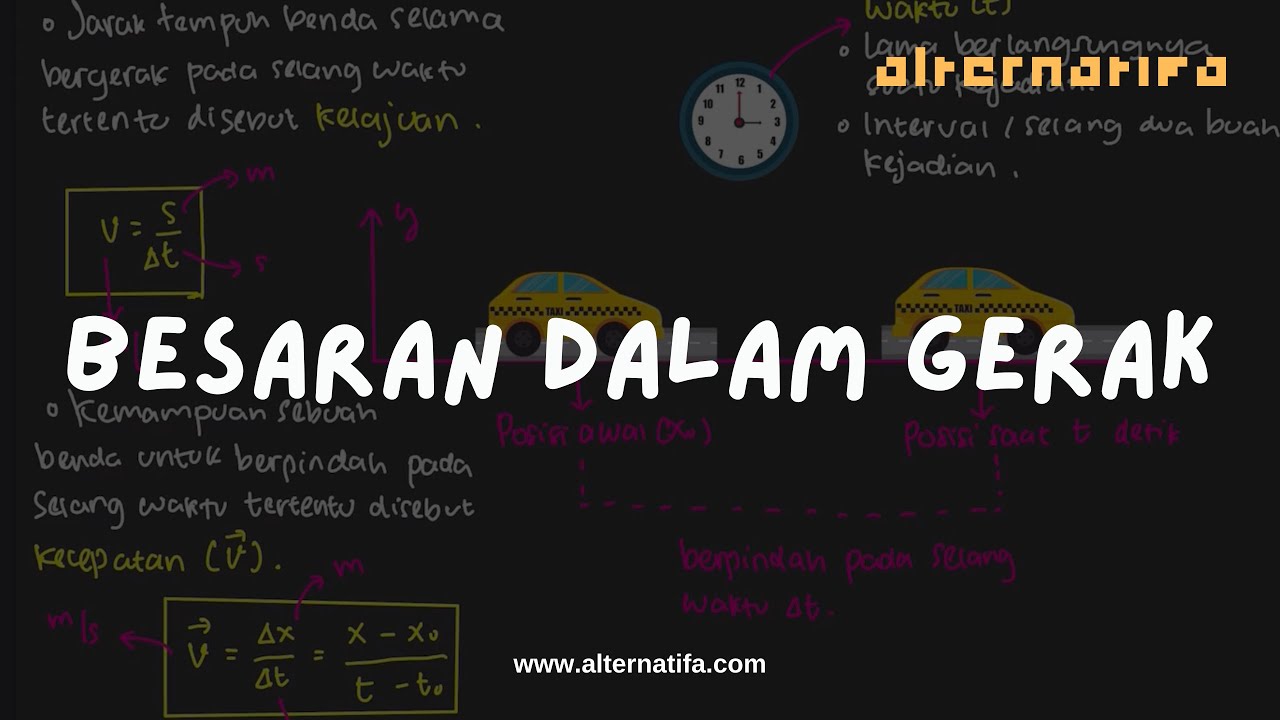
Kinematika Gerak : Besaran dalam Gerak | Fisika SMA | Alternatifa

MATERI KINEMATIK kelas 11 bag 1 PENGERTIAN GERAK, JARAK & PERPINDAHAN K Merdeka

FISIKA KINEMATIKA KELAS XI JARAK PERPINDAHAN KELAJUAN KECEPATAN PART 1 KURIKULUM MERDEKA

mod01lec03 - Introduction to Mobile Robot Kinematics

Gerak Lurus • Part 1: Gerak Lurus Beraturan (GLB) dan Gerak Lurus Berubah Beraturan (GLBB)
5.0 / 5 (0 votes)

